
Selling a restaurant gift card should be the easy part. The harder test comes in January: can a guest redeem part of the balance, can staff find the remainder, and does the report agree with what happened at the till?
Before promoting holiday gift cards, make the purchase-to-redemption journey work. This checklist is for independent Canadian restaurants and cafés preparing a first programme or checking an existing one.
1. Decide exactly what you are selling
Start with a simple dollar-value gift card rather than a complicated bundle. Write down:
- Where it can be purchased: in person, on your website, or both.
- Where it can be redeemed: which locations and which ordering channels.
- How the recipient receives it and checks the balance.
- Who handles a missing delivery email, lost code or payment dispute.
Do not call a discount coupon a gift card, or assume a prepaid app wallet can automatically be transferred to a friend. They solve different problems. Test the gifting and recipient experience in your actual system.
Choose denominations around purchases your guests already make. A café might offer C$25 and C$50; a restaurant might add C$100. Those are illustrative choices, not recommended targets for every business. Allowing a custom amount can also help someone buying for a group.
2. Publish clear terms before payment
A customer should not need to ask a cashier whether a card works online or at your second location. Put the redemption locations, channels, balance-check method and lost-card process beside the purchase button, then repeat them in the delivery message.
Check the rules for your province before setting an expiry date or fee. In BC, ordinary purchased dollar-value gift cards generally cannot expire. The provincial regulator lists exceptions, including some discounted, charitable and specific-service cards; it also limits permitted fees. Do not apply an exception to your whole programme without checking it. See Consumer Protection BC’s gift-card guidance.
In BC, a standard dollar-value card that cannot expire must remain usable until its balance is spent; it cannot require the guest to spend everything in one visit. The regulator explains this in its partial-redemption guidance. Other provinces have their own rules.
If you offer “buy C$50, receive a bonus,” show the purchased value and promotional benefit separately. Confirm the treatment of the bonus instead of quietly attaching promotional restrictions to the money someone paid.
3. Run a real purchase and redemption test
Use your approved testing process or a controlled purchase that you can reconcile. Have someone unfamiliar with the setup follow this sequence on a phone:
- Find the gift-card page from your restaurant’s homepage.
- Purchase a card and send it to a different recipient.
- Confirm the recipient receives the correct amount and usable instructions.
- Redeem only part of the value.
- Check the remaining balance, then use it on another purchase.
- Try a purchase larger than the balance and confirm how the remainder is paid.
- Check the receipt, order record and gift-card report.
Also check delayed delivery, duplicate-send recovery and what staff should do if the balance cannot be retrieved. Use the same process for each supported channel. “Works at the counter” does not prove it works in your app.
Fix unclear links and mobile screens before driving traffic to them. The online ordering menu checklist offers a similar test-first approach for the rest of your checkout.
4. Track money loaded, money used and money still owed
A C$50 gift-card sale brings in cash today, but the guest can claim goods later. Do not mistake the full cash receipt for money you can spend without planning for redemption.
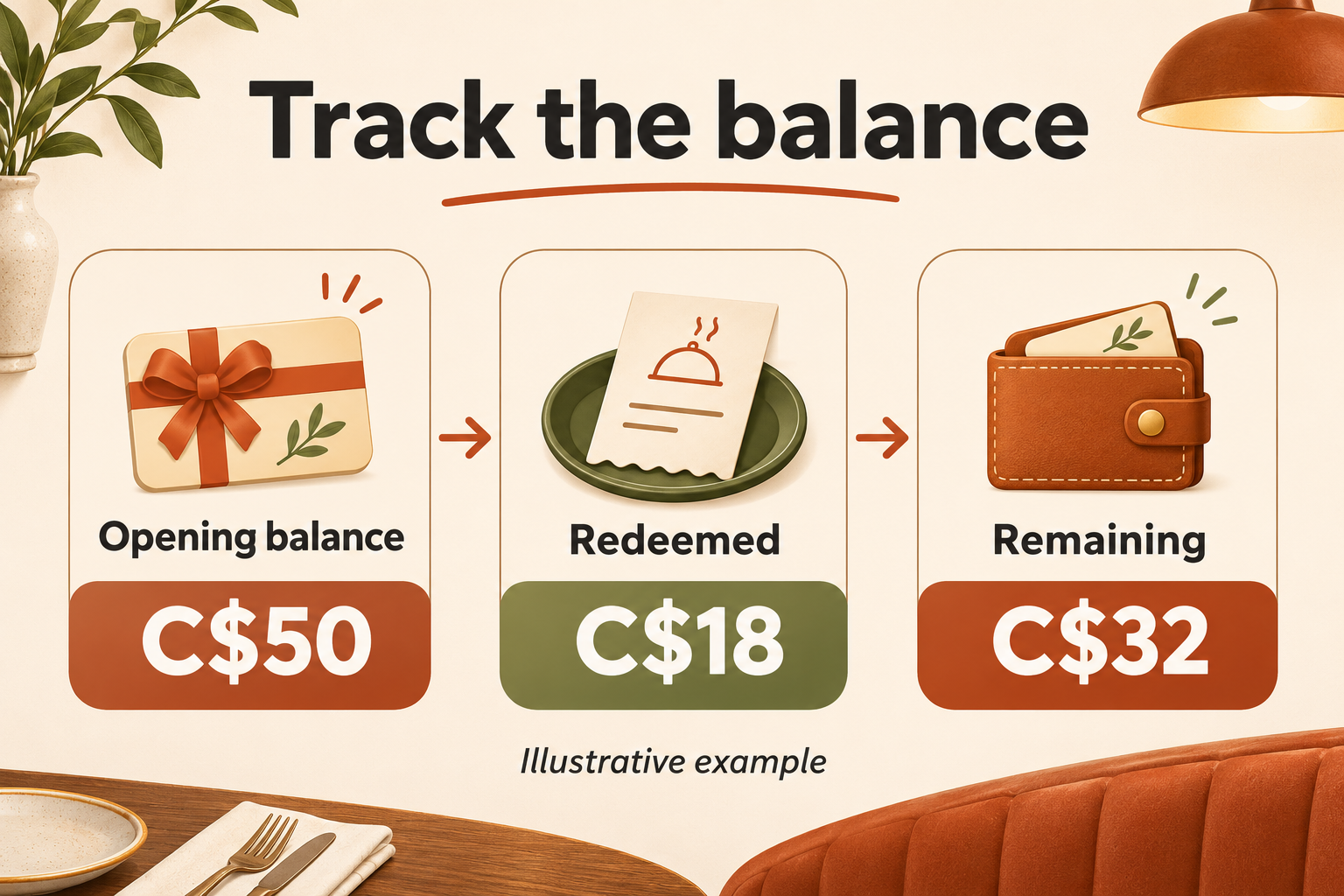
Original AI-generated illustration; example amounts only.
Here is a simple illustrative balance example, not a tax calculation:
| Event | Change in stored value | Balance |
|---|---|---|
| Card activated | +C$50 | C$50 |
| Guest uses C$18 | −C$18 | C$32 |
| Second visit uses C$12 | −C$12 | C$20 |
Keep a reconciliation that connects the opening outstanding balance, value added, redemptions, authorised adjustments and closing balance. Record refunds, reversals and promotional credit distinctly so a discrepancy can be traced rather than patched with a guessed adjustment.
For qualifying gift certificates, the CRA says GST/HST is not collected when the certificate is sold; applicable tax is calculated on the items when it is redeemed. Have your bookkeeper confirm your setup, including provincial taxes and any promotional arrangement. See the CRA’s current GST/HST registrant guide.
5. Give staff a one-page playbook
Write short steps for selling, activating, redeeming and checking a balance. Add a named escalation contact for exceptions.
Cover these awkward moments before the queue forms:
- A recipient has an email but cannot find the code.
- A guest wants to use a card at a different location.
- A refund is requested after part of the card has been redeemed.
- A guest wants to pay the remainder by another method.
Staff should know what they can approve and which actions need a manager. Protect card codes like payment credentials: avoid shared public spreadsheets or screenshots containing usable balances.
6. Promote the gift, not an automatic discount
A gift card can be an easy present without giving away extra margin. Start with a visible website link, a counter sign and a clear social post showing what a recipient can enjoy. Use appetising food photography and a direct purchase link.
Before adding a bonus, calculate the potential cost and decide how you will measure the result. A larger number of cards sold does not prove the offer produced additional profitable visits.
After the holidays, review cards sold, purchase value, redemptions, outstanding balances and support problems. Separate that from your ordinary order-sales report. Improve the journey before repeating the promotion.
Ready to connect prepaid value with your café’s app?
Menuro’s loyalty and rewards tools include prepaid-wallet features. Bring your desired gifting, balance and redemption workflow to a Menuro demo so we can confirm the supported setup for your restaurant rather than promise a feature that has not been checked.
If your holiday schedule is changing too, use the restaurant holiday-hours checklist to keep your ordering hours accurate.
Published November 8, 2026. Operational guidance; provincial gift-card rules and your tax treatment should be checked for your specific setup. Artwork is original AI-generated illustration, not a real customer location.