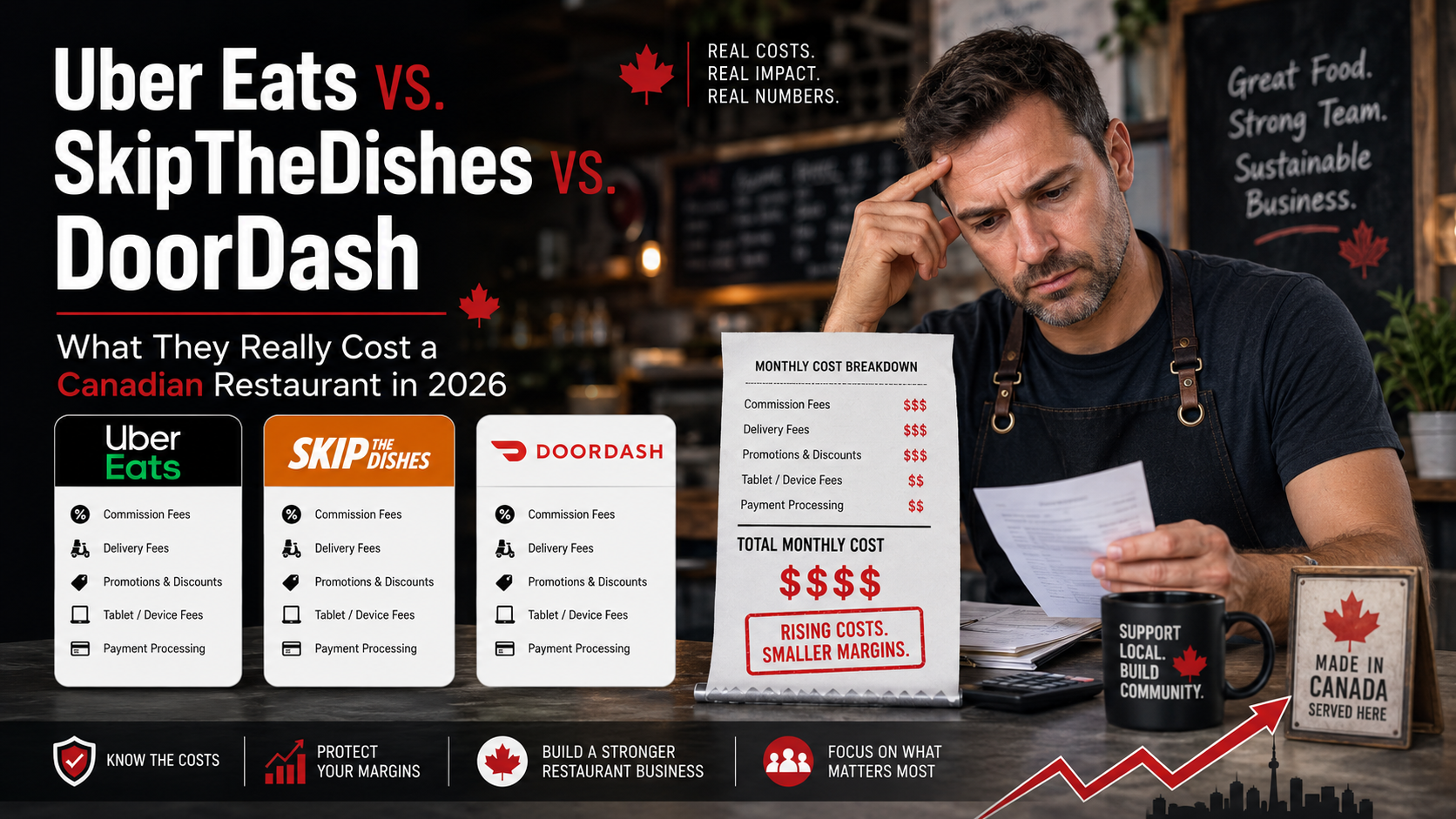
Uber Eats vs. SkipTheDishes vs. DoorDash: What They Really Cost a Canadian Restaurant in 2026
The headline commission rate is the number the apps want you to focus on. It's also the number that hides the most. Here's the real math — fees, fine print, and the cost almost no one puts on the invoice — for Canadian restaurants in 2026.
If you run an independent restaurant in Canada, you already feel it: a $40 order comes in, the app takes its cut, and what lands in your account doesn't match what the customer paid. Multiply that across a month and the delivery channel can quietly become the most expensive "marketing" you've ever bought.
This isn't an anti-delivery rant. The apps bring real volume and real customers. But you can't make a smart channel decision until you can see the whole cost — so let's lay it out honestly, platform by platform, with current 2026 Canadian numbers.
The quick answer
Here's where the three major platforms land for Canadian restaurants as of 2026. Treat every number as a verified snapshot, not a permanent fixture — these rates move, and Skip's are negotiated individually.
| Platform | Delivery commission | Pickup commission | Your-own-driver option | Notable 2026 change |
|---|---|---|---|---|
| Uber Eats | 20% / 25% / 30% (Lite / Plus / Premium) | 7% validated, 10% if not | 15% self-delivery | First fee hike in ~a decade (Mar 2026); new +5% surcharge on Uber One member orders |
| SkipTheDishes | 20–30% (negotiated) | ~11–14% | SkipGo flat ~$7–9/order | Most negotiable platform; rates depend on volume, cuisine, location |
| DoorDash | 15–20% / 25% / 30% (Basic / Plus / Premier) | 6% | DoorDash Drive (flat fee) | Basic tier rose toward 20% in Canada — check your agreement |
The short version: most Canadian independents on a standard tier are paying 25–30% on delivery, before add-ons. A restaurant pushing $30,000/month through these apps is sending roughly $4,500–$9,000 a month out the door in fees.
How delivery commissions actually work in Canada
Every platform charges a percentage of your order subtotal (before tax and tip) on delivery orders. That base commission is just the start. Your effective rate — what you actually lose per order — almost always runs higher once you add:
- Payment processing (sometimes bundled into commission, sometimes separate)
- Marketing and promoted placement (sponsored listings, "featured" spots, deal participation)
- Discount pressure — apps nudge you into BOGOs and free-delivery promos to stay visible, and you eat the difference
- Refund and adjustment deductions for missing items or complaints
- Tablet rentals on some platforms and in some markets
One quiet bit of good news for Canada: a handful of provinces have introduced commission caps that limit what platforms can charge in certain jurisdictions. Worth checking whether yours is one of them.
Uber Eats: what it really costs
Uber Eats runs three marketplace tiers in Canada:
- Lite — 20%: Basic listing; customers pay more of the delivery fee. (This tier rose from 15% to 20% in March 2026.)
- Plus — 25%: Where most independents land. Note the catch added in 2026: orders from Uber One members now carry an extra 5%, pushing those to 30%.
- Premium — 30%: Top placement and promotional eligibility.
On top of the tier: pickup orders are 7% if you've validated that your in-app prices match in-store pricing — and 10% if you haven't (a detail many owners miss during onboarding). If you run your own drivers, the commission drops to about 15%.
The cheapest Uber path is the one most owners don't realize exists: Uber Direct / Webshop, where customers order through your own website and Uber only charges roughly 2.9% payment processing — no marketplace commission. That's the model worth paying attention to, and we'll come back to it.
March 2026 marked Uber Eats' first marketplace fee increase in roughly ten years, so if you haven't looked at your rates recently, you're likely paying more than you think.
SkipTheDishes: what it really costs
Skip (owned by Just Eat Takeaway) is Canada's homegrown giant and, in many provinces, the volume leader. It's also the most variable of the three, because Skip negotiates rates individually rather than publishing fixed tiers.
- Delivery commission: 20–30%, depending on your location, cuisine category, order volume, and any promotional commitments.
- Pickup: roughly 11–14%.
- SkipGo (delivery-as-a-service): a flat courier charge of about $7–9 per order, which can actually beat percentage commissions on higher-value orders — above roughly $35, a flat fee often wins.
- A Skip tablet (you can sometimes use your own) and optional Skip Premium marketing placement.
Because Skip's rates are negotiable, this is the one platform where picking up the phone to renegotiate genuinely moves the needle — especially if your volume has grown since you signed.
One thing Skip doesn't advertise: the customer's name, phone, and email belong to Skip, not to you. More on why that matters below.
DoorDash: what it really costs
DoorDash uses three partnership plans, similar in shape to Uber Eats:
- Basic — 15–20%: The entry tier. Note that the Canadian Basic rate has crept up toward 20% — if you signed expecting 15%, check your current agreement.
- Plus — 25%: DashPass eligibility and a wider delivery area.
- Premier — 30%: Best placement and guaranteed delivery volume.
Pickup orders are 6%, the lowest pickup rate of the three. DoorDash also offers DoorDash Drive, a flat-fee, delivery-only service with no marketplace listing — some restaurants use it to fulfill their own direct orders, which is a smart way to get DoorDash's couriers without the marketplace commission.
The real-world math: one $40 order
Percentages stay abstract until you run them against a real ticket. Here's a single $40 delivery order, assuming a 30% food cost and $1.50 in packaging.
Through a marketplace at 25% commission:
- Commission: –$10.00
- Food cost: –$12.00
- Packaging: –$1.50
- You keep: ~$16.50 (before labour, rent, and overhead)
Through your own direct ordering channel at ~3% processing:
- Processing: –$1.20
- Food cost: –$12.00
- Packaging: –$1.50
- You keep: ~$25.30
That's roughly $8.80 more per order kept on a direct channel. At just 300 orders a month, that's about $2,640/month — over $31,000 a year — staying in your business instead of the platform's.
Why this hurts more in 2026 specifically
Context matters. Canadian independents are running on thin margins to begin with — averaging around 10% — and costs have spiked: operators report spending roughly 37% more on food due to tariffs, and the vast majority have already raised menu prices to cope. A 25–30% commission doesn't shave a thin margin; on many orders it erases it. When money is this tight, the delivery channel deserves the same scrutiny as any other line item — not a free pass because "everyone's on the apps."
The cost that never appears on the invoice
Here's the one that should bother you most: on the marketplace apps, you don't own your customers.
When someone orders your food through Skip, Uber Eats, or DoorDash, the platform keeps the relationship. You don't get their phone number or email. You can't text them a Tuesday-night offer, invite them into a loyalty program, or win them back when they drift. You paid 25–30% to acquire a customer — and then handed the ability to keep them to the app. Next month, that same customer opens the app, sees 30 competitors next to you, and you pay the commission all over again to win them back.
That's the real long-term cost. The commission is rent. The lost customer relationship is the mortgage you never get to build equity in.
What smart Canadian operators are doing in 2026
The winning move isn't quitting the apps cold turkey — for most restaurants, that's not realistic. It's reframing them: treat the marketplaces as a paid acquisition channel, then move your repeat customers to a direct channel you own and control.
The math is simple. Every regular you shift off a 25–30% marketplace and onto your own ordering — at roughly 3% processing — is pure margin recovered, month after month. Do that with even a third of your repeat business and the delivery apps stop being the thing eating your restaurant alive and start being just one channel among several.
To make that shift, you need three things: a direct ordering channel customers actually use (your own branded app or site, not a clunky web form), a way to capture customer contact info so the relationship is yours, and a loyalty or marketing system that gives people a reason to order direct next time.
That's exactly what Menuro is built to do. We give independent restaurants their own branded app and online ordering with 0% commission — you keep 100% of every direct order — plus a built-in loyalty program and marketing automation so the customers you worked to win become regulars who order direct. Your data, your customers, your money — done for you, live in 1–2 weeks.
The apps will always be there for discovery. The goal is to stop renting your best customers back from them every single month.
Make the apps work for you — not the other way around
See what your restaurant looks like with its own commission-free ordering app and a loyalty program that turns app customers into direct regulars.
Book a free Menuro demo — No contracts. No setup fees. 0% commission, forever.
Frequently asked questions
Which delivery app is cheapest for Canadian restaurants? On headline pickup rates, DoorDash (6%) is lowest. On delivery, all three cluster at 25–30% on standard tiers. For high average-order-value restaurants, Skip's flat-fee SkipGo can beat percentage commissions. But the cheapest channel overall is almost always your own direct ordering at ~3% processing.
Do delivery apps give me my customers' contact information? No. On the marketplace apps, the customer relationship — name, phone, and email — belongs to the platform, not your restaurant. To own that data, you need a direct ordering channel.
Did delivery commissions go up in 2026? Yes. Uber Eats raised marketplace fees in March 2026 (its first increase in about a decade), including moving the Lite tier to 20% and adding a 5% surcharge on Uber One member orders. DoorDash's Canadian Basic tier has also risen toward 20%. Always confirm your own current rate in your platform dashboard or agreement.
Should I leave the delivery apps entirely? For most restaurants, no — they're a valuable discovery channel. The smarter play is to keep them for new-customer acquisition while moving your repeat customers to a commission-free direct channel you own.
Sources & verification: Commission structures reflect publicly reported 2026 Canadian rates from platform announcements and restaurant-industry trade coverage, including Uber Eats' official marketplace fee notice and Restaurant Dive's reporting on the March 2026 increase. Rates vary by market, volume, cuisine, and contract — always confirm your exact rate in your Uber Eats Manager, DoorDash Merchant Portal, or SkipTheDishes partner agreement.