Every dollar you spend on marketing is trying to do one of two things: bring in someone who has never eaten your food, or bring back someone who already has. That is it. Those are the two goals.
Most restaurants pour almost all of their time, money, and energy into the first one and barely touch the second. In a tight 2026 market, where Canadian diners are eating out less and margins are thin, that is an expensive habit. So let's break marketing into its two real jobs, look at what each one actually costs, and figure out where your next dollar is best spent.
Goal one: winning new customers
New-customer marketing is what most people picture when they hear "restaurant marketing." It is the Instagram posts, the Meta and Google ads, the delivery-app listings, the flyers, the grand-opening buzz. It has a real job to do, especially when you are new or expanding. You cannot build a base of regulars without a steady flow of first-timers walking through the door.
But here is the part that does not make the highlight reel: it is the expensive half. Acquisition costs for restaurants typically run somewhere between $27 and $83 or more per guest, and that number has been climbing as ad platforms get more crowded and targeting gets harder.
Then there is the leak. Industry data shows that roughly 70% of first-time restaurant guests never come back. For every ten new people you pay to bring in, about three return. The other seven are gone, along with whatever you spent to get them.
None of that makes acquisition a waste. It makes acquisition on its own a bucket with a hole in it. You can keep pouring water in, but if you are not also patching the hole, you are just paying to refill it.
Goal two: lifecycle marketing (keeping the customers you already have)
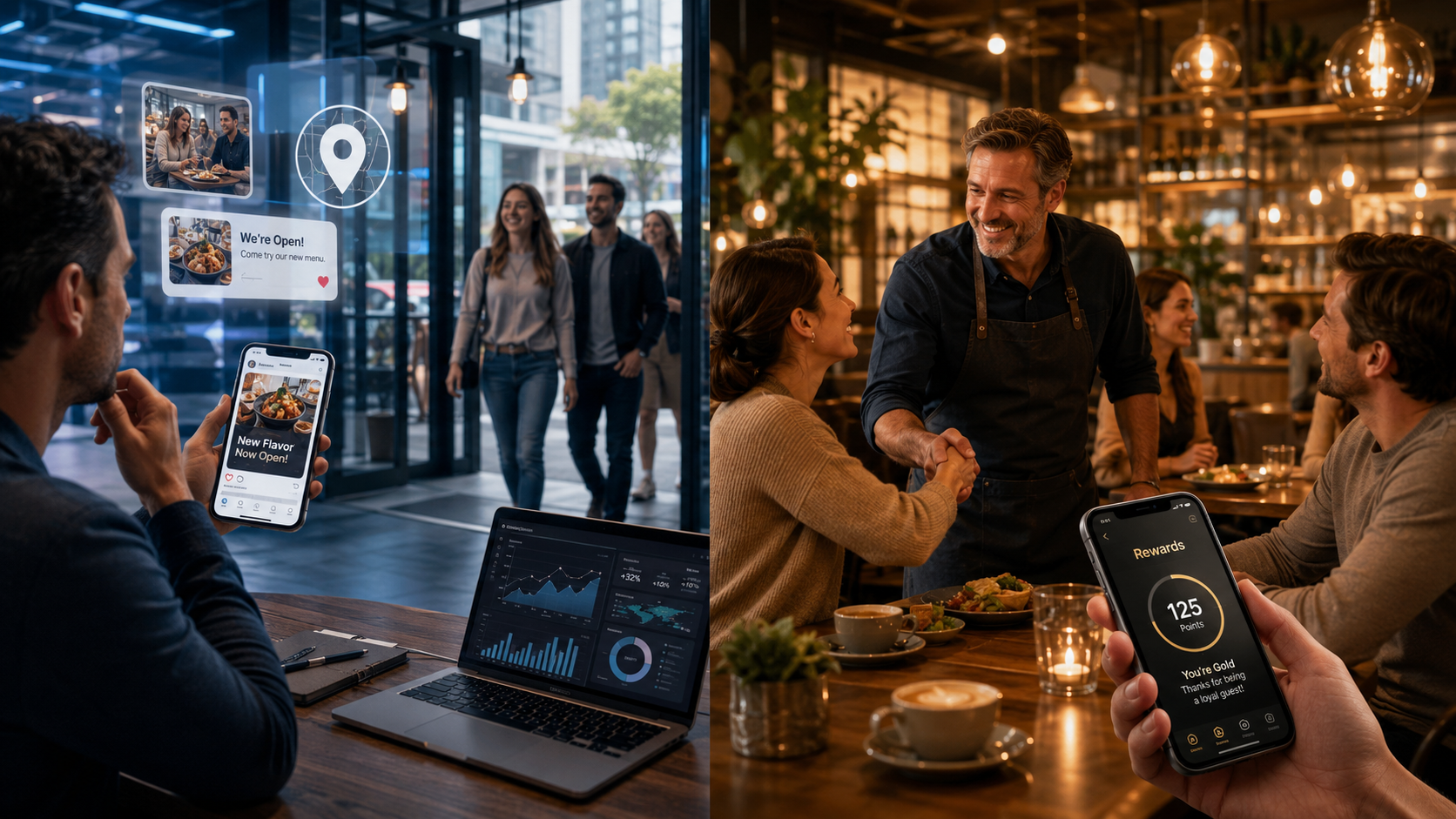
Lifecycle marketing, sometimes called retention or CRM marketing, is everything you do after that first visit to turn a stranger into a regular. The welcome message after someone's first order. The "we miss you" text when a regular has not been in for a month. The birthday reward. The loyalty program that gives people a reason to pick you over the place across the street. The extra attention for your top spenders.
This is the half most independents neglect, which is odd, because the economics are dramatically better.
Start with cost. Research from Bain & Company, cited for years in the Harvard Business Review, found that acquiring a new customer costs anywhere from 5 to 25 times more than keeping an existing one. Restaurant-specific figures put it around 5 to 7 times. The reason is simple: you are marketing to people who already know you, already like your food, and already trust you. The odds of selling to an existing customer sit around 60% to 70%. For a brand-new prospect, it is 5% to 20%.
Then there is the channel itself. A well-built email or SMS automation costs about a penny to a nickel per message to send. A single repeat visit is worth roughly $42 to $68 on an average full-service check. No other marketing channel returns that kind of math. The National Restaurant Association has found that email and SMS automation deliver the highest ROI of any restaurant marketing channel, several times higher than social ads and far higher than print.
About that 80/20 rule
You have probably heard that 80% of your revenue comes from 20% of your customers. It gets repeated in restaurant blogs constantly. So is it actually true?
Sort of. The 80/20 split (the Pareto Principle) is a rule of thumb, not a precise measurement, and the real number depends on the kind of restaurant you run. The more credible, restaurant-specific data comes from the National Restaurant Association, and it tells a slightly different but more useful story. Repeat customers drive roughly:
- 71% of sales at quick-service restaurants
- 68% at fast casual
- 64% at casual dining
- 51% at fine dining
So for a typical independent takeout or fast-casual spot, it is not quite 80/20. It is closer to 70/30. But the point holds, and it actually lands harder with the real number: something like two-thirds to three-quarters of your sales come from people who have already eaten with you before. That is the exact group most restaurants spend the least marketing effort on.
Why keeping customers compounds
Retention does not just cost less. It pays back more over time. Bain's research found that lifting your retention rate by just 5% can raise profits anywhere from 25% to 95%. Regulars also spend more per visit. One widely cited study found loyal customers spend about 67% more than new or one-time guests.
Put those together and you get a compounding effect. A regular is cheaper to reach, more likely to buy, spends more when they do, and sticks around long enough for all of that to repeat month after month. A first-timer is a one-off bet that pays off less than a third of the time.
The catch: you still need both
This is where a lot of "just focus on retention" advice gets it wrong. You cannot keep customers you never acquired in the first place. And if your loyal base is quietly shrinking, you need fresh faces coming in the top just to hold steady. It usually is shrinking, too. Restaurants have the highest customer churn of any major industry, losing close to 45% of customers every year.
So this is not an argument for abandoning acquisition. It is an argument for balance, with one specific correction in mind: most restaurants are already decent at acquisition and genuinely bad at lifecycle marketing. That is backwards, because the cheaper, higher-return half is the one being ignored.
And the gap is bigger than most owners realize. Only about 24% of independent and small multi-unit restaurants use any form of email automation. The average independent already has 2,000 to 5,000 guest records sitting in its POS, reservation, and online-ordering systems, yet actively markets to only 15% to 20% of them. The list is already there. It is just going to waste.
How to actually start doing lifecycle marketing
You do not need a big budget for this. You need a system. Roughly in this order:
- Capture contact info at the counter. A phone number or email at checkout is the single most valuable marketing asset you can collect, and most restaurants let it walk right out the door.
- Turn on three automations first: a welcome message after the first visit, a win-back text when a regular lapses, and a birthday reward. Those three cover the highest-ROI moments in the whole customer relationship.
- Launch a simple loyalty program. Points for spend is plenty to start with. Loyalty programs return around 5x on average, and members reliably spend more than non-members.
- Know your regulars by name and number. Your POS can tell you who visits most and spends the most. Those are the people to protect and reward before anyone else.
Where Menuro fits
The reason most independents skip lifecycle marketing is not laziness. It is that they never owned the pieces they needed to do it. When your orders come through third-party delivery apps, you do not get the customer's phone number or email, so there is no list to market to. Without a list, none of the steps above are even possible.
That is the gap Menuro closes. We give independent restaurants their own branded app and online ordering, so every customer and every order belongs to you, along with the loyalty program and automated marketing (win-back texts, birthday rewards, push notifications) that turn a first visit into a tenth. You own the data, and you own the tools that make the data worth something. It is acquisition and lifecycle marketing in one place, built around the cheaper, more profitable half that most restaurants are leaving on the table.
The takeaway
Acquisition and lifecycle marketing are not rivals. You need both. But if you have been spending 90% of your effort chasing new faces and almost nothing bringing the old ones back, the math says you have got it exactly backwards. The customers who already love you are cheaper to reach, more likely to buy, and worth more when they do. Start there.
Book a free Menuro demo and see what your restaurant looks like with its own app, loyalty program, and marketing built in. No contracts. No setup fees. 0% commission, forever.
A note on the numbers: cost and retention figures above come from widely cited research by Bain & Company (via the Harvard Business Review) and industry data from the National Restaurant Association, along with restaurant marketing benchmarks reported by sources including Popmenu, BentoBox, and Toast. The repeat-customer share by restaurant type is attributed to the National Restaurant Association. Exact figures vary by market, restaurant type, and study, so treat them as strong directional benchmarks rather than guarantees.