
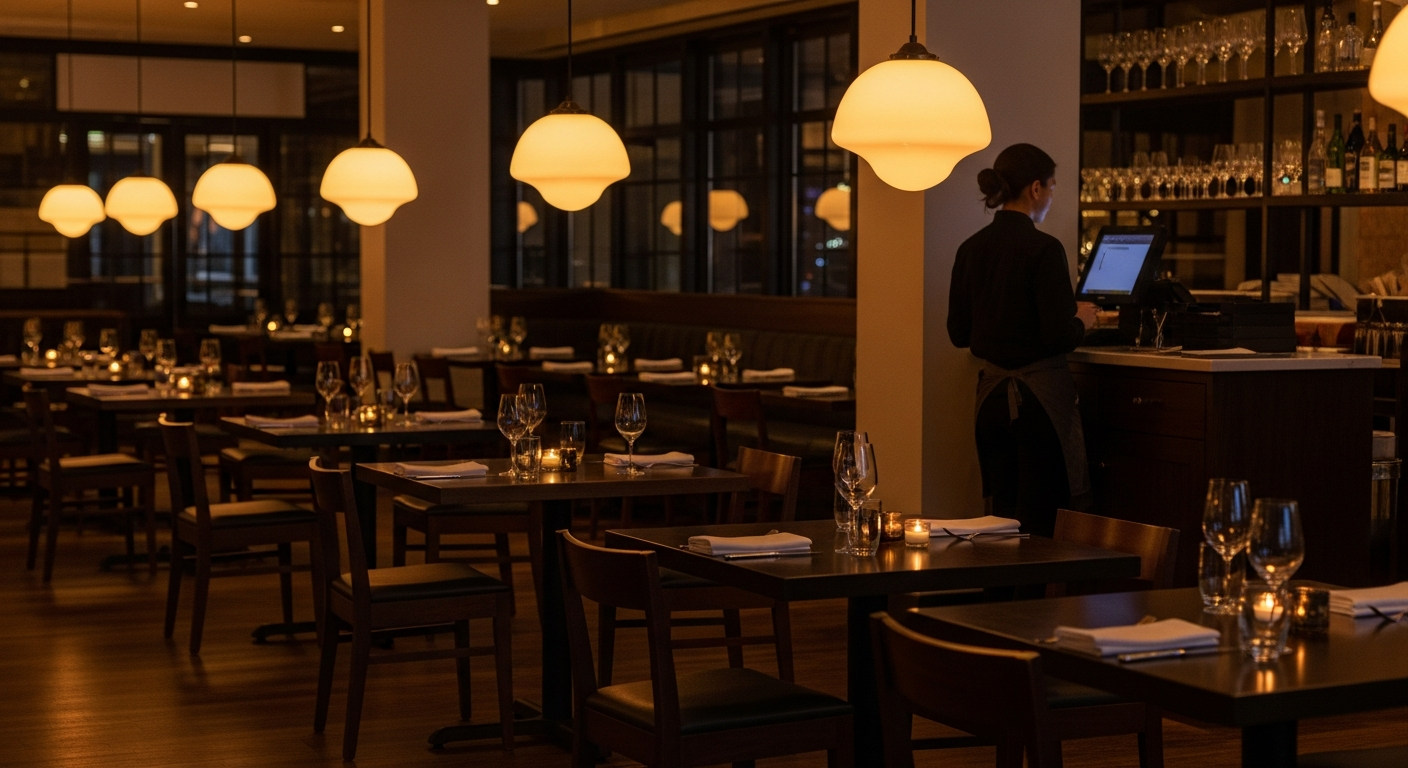
It's 7:15 on a Tuesday evening. Your kitchen is staffed. The lights are on. The dishwasher is running. Your line cook is prepping mise en place for a dining room that's one-third full. Eighteen guests are seated across 60 chairs, and the other 42 chairs are earning you exactly zero dollars while your rent, insurance, electricity, and payroll grind on regardless.
This is what bleeding looks like in the restaurant business. It's not dramatic. It's not a single catastrophic event. It's 52 Tuesdays a year where you pay full operating costs against a fraction of your revenue potential.
Let's put real numbers on it.
The Dollar Cost of Tuesday Night Empty Seats
Toast's 2024 Restaurant Trends Report, drawing from transaction data across more than 112,000 restaurant locations, found that Tuesday is consistently the lowest-revenue day of the week for full-service restaurants, generating 18–25% less revenue than Friday or Saturday nights. That tracks with what most operators already feel in their gut. But the gap is worse than most realize once you do the math.
The average full-service check in Toast's 2024 data was $47.50 per guest. A 60-seat restaurant running at 30% occupancy on Tuesday (18 covers) versus 70% occupancy (42 covers) faces a single-night revenue gap of $1,140. Multiply that by 52 weeks and you're looking at $59,280 in unrealized revenue from one night of the week.
David "Rev" Ciancio, a restaurant marketing consultant who has spoken at MURTEC and dozens of industry events, frames it even more starkly: "If you have 60 seats and you're running 30% full on Tuesday, you've got 42 empty seats. At a $45 average check, that's $1,890 in potential revenue evaporating every single Tuesday. Multiply by 52 weeks — you're staring at nearly $100,000 in lost revenue from one night of the week. And your rent doesn't care what day it is."
The National Restaurant Association's 2025 State of the Restaurant Industry Report confirms the structural problem: fixed costs (rent, insurance, base labor, utilities) account for 30–35% of total restaurant revenue, and the average full-service restaurant operates on a 3–5% profit margin. Those fixed costs hit whether you serve 18 guests or 80.
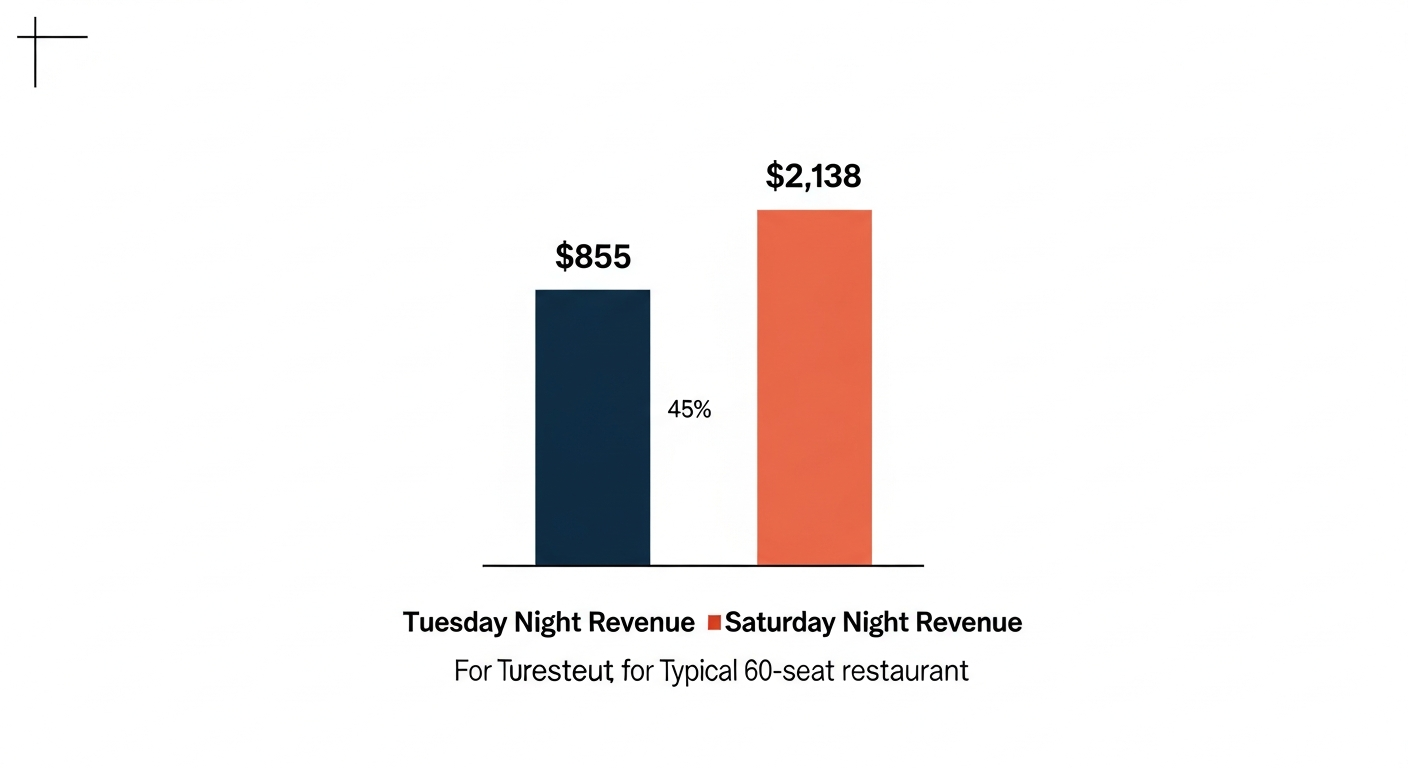
SevenRooms' 2024 benchmarking data puts the disparity in sharper relief. Revenue Per Available Seat Hour (RevPASH) on Tuesday averages 40–55% of Saturday RevPASH in full-service restaurants. Monday through Wednesday combined accounts for only 30–35% of weekly revenue, according to Toast's 2024 transaction data, despite representing 43% of the operating week.
Joel Montaniel, CEO of SevenRooms, summed it up in a 2024 Nation's Restaurant News interview: "The single biggest revenue unlock isn't getting more people in on Saturday — you're already constrained. It's getting 15–20 more covers on Tuesday and Wednesday. That's almost pure profit because your fixed costs are already covered."
Most Operators Know the Problem. Almost None Have a Plan.
Popmenu's 2024 Restaurant Marketing Survey found that 67% of restaurant operators ranked filling off-peak hours as one of their top three operational challenges. That's two out of three owners acknowledging the bleeding. But only 22% had a dedicated marketing strategy for slow nights.
Kevin Rice, VP of Marketing at Popmenu, described the gap during a 2024 webinar: "The gap between awareness and action is where the money is bleeding out."
Black Box Intelligence's 2024 data reinforces the urgency. Same-store traffic for full-service restaurants declined 3.3% year-over-year in 2024, with the steepest declines concentrated on Monday through Wednesday, where traffic dropped 4.8%. The slow nights are getting slower, and operators without a plan are falling further behind.
Jim Taylor, CEO of BenchmarkSixty Restaurant Consulting, put it bluntly in a 2024 Restaurant Dive interview: "Your Tuesday night P&L is your real P&L. Anyone can make money on a packed Saturday. Show me your Tuesday numbers and I'll tell you if your business is healthy."
What Restaurants That Fixed Tuesday Night Did Differently
The operators who turned their weakest night around didn't rely on one tactic. But their approaches share a common thread: they gave Tuesday its own identity instead of treating it as a lesser version of Saturday.
Odd Duck in Austin, TX created a Tuesday Tasting Menu — a lower-priced, curated menu available only on that night. Within three months, Tuesday covers increased over 40%. The fixed tasting menu also reduced food waste by 15% because the kitchen could prep with precision. Tuesday went from their lowest-revenue night to their fourth highest within a quarter. The concept was discussed at the 2024 NRA Show and covered in hospitality trade publications.
Cane Rosso, the Neapolitan pizza chain in Dallas, launched "Tuesday Date Night" with a prix fixe for two including a bottle of wine at $55, compared to a typical à la carte spend of $80+ for two. Tuesday covers jumped 52% within eight weeks. Per-head average was lower, but total Tuesday revenue increased 38% on volume. Food cost on the prix fixe was tightly controlled at 26%, below their normal 30%. PMQ Pizza Magazine and the Dallas Morning News both covered the results.
Barrio Queen in the Phoenix/Scottsdale area took the opposite approach to discounting. Instead of cheap tacos, they introduced a premium taco tasting flight with mezcal pairings, positioned as an experience. Tuesday average check increased 12% while covers rose 33%. The premium positioning attracted higher-spending guests on what had been their deadest night, as reported at the 2024 Western Foodservice & Hospitality Expo.
Bobby Stuckey, the Master Sommelier who co-owns Frasca Food & Wine in Boulder, CO, described his philosophy on a hospitality podcast in 2024: "We stopped thinking about Tuesday as a slow night and started thinking about it as our 'regulars night.' We give our best guests a reason to come in when we need them most. It's not discounting — it's relationship-building. Our Tuesday revenue is now within 15% of Friday."
The Mechanics: How to Fill Tuesday Without Destroying Your Margins
Discount-driven promotions can backfire by training guests to expect lower prices and by attracting deal-seekers who never come back at full price. The operators above avoided that trap. Here's how to think about building a Tuesday strategy that protects your margins.
Create scarcity, not discounts. Odd Duck's tasting menu and Barrio Queen's mezcal flights worked because they offered something unavailable on other nights. Scarcity drives interest without cheapening your brand. A Tuesday-only menu, a wine pairing event, or a chef's counter experience gives guests a reason to show up that has nothing to do with saving money.
Target your existing guests first. SevenRooms' 2024 data showed that restaurants using targeted off-peak promotions saw RevPASH increase 15–26% on promoted nights. Boqueria, the Spanish tapas group in New York, used SevenRooms' CRM to send targeted emails to guests who hadn't visited in 30+ days, specifically promoting Monday through Wednesday. Weeknight covers increased 28% within six months, generating $19 in attributable revenue for every marketing dollar spent.
Union Square Hospitality Group, Danny Meyer's organization, took a similar approach. They used Resy and internal CRM data to identify weekend-only guests and sent personalized "weeknight insider" invitations offering priority seating and early access to new menu items. Weeknight reservations from those previously weekend-only guests increased 17%, and overall weekly RevPASH improved 11% across participating locations.
Use SMS for same-day urgency. Popmenu's 2024 data shows SMS open rates for restaurants hit 98%, with 90% read within three minutes. A message sent at 2 PM on Tuesday with a specific, compelling reason to come in that evening converts at rates that email can't match. Paytronix's 2024 Loyalty & Engagement Report found that restaurants using SMS campaigns for off-peak promotions saw a 12–22% increase in covers on targeted nights. Handcraft Kitchen & Cocktails in New York used Popmenu's automation to send offers every Monday afternoon promoting Tuesday specials. Tuesday night revenue rose 35% over four months, with email campaigns hitting a 44% open rate and 8.2% redemption rate.
Lean on your loyalty base. Paytronix's 2024 Annual Loyalty Report found that loyalty program members visit 35% more frequently than non-members and carry a 20% higher average check. Restaurants with active loyalty programs saw 18–28% higher off-peak traffic compared to those without. Lazy Dog Restaurant & Bar, with 50+ locations across the Western U.S., ran a "Weeknight Happy Hour Extended" program with loyalty-app-exclusive pricing on Monday through Wednesday. Off-peak weeknight traffic increased 22% chain-wide, and the program drove $2.4 million in incremental off-peak revenue in its first year, according to Nation's Restaurant News.
Hattie B's Hot Chicken in Nashville used Olo's platform to push Tuesday-specific digital offers including free sides with entrée purchases and double loyalty points. Digital orders on Tuesdays increased 29%, in-store traffic rose 14%, and the double-points promotion drove a 41% increase in loyalty sign-ups on Tuesdays.
The Compounding Effect of Fixing One Night
SevenRooms' 2024 benchmarking data shows that restaurants implementing structured off-peak programming close the RevPASH gap from 40–55% of peak nights to 60–75% of peak nights. That shift, applied to a 60-seat restaurant, can represent $70,000–$150,000+ in recovered annual revenue.
But the impact extends beyond the direct revenue. Repeat guests spend 67% more than new guests, according to data from Bain & Company reconfirmed in Paytronix's 2024 report. After a guest visits three times, the probability of a fourth visit jumps above 70%, per Paytronix behavioral data. Every Tuesday guest you convert into a regular compounds over months and years.
Zack Oates, founder and CEO of Ovation, described the pattern in a 2024 Restaurant Business Online interview: "Restaurants that create a specific identity for their off-peak nights — whether it's a themed menu, a loyalty-exclusive event, or a community night — see 20–40% lifts in those dayparts within weeks, not months."
The restaurants that treat Tuesday as a solvable problem, rather than an inevitable loss, gain a structural advantage. Their fixed costs get spread across more revenue. Their staff stays sharper because they're busy. Their regulars develop a midweek habit. And their annual P&L reflects the difference between bleeding $60,000–$100,000 a year and capturing it.
Your Tuesday Night Doesn't Have to Stay Empty
Menuro gives independent restaurants the tools to build Tuesday-specific promotions, send targeted offers to the right guests at the right time, and track which campaigns bring people through the door. No commissions. No middlemen. Your guests, your data, your revenue.
See how it works at menuro.io/demo.