
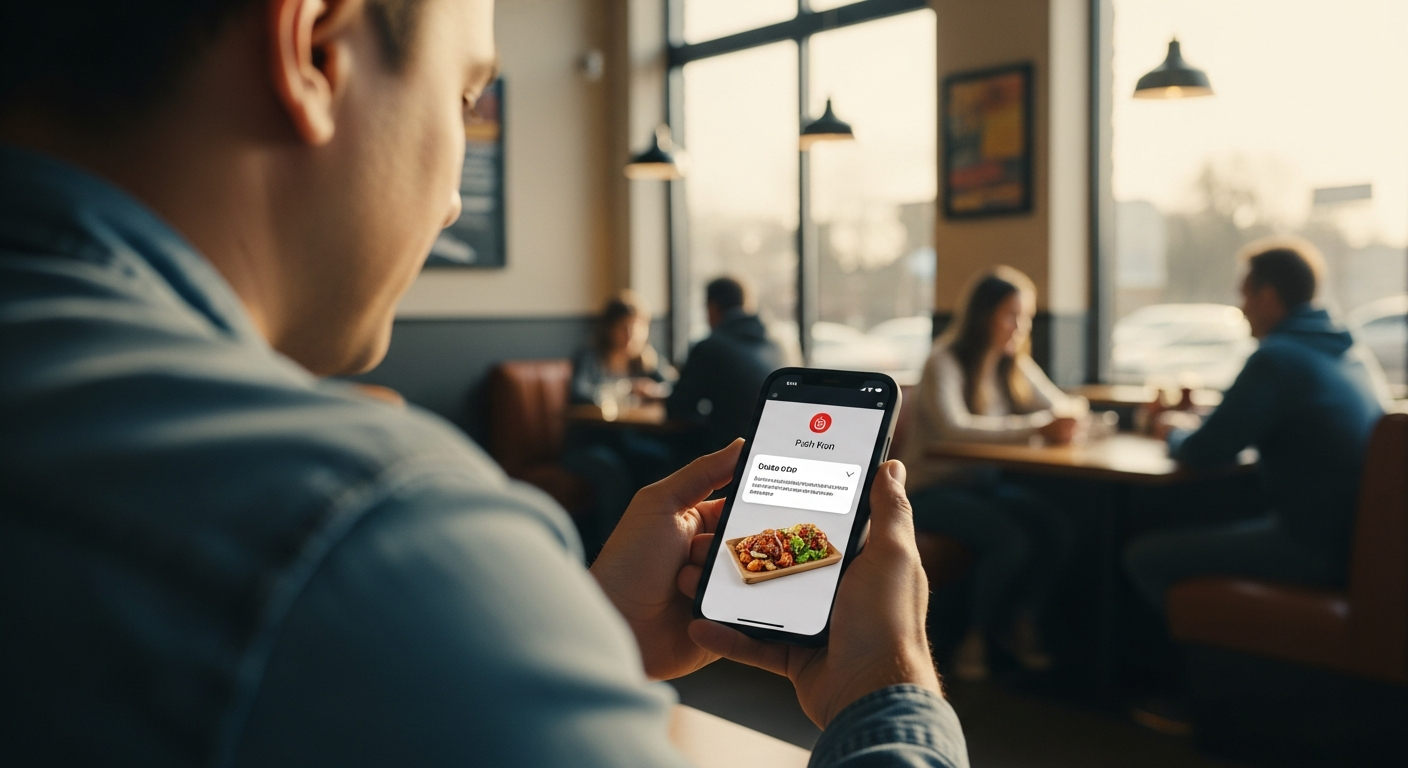
It's 4:47 PM on a Tuesday. Your dining room is quiet. Your line cooks are prepping, your servers are rolling silverware, and the dinner rush — if you can call it that — is still an hour away.
Meanwhile, 2,300 people who have eaten at your restaurant in the last 90 days are staring at their phones right now, trying to answer the same question: What's for dinner?
You could hope they remember you. Or you could send a single push notification — "Your chicken parm is one tap away. Order now, skip the wait." — and put yourself at the front of that decision.
That's not hypothetical. According to Olo's 2025 Digital Ordering Benchmark Report, restaurants using push notifications through their own branded app see a 20–30% lift in digital reorder rates compared to those relying on email alone. And a Popmenu survey of 500+ independent restaurants found that operators using automated push and text campaigns generated an average of $2,700 per month in additional revenue per location.
Push notifications aren't a "nice to have" anymore. They're the single highest-ROI marketing channel available to restaurants today. Here's how to use them.
Why Push Notifications Outperform Every Other Restaurant Marketing Channel
Let's put some numbers side by side.
Restaurant email campaigns average an open rate of 18–20%, which sounds decent until you see the click-through rate: roughly 1.8–2.5%. Push notifications for the food and drink industry, by contrast, average a 4.05% open rate (per Airship's 2024 Push Notification Benchmark Report) — but that metric undersells it, because push notifications don't require "opening" the way email does. They appear directly on the screen. The click-through rate hits 4.6–5.5%, more than double email's CTR.
But the real gap shows up in revenue. Olo's 2025 data pegs revenue per push notification recipient at $0.12–$0.30, compared to $0.02–$0.06 for email. That's a 5× to 6× revenue advantage per message sent.
Noah Glass, founder and CEO of Olo, put it plainly: "Push-engaged guests order 2× more often and spend 15–20% more per order. It's the single highest-ROI digital marketing channel available to restaurants today."
And the loyalty data backs him up. Paytronix's 2024 Loyalty Report found that push-delivered offers see a 38% redemption rate, compared to 14% for email-delivered offers and just 9% for in-app banners. Andrew Robbins, CEO of Paytronix, doesn't mince words: "Loyalty without communication is just a database. Push notifications are the activation layer that turns a loyalty program from a cost center into a revenue engine."
The Three Push Notifications That Actually Drive Repeat Orders
Not all push notifications are created equal. Blast a generic "Come eat with us!" message and you'll train your customers to ignore you. The restaurants seeing real results are running specific, triggered campaigns tied to customer behavior.
Here are the three that matter most:
1. The Post-First-Order Follow-Up
This is the most important push notification you'll ever send. Thanx's 2024 Guest Engagement Benchmark Report found that customers who receive a push notification within 24 hours of their first order are 65% more likely to place a second order within 30 days than those who receive no follow-up.
Zach Goldstein, founder and CEO of Thanx, calls this "the second order problem": "The most critical moment in the customer lifecycle is the gap between the first and second order. Miss that window, and you've likely lost that customer to a competitor — or worse, to their couch and a delivery app."
The fix is simple. Within two hours of a first order, send a thank-you push. At seven days, send a "we'd love to see you again" message. At 14 days, send a personalized offer. Kim Teo, co-founder of restaurant tech platform Mr Yum, reports that this three-touch sequence alone has helped restaurants triple their reorder rate.
The data on the first-to-second-order conversion is stark: 38–42% with push notification follow-up vs. 18–22% without (Thanx, 2024). That gap is the difference between a one-time customer and a regular.
2. The Meal-Timed Personalized Push
Timing matters more than almost anything else. OneSignal's 2024 Messaging Engagement Report found that push notifications sent at meal-relevant times — 11 AM to 1 PM for lunch, 4 PM to 6 PM for dinner — see up to 40% higher engagement than those sent at random times.
But timing plus personalization is where the real leverage is. According to Braze's 2024 Customer Engagement Review, personalized push notifications deliver 4× the open rate of generic blasts — roughly 12–16% vs. 3–4%.
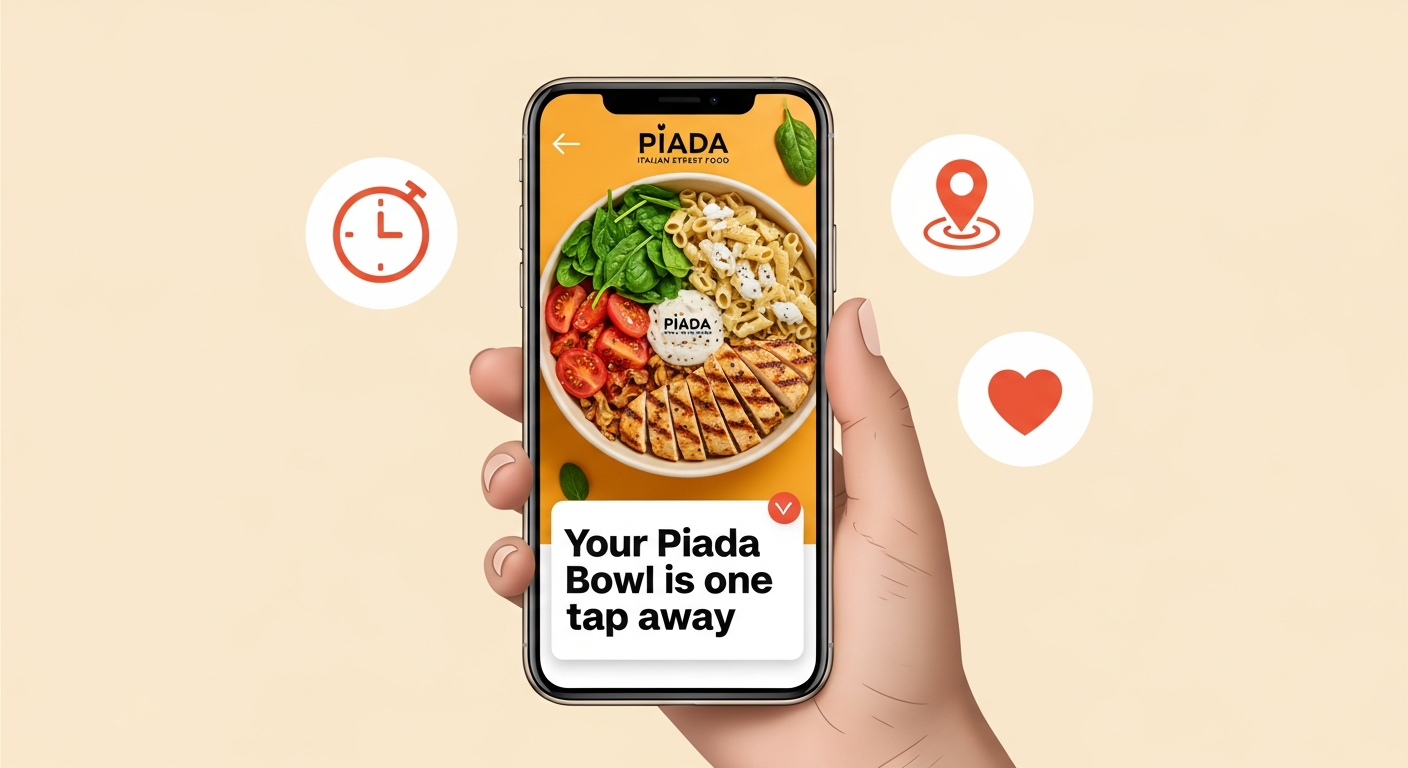
Piada Italian Street Food, a 50-location fast-casual chain based in Columbus, Ohio, nailed this. Their personalized reorder pushes — messages like "Your Piada Bowl is one tap away" — converted at 9.3%, their highest-performing push type. Customers receiving push notifications ordered 2.1× more frequently per quarter, and the average order value for push-driven orders was $14.80 compared to $12.60 for organic app orders — a 17.5% AOV lift. Piada credited push with driving $1.2 million in incremental annual digital revenue across the chain (Olo customer spotlight, January 2025).
3. The Win-Back Campaign
Every restaurant has lapsed customers. The question is whether you do anything about it. The industry churn numbers are sobering: according to Thanx's 2024 data, 68% of non-loyalty customers churn within 90 days. Even loyalty members churn at 41%. But push-engaged loyalty members? Just 29%.
Snooze, an A.M. Eatery with 50+ locations, used push notifications specifically to solve the irregular visit patterns common in the breakfast and brunch segment. Their lapsed-customer win-back pushes — sent to anyone who hadn't visited in 30+ days — achieved a 14% redemption rate, bringing back an estimated 3,200 lapsed guests per month across all locations. The revenue impact: approximately $128,000 per month chain-wide, based on an average brunch check of about $40 for two people (SevenRooms case study, 2024).
Real Operators, Real Results: What the Numbers Look Like in Practice
Let's look at how this plays out across different restaurant types.
Slutty Vegan (Atlanta, GA) — the plant-based burger chain founded by Pinky Cole — launched a branded mobile app with push notifications in 2023. By mid-2024, they had over 125,000 app downloads. Push notifications promoting limited-time offers drove a 35% increase in same-day digital orders on notification days. The repeat order rate among app users hit 58%, compared to 31% among non-app customers. Their secret? Time-targeted pushes sent at 11:15 AM and 4:45 PM referencing the customer's last order (Nation's Restaurant News, March 2024).
Velvet Taco (Dallas, TX) tied their push strategy to their "Weekly Taco Feature" program. Push notifications announcing the new weekly special drove a 22% increase in Wednesday visits. App users receiving pushes visited 18.4 times per year — compared to 5.7 for non-app customers. Average check for push-driven orders was $2.40 higher than the overall average. Their marketing team called push their #1 ROI channel, outperforming Instagram, email, and paid social (Paytronix case study, Q1 2024).
Mendocino Farms (Los Angeles, CA) used push to attack their weakest days. Tuesday and Wednesday lunch pushes increased orders on those days by 18% over a six-month test. Push-engaged customers had a 72% 90-day retention rate, compared to 44% for non-push-engaged app users (Thanx case study, 2024).
And it's not just chains. Joe's Taco Lounge, a single-location independent in Phoenix, implemented automated push and text campaigns through Popmenu in early 2024. Monthly repeat orders jumped from 340 to 580 — a 70.6% increase — within four months. Revenue attributable to push campaigns: approximately $4,100 per month on a marketing spend of about $300. That's a 13.7× return on marketing spend. Owner Joe Carrillo said his 3 PM Tuesday "Taco Tuesday" push reminder became his single most effective marketing tactic (Popmenu customer spotlight, June 2024).
The Rules: How to Push Without Pushing Customers Away
Push notifications are powerful precisely because they're direct. That directness is also what makes them dangerous if you overdo it.
Here are the guardrails that matter:
Frequency: 2–4 per week, max. OneSignal's 2024 data is clear: restaurants sending more than 6 pushes per week see opt-out rates spike by over 50%. At 2–4 per week, the unsubscribe rate per push stays at a manageable 0.5–1.0%. Push past 7 per week and it jumps to 2.5–4.0% (Airship, 2024). You'll burn through your audience in weeks.
Personalization is non-negotiable. Generic blasts get 3–4% open rates. Personalized messages — using the customer's name, their last order, or their location — hit 12–16% (Braze, 2024). Geo-targeted pushes sent when a customer is within a defined radius of your restaurant convert at 8–12%, compared to 2–4% for non-geo-targeted messages (Popmenu, 2024).
Timing beats creativity. A mediocre offer sent at 4:30 PM beats a brilliant offer sent at 9 AM. As Brendan Sweeney, CEO of Popmenu, puts it: "A well-timed push at 4:30 PM is worth more than a $500 Instagram campaign."
Recover abandoned carts. This is free money. Olo's 2025 data shows that abandoned cart push notifications sent within 30 minutes recover 8–12% of incomplete digital orders. If you're doing any volume of online ordering and not sending these, you're leaving revenue on the table every single day.
Protect your opt-in rates. Restaurant apps enjoy strong opt-in rates — 55–65% on Android and 40–50% on iOS (Airship, 2024) — because customers see direct transactional value. Don't squander that trust with irrelevant messages. Every push should either save the customer time, save them money, or give them something they actually want.
The Math for Your Restaurant
Let's make this concrete for a single-location independent doing $60K/month in revenue.
Say you have 1,500 app users with push enabled. At a conservative $0.15 revenue per push recipient, sending 3 pushes per week to your full list generates:
1,500 × $0.15 × 3 pushes × 4.3 weeks = $2,902/month
That's in line with Popmenu's finding of $2,700/month in push-driven revenue for independents. Over a year, that's nearly $35,000 in additional revenue — from a channel that costs essentially nothing beyond your app platform.
Now factor in the retention impact. Push-engaged loyalty members churn at just 29%, compared to 68% for non-loyalty customers (Thanx, 2024). Loyalty members generate 2.5–3× more lifetime revenue than non-members (Square, 2024). And push-engaged loyalty members visit 56% more often than loyalty members who don't engage with push (Paytronix, 2024).
This isn't incremental. It's transformational. And it all starts with having your own app — not renting space on someone else's platform.
Stop Renting Your Customer Relationships. Start Owning Them.
Every order that goes through DoorDash or Uber Eats is a customer relationship you don't own. You can't send them a push notification. You can't trigger a win-back campaign. You can't even see their email address.
With your own branded app, you control the entire relationship — from first order to 50th. You send the pushes. You set the timing. You keep 100% of the revenue.
Menuro builds done-for-you restaurant apps with push notifications, loyalty programs, automated campaigns, and direct ordering built in. No commissions. No tech skills required. We handle everything.
The restaurants winning the repeat-order game aren't the ones with the biggest budgets. They're the ones who show up on their customers' lock screens at 4:30 PM with exactly the right message.
Ready to see what that looks like for your restaurant? Book a free demo at menuro.io/demo and we'll map out a push notification strategy tailored to your menu, your customers, and your revenue goals.