
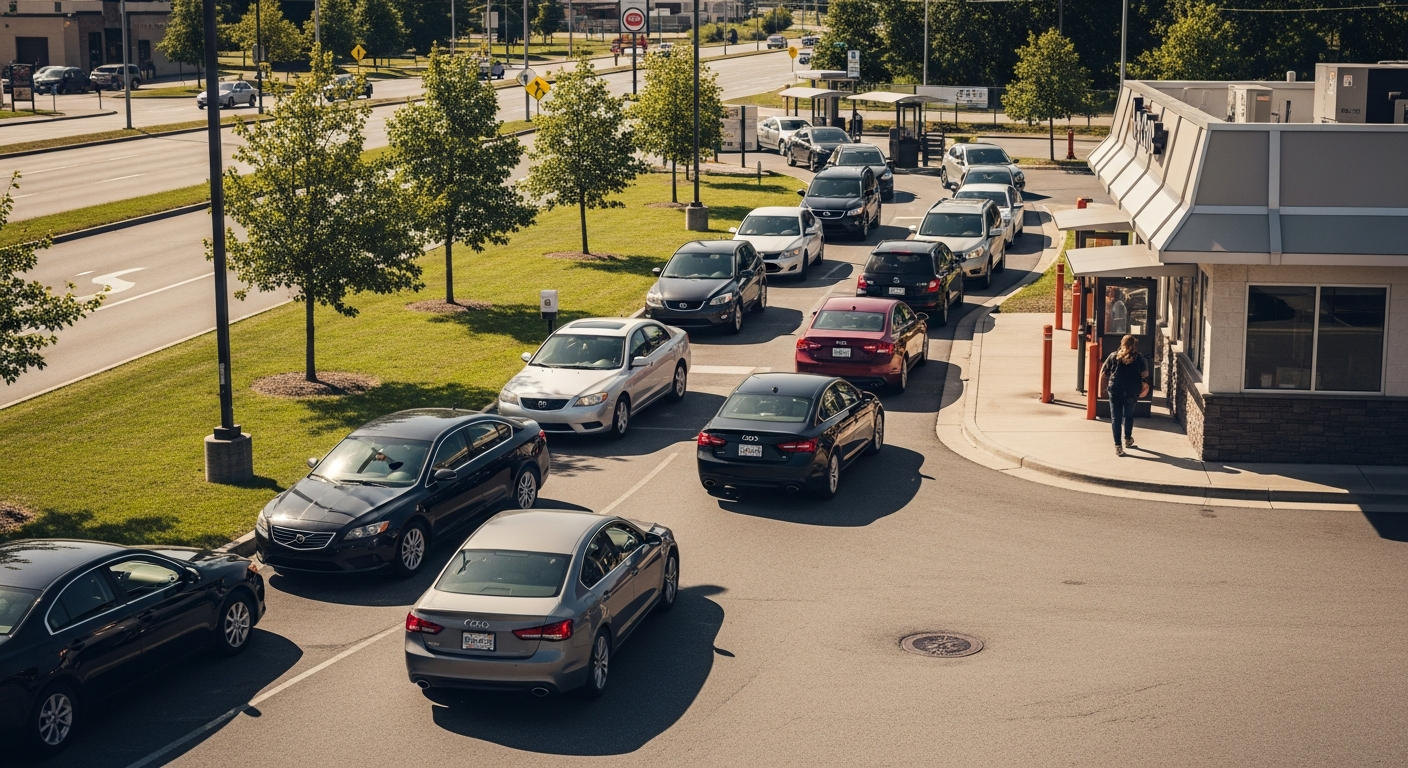
It's 12:15 p.m. on a Tuesday. Your drive-thru line wraps around the building and six cars deep into the parking lot. A silver Honda Civic pulls in, idles for about 20 seconds, and then rolls right back out onto the street. Two minutes later, a white pickup does the same thing. Neither driver ordered. Neither will show up in your POS data. As far as your numbers are concerned, those customers never existed.
But they did. And they took roughly $20 with them.
This happens all day, every day, at QSR locations across the country. The Bluedot "State of What Feeds Us" report (2024, Vol. 6) found that 75% of consumers have decided not to visit a restaurant because the drive-thru line looked too long. Not "considered leaving." Decided not to visit. Three out of four people have already made the call before they even pull in.
The ones who do pull in aren't much more patient. Bluedot's same study found that 28% of consumers will bail after waiting five minutes, and 50% will leave after ten.
Drive-thru walk-away orders are one of the most expensive problems in QSR, and most operators have no system for measuring them.
The Math Behind $600 a Week in Lost Drive-Thru Orders
Let's build this from the ground up with sourced numbers.
Revenue Management Solutions reported in Q3 2024 that the average QSR check size hit $9.63, up from $8.91 in 2022 due to menu price inflation. Circana (formerly NPD Group) pegged drive-thru-specific checks even higher at $10.31 in 2024, since drive-thru orders tend to include more family and group meals.
A mid-volume QSR location processes 150 to 250 drive-thru cars per day, according to Revenue Management Solutions' 2024 operational benchmarks. Take a location doing 200 cars a day.
Now apply a conservative balk rate. Presto Automation's 2023 survey found that 43% of drive-thru customers have left a line without ordering at least once in the past month. The Bluedot data puts the "avoided entirely" number at 75%. We don't need to use the dramatic end of that range. A 5% daily balk rate — meaning 10 out of 200 potential customers see the line and leave — is a modest assumption.
10 lost cars × $9.63 = $96.30 per day.
$96.30 × 7 days = $674.10 per week.
Even at a 4% balk rate (8 cars per day), the weekly loss comes to $539.28.
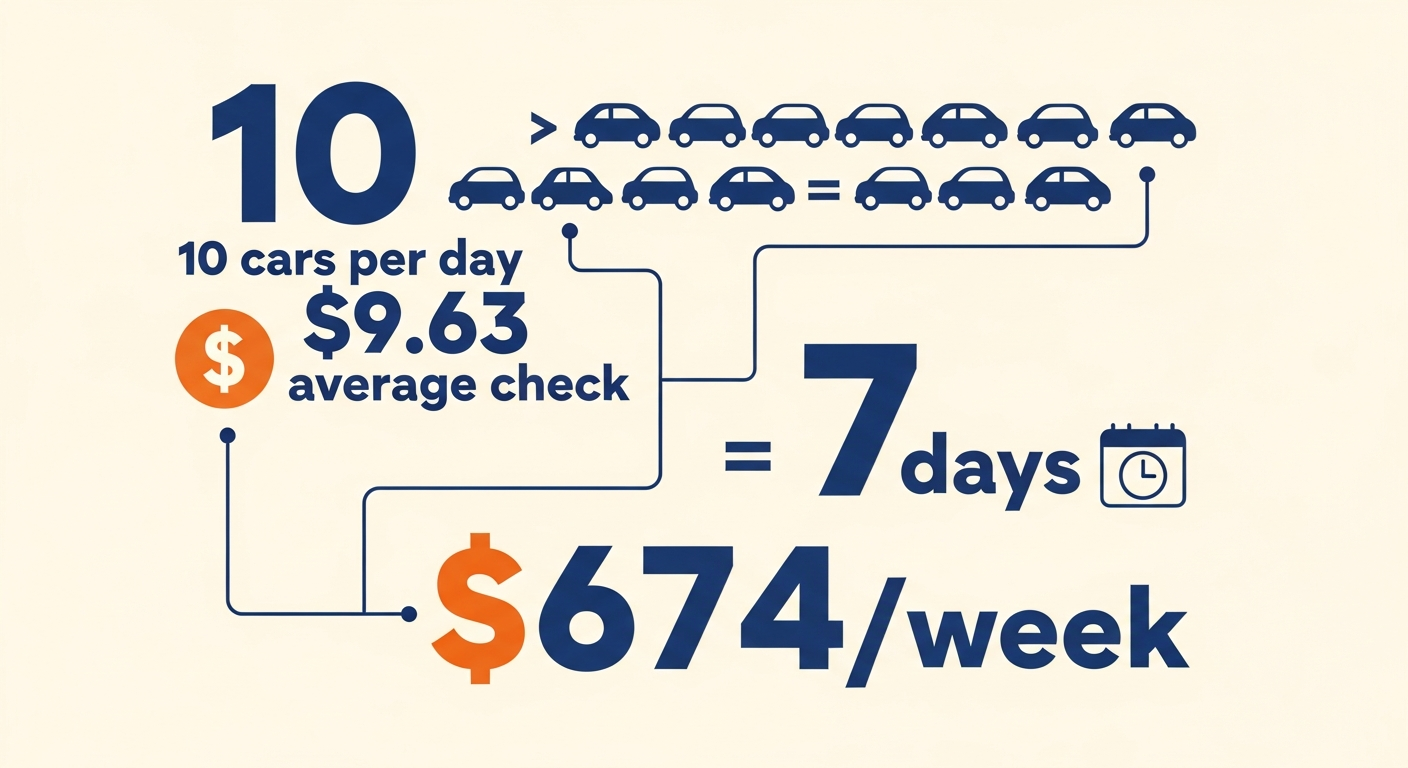
The $600/week figure sits in the middle of that range. Annualized, it's $31,200 per location. A 10-unit operator is looking at $312,000 a year in revenue that drove up to the building and left.
And this is getting worse, not better. Revenue Management Solutions reported that QSR traffic (transaction counts) declined 3.5% year-over-year in 2024 even as check sizes rose. Fewer customers are showing up in the first place, which makes every walk-away more damaging to the P&L.
Drive-Thru Wait Times Keep Getting Longer
The Intouch Insight 2024 Annual Drive-Thru Study, conducted across 10 major QSR brands with mystery shoppers, measured the average total drive-thru time at 6 minutes and 22 seconds. That's up from 5 minutes 57 seconds in 2023 and roughly 5 minutes 30 seconds in 2019.
Drive-thru lines have gotten 52 seconds slower in five years. That might sound small, but in a system where every 10 seconds of delay compounds across a queue, it's enormous.
Mike Lukianoff, CEO of Presto Automation, put it this way in 2024: "Every 10 seconds you save in the drive-thru translates to meaningful revenue. For a busy QSR location, shaving 30 seconds off average service time can mean serving 15–20 more cars during peak hours. At a $10 average check, that's $150–$200 in additional revenue per peak period, per day."
The Intouch Insight study also found that order accuracy dropped to approximately 85%, meaning about 1 in 7 orders had an error. A slow line that also gets your order wrong is a one-two punch that Technomic's 2024 Consumer Trends data confirms: negative drive-thru experiences are the number-one reason QSR customers switch to a competitor, ranking above food quality and price.
Technomic also found that 89% of QSR customers rank speed as a top-three factor in choosing a drive-thru restaurant, and 62% say they're less likely to return to a location within 30 days if speed expectations aren't met.
The labor picture makes this harder to fix with staffing alone. Black Box Intelligence's 2024 Workforce Report put QSR employee turnover at 100–130% annually. Revenue Management Solutions found that locations operating below 90% of optimal staffing see drive-thru times increase by 25–40%.
So the lines are longer, accuracy is down, customers are less patient, and you can't hire enough people to brute-force the problem. That's the situation.
What Operators Who've Solved This Are Doing
Several QSR operators have attacked drive-thru walk-away losses with measurable results. Their approaches fall into three categories: physical redesign, technology deployment, and channel diversion.
Physical Redesign: Taco Bell "Defy" and Burger King "Sizzle"
Taco Bell opened its "Defy" prototype in Overland Park, Kansas, in June 2022. The two-story building has four drive-thru lanes and a proprietary lift system that lowers orders down to cars. Mobile pre-orders move through in under two minutes. Yum! Brands CEO David Gibbs said on a 2023 earnings call that Defy demonstrated "meaningfully higher throughput" than traditional locations. A second Defy opened in Brooklyn Park, Minnesota, in 2023.
Burger King's "Sizzle" prototype, launched in Jacksonville, Florida, in 2023, features a suspended kitchen with conveyor-belt delivery to drive-thru lanes and a separate mobile order lane. Restaurant Brands International projected the design would cut drive-thru times by 30–40%.
These are multi-million-dollar builds, obviously. Most independent QSR operators aren't demolishing their building and starting over. But the underlying principle applies at any scale: separating mobile orders from traditional orders reduces congestion for everyone.
Technology: AI Ordering and Faster Payment
Checkers/Rally's partnered with Presto Automation to deploy AI voice ordering at drive-thrus starting in 2023. Joel Burrows, CEO of Checkers/Rally's, told Nation's Restaurant News: "The drive-thru is our entire business model. When we looked at the data, we realized that during peak lunch and dinner, we were turning away cars — people would see the line and just keep driving. That's not a hypothetical loss. Those are real dollars leaving our parking lot."
Pristo reported the AI system achieved 95%+ order accuracy and increased average check size by $0.50 to $1.00 through consistent upselling. Checkers expanded the system to over 200 locations by early 2024.
Panera Bread took a different approach, piloting Amazon One palm-scanning payment at drive-thrus in St. Louis starting in 2023. The goal was to shave 10–15 seconds per transaction at the payment window. Panera also found that digital and loyalty-identified orders carry average check sizes 15–20% higher than anonymous drive-thru orders.
Channel Diversion: Moving Orders Off the Line Entirely
This is the lever most accessible to independent and small-chain QSR operators.
Whataburger began adding dedicated mobile order pickup lanes at new and remodeled locations in 2023–2024. Mobile orders as a percentage of total sales grew from roughly 12% to over 20% between 2022 and 2024. Each mobile order that bypasses the main drive-thru lane frees up capacity for the next car in line.
Bluedot's 2024 data found that mobile order-ahead reduces effective drive-thru time by 2 to 4 minutes per transaction. That's because the ordering, payment, and kitchen ticket all happen before the car arrives. The only remaining step is handoff.
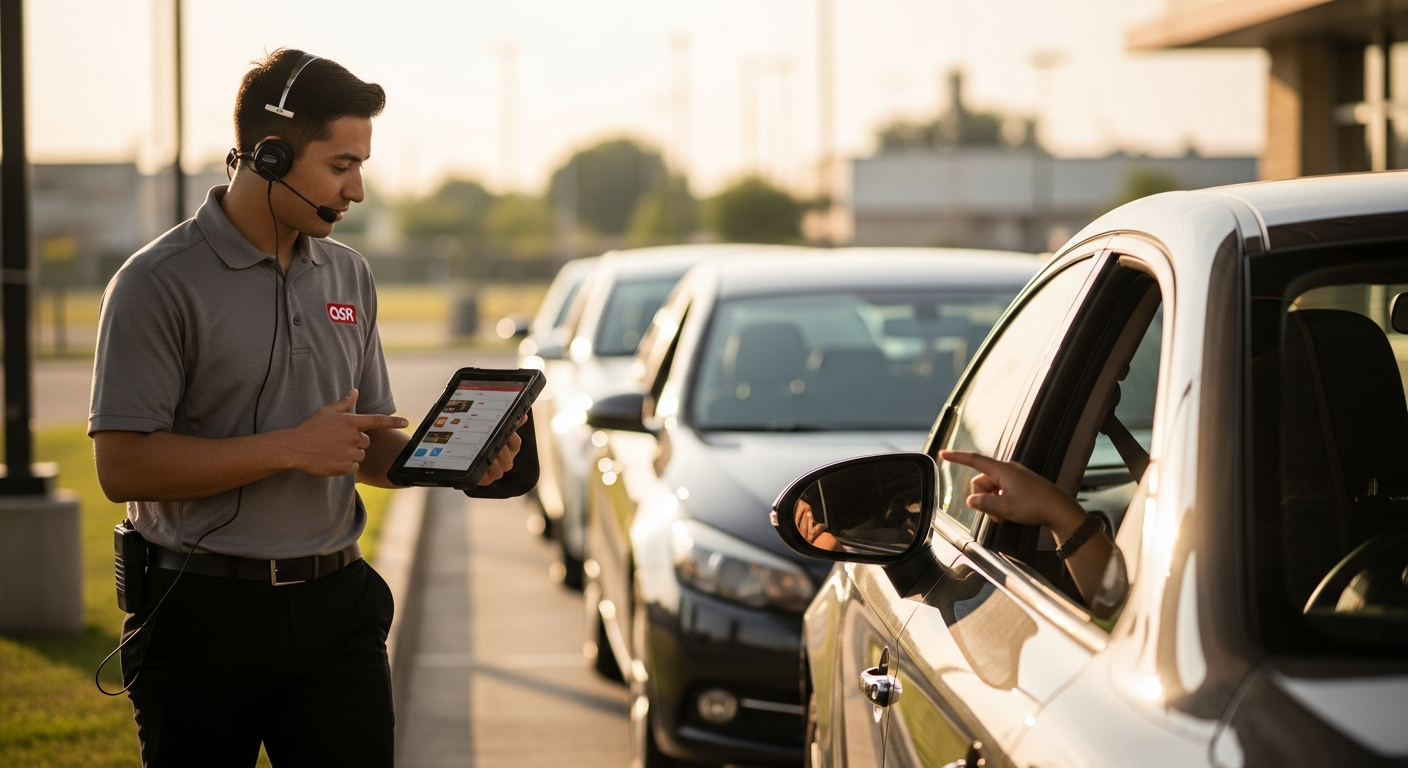
Chick-fil-A, which had the longest average wait times in the Intouch Insight 2024 study at over 7 minutes, has invested in tablet-based "line busting" where employees walk the line taking orders on handheld devices. Chick-fil-A reported that this reduced perceived wait times by 50% even when actual times didn't change much, because the ordering interaction happened earlier in the process. The chain also built dedicated mobile order pickup lanes at many locations.
The Speed-to-Revenue Connection for Smaller Operators
You don't need a $3 million Defy build or an AI voice bot to start recovering walk-away revenue. The data points toward a clear priority list.
First, get mobile ordering working and promoted. Olo's 2024 data showed that digital orders average 10–20% higher check sizes than non-digital orders. McDonald's reported that 40%+ of systemwide sales now flow through digital channels. App download-to-first-order conversion rates run 40–55% for well-designed QSR apps, according to Appsflyer and Olo benchmarks from 2024. Every order placed through a phone before the customer arrives is an order that doesn't add time to your line.
Second, create a separate pickup flow for mobile orders. This doesn't require a second drive-thru lane. A designated parking spot with curbside handoff, or a counter pickup window separate from the drive-thru, keeps pre-paid orders from clogging the queue. Whataburger's results show this works even at scale.
Third, build a repeat-order habit through your own channels. The Paytronix 2024 Loyalty Report found that loyalty program members visit 35–40% more frequently than non-members and spend 20–40% more per visit. Top-decile QSR loyalty members visit 8 to 12 times per month. These are customers who already know what they want, order ahead, and show up to grab their food. They skip the menu board, skip the speaker, and free up line capacity.
Pal's Sudden Service, a 31-unit chain in northeast Tennessee and southwest Virginia, delivers a total drive-thru experience averaging under 2 minutes, with food handed over in under 20 seconds from the order window. Pal's won the Malcolm Baldrige National Quality Award for operational excellence and reports same-store sales growth consistently above the QSR industry average. Their employee turnover runs at roughly 33%, about one-third of the industry's 100%+ norm. Speed, consistency, and retention feed each other.
You might not hit 20-second handoffs, but the principle holds: the fastest transaction is one where the customer ordered and paid before they arrived.
The Cost of Doing Nothing
QSR customer churn is brutal. Black Box Intelligence and Revenue Management Solutions reported in 2024 that approximately 60–70% of first-time QSR visitors do not return within 90 days. The classic Bain & Company research, still cited by the National Restaurant Association, found that a 5% improvement in customer retention can increase profits by 25–95%.
Every car that drives away from your line is a potential regular who found somewhere else. Technomic's 2024 data showed that 62% of customers who have a bad speed experience are less likely to return within 30 days. That's not a one-time $10 loss. That's a customer who might have visited twice a month for the next year: $240 in lifetime value, gone because the line looked too long at 12:15 on a Tuesday.
Judy Chan, VP of Product at Bluedot, summarized the shift in their 2024 report commentary: "Consumer patience has fundamentally shifted. What was an acceptable wait in 2019 is no longer tolerable in 2024. Three-quarters of consumers are making the decision to skip your restaurant before they even enter the line. The line IS your first impression."
Drive-thru accounts for 65–75% of total QSR sales at locations with a drive-thru lane, according to Technomic's 2024 data. McDonald's has stated that drive-thru represents over 70% of U.S. sales. Chick-fil-A locations report drive-thru exceeding 80% of revenue at some stores. When the majority of your revenue flows through a single channel, a 4–5% leak in that channel is a serious P&L problem.
$600 a week. $31,200 a year. Per location. And that's using conservative assumptions.
Get Those Orders Before the Line Does
Menuro helps QSR and fast-casual operators launch their own branded mobile ordering app, so customers can order and pay before they pull into the lot. No line. No balk. No lost sale. If you want to see how it works for drive-thru-heavy operations, book a 15-minute demo at menuro.io/demo.