
Last Friday night, 47 takeout orders left your restaurant. Forty-seven bags of your food — your recipes, your brand, your reputation — went home with people who already chose you over every other option in a five-mile radius.
How many of those 47 people will ever sit down at one of your tables?
If you're like most independent restaurants, the honest answer is: you have no idea. You don't know their names. You don't have their emails. You couldn't reach them again if you tried. And according to Olo's 2024 Engagement Benchmarks Report, only 19% of first-time takeout customers ever come back for a second order within 90 days — if you do nothing.
That's not a retention strategy. That's a leak.
This post is the playbook for how to turn first-time takeout customers into dine-in regulars — with real numbers, real restaurant case studies, and specific tactics you can start using this week.
Why Dine-In Conversion Is the Highest-ROI Move You Can Make
Let's start with the math, because the math is what makes this urgent.
According to Black Box Intelligence's Q1 2025 Guest Intelligence Report, the average dine-in check at a full-service restaurant is $45.50. The average takeout check? $28.30. That's a 47% gap — and it's been widening since 2022.
Where does the gap come from? Mostly alcohol. Paytronix's 2024 Annual Loyalty Report found that the alcohol attachment rate for dine-in is 38%, compared to just 9% for takeout. Add appetizers, desserts, and the second round of drinks that happens when people are comfortable at a table, and you're looking at a fundamentally different transaction.
Now layer on this insight from Paytronix CEO Andrew Robbins: "A customer who has experienced both your off-premise and on-premise channels has a lifetime value 3.2x higher than a single-channel customer. The cross-channel customer visits more often, spends more per visit, and churns at roughly half the rate."
Getting a takeout customer into a seat isn't a nice-to-have. It's the single highest-ROI move most restaurants can make — because the hard part is already done. That person already knows your food. They already chose you. As restaurant marketing consultant David "Rev" Ciancio put it on the Restaurant Unstoppable Podcast: "You don't need to convince them you're good — you need to convince them the experience of sitting in your restaurant is worth the trip. That's a completely different, and much easier, marketing problem."
The probability of converting an existing customer to a repeat visit is 60–70%, according to Bain & Company data cited in Square's 2024 Future of Restaurants Report. Compare that to a 5–20% probability for acquiring a brand-new customer. Every takeout bag that leaves your restaurant is a warm lead. The question is whether you're treating it like one.
Step 1: Capture the Data (Or Nothing Else Matters)
Here's the uncomfortable truth: 43% of restaurant operators say they have no visibility into who their takeout customers are — no name, no email, no phone number (Toast 2024 Restaurant Technology Survey). If orders come through DoorDash or Uber Eats, you get the revenue minus 15–30% in commissions, and you get zero relationship data.
Olo's 2024 "Beyond the Transaction" report found that 81% of first-time third-party delivery customers never order from the same restaurant again on the platform. The algorithm doesn't work for you — it promotes variety and your competitors.
Contrast that with restaurants that capture first-party data from takeout orders: they convert 33% of those customers into a second transaction within 60 days, compared to just 11% through third-party marketplaces.
The gap is enormous. And it starts with one simple shift: own the ordering channel.
When a customer orders through your own app or website, you get their name, email, phone number, order history, and preferences. That's not just data — it's the foundation of every tactic in this playbook.
Bartaco, the upscale taco concept with 17+ locations, made this exact move in early 2024 when they removed third-party delivery entirely and pushed all off-premise orders through their own app. The result? Full customer profiles on every order, an 11% app-to-dine-in conversion rate, and an estimated $1.2 million saved system-wide in commission fees. Dine-in customers acquired through the app had 40% higher annual spend than walk-in dine-in customers (Restaurant Dive, February 2025).
You don't need 17 locations to do this. You need a direct ordering channel that captures contact information on every single transaction.
Step 2: The Takeout Bag Is Your Best Marketing Channel
Brendan Sweeney, CEO of Popmenu, said something that should be taped to every restaurant's expo line: "The biggest missed opportunity in the restaurant industry right now is the takeout bag. Every single one of those bags is going to someone who already chose you. They've already cleared the hardest hurdle — trial."
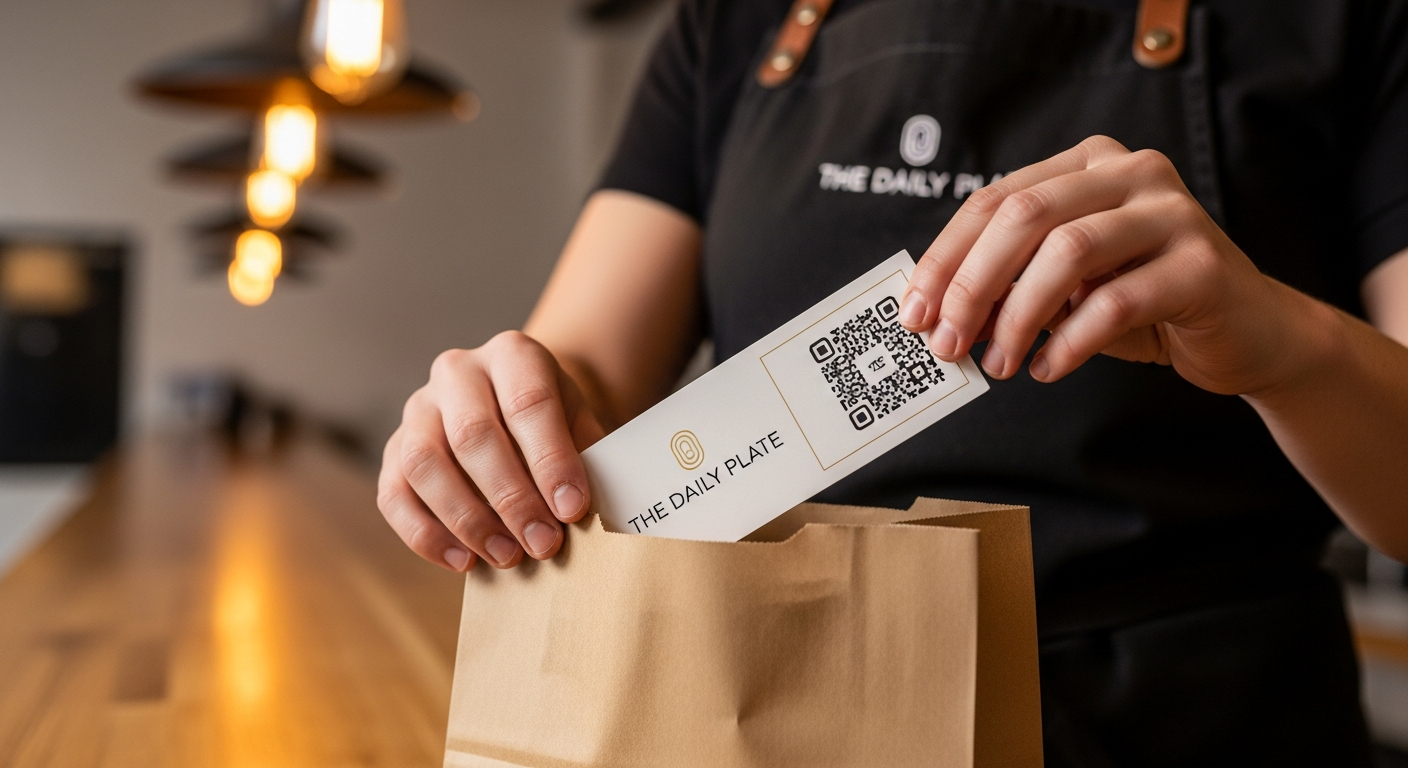
The Mockingbird in Nashville proved this with almost zero budget. Owner Mikey Corona inserted a physical card in every takeout bag with a QR code linking to a "First Dine-In Experience" landing page — a $10 credit on a $50+ dine-in check.
The results over Q4 2024: 410 QR scans, 139 dine-in reservations booked (a 33.9% conversion rate from scan to reservation), and an average dine-in check of $67 from converted customers. Estimated incremental revenue: $9,313 — from a program that cost essentially nothing beyond printing cards.
Corona told Popmenu's blog: "These people already loved our food. They just needed a nudge and a reason to come sit down."
Popmenu's 2024 benchmark data backs this up: in-bag inserts drive an 8–12% app download conversion rate, while post-order SMS drives 14–18%. Both are remarkably high compared to cold acquisition channels that cost $8–$15 per new customer (Toast 2024).
The insert doesn't need to be fancy. It needs three things:
- A specific dine-in offer (free appetizer, complimentary drink, $10 credit — something that only works in-house)
- A QR code that captures their contact info when scanned
- A reason that speaks to the experience, not just the discount ("Chef Marco's favorite dish doesn't travel well — come taste it at the table")
Step 3: Build the Automated Follow-Up Sequence That Actually Converts First-Time Takeout Customers Into Dine-In Regulars
The insert gets the data. The automation does the converting.
SevenRooms CEO Joel Montaniel shared a key insight at the company's OPEN conference in March 2025: "The key is the second touchpoint — not the first. The first email gets opened; the second one gets the reservation."
The data supports a three-touch sequence, and Boqueria — a Spanish tapas group with 7 locations in New York and DC — has one of the best-documented examples:
- Touchpoint 1 (Order confirmation): A "behind the scenes" video of their kitchen. No ask. Just brand building.
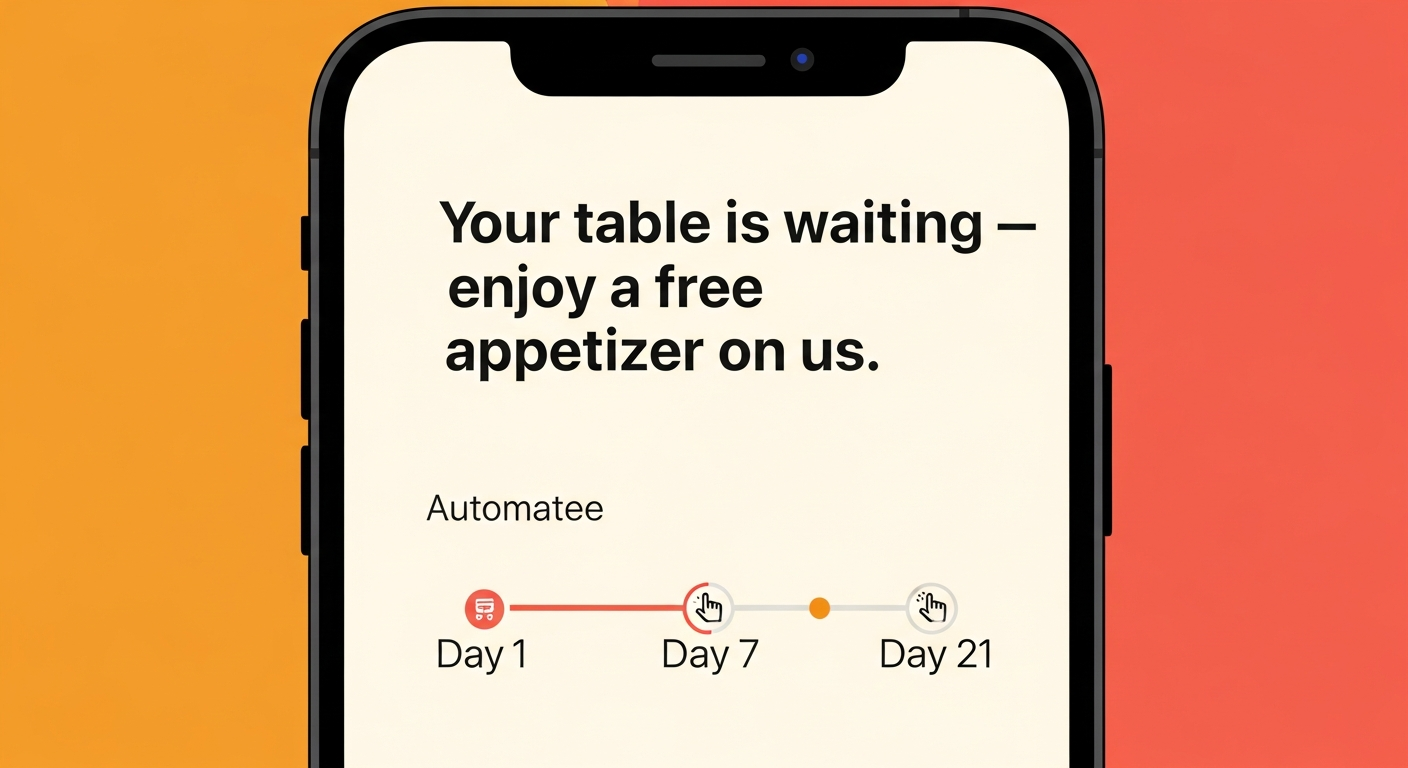
- Touchpoint 2 (Day 7): A personalized email — "Chef [Name]'s favorite dish that doesn't travel well" — with a direct reservation link.
- Touchpoint 3 (Day 21): "We saved you a seat" with a 15% dine-in discount.
The results, reported at SevenRooms' OPEN conference: a 26% open-to-booking rate on the Day 7 email. Takeout-to-dine-in conversion over 60 days: 21%. The converted cohort's average check was $94 per party — compared to a $41 average takeout order. That's a 129% increase in spend per occasion.
Popmenu's 2024 data, cited in Restaurant Business Magazine, shows that personalized "We miss you" emails sent 7–14 days after a first takeout order see a 12.7% redemption rate on included offers — versus just 3.1% for generic promotional blasts. And SevenRooms' 2025 Hospitality Marketing Report found that restaurants using automated email flows generate 5.8x higher revenue per recipient than those sending one-off campaigns.
This isn't about sending more emails. It's about sending the right emails at the right time, automatically, to someone who already raised their hand by ordering from you.
Here's what a simple, high-performing sequence looks like:
| Timing | Message | Goal |
|---|---|---|
| Day 0 | Order confirmation + app download prompt | Capture contact data |
| Day 5–7 | "Your table is waiting" + dine-in incentive | Drive first reservation |
| Day 14–21 | "We saved you a seat" + stronger offer | Catch those who didn't convert |
| Day 30 | Loyalty program invitation | Lock in long-term relationship |
Hank's Pasta Bar in Alexandria, VA ran a version of this through SevenRooms starting mid-2024. Every takeout order triggered an automated email 5 days later with a "Your table is waiting" message and a complimentary limoncello offer for dine-in. Over six months, 17% of first-time takeout customers made a dine-in reservation within 30 days. Their average dine-in check was $72 vs. a $38 takeout check — an 89% increase. Owner Jamie Leeds told Restaurant Business Magazine: "We were basically ignoring the biggest lead funnel we had."
Step 4: Use Loyalty to Make Dine-In the Default
Once someone sits down, you need to make sure they come back. This is where loyalty programs earn their keep.
Paytronix's 2024 Annual Loyalty Report found that loyalty members visit 35% more frequently and spend 20% more per visit than non-members. The program-wide redemption rate is 48% — meaning nearly half of earned rewards actually get used. That's not a dormant database. That's active engagement.
Curry Up Now, the Indian fast-casual chain with 12 locations, used Paytronix to identify approximately 28,000 customers who had ordered takeout two or more times but never dined in. They offered double loyalty points for the first dine-in visit plus a free naan appetizer. The conversion rate: 14.2% from takeout-only to dine-in within 45 days. Converted customers showed 23% higher 90-day lifetime value. The program generated an estimated $165,000 in incremental dine-in revenue across all locations in Q3 2024.
The playbook: use your loyalty program to create a dine-in incentive structure that makes eating in your restaurant the most rewarding option. Double points for dine-in. Exclusive menu items only available at the table. A free dessert on the third dine-in visit. Make the seat worth more than the bag.
Square's 2024 data shows that loyalty program enrollment rates hit 22–27% when prompted at checkout. If you're capturing contact data through direct ordering and prompting loyalty enrollment in your automated sequence, you're building a flywheel: takeout → data capture → automated follow-up → dine-in conversion → loyalty enrollment → repeat visits.
The Cost of Doing Nothing
Let's be blunt about the alternative.
Black Box Intelligence's 2024 Consumer Trends Report found that 68% of new restaurant customers never return within 12 months if no proactive retention effort is made. Restaurants without a loyalty or CRM program see 22% lower same-store sales growth over a two-year period (Paytronix 2024).
At average restaurant profit margins of 3–5% for full-service and 6–9% for fast-casual (NRA 2025), the difference between a $28 takeout check and a $45 dine-in check is often the difference between breaking even and actual profitability on that transaction.
And if you're paying $8–$15 to acquire a customer through digital channels (Toast 2024) and then never capturing their data or following up, you're running a negative-ROI acquisition engine. You're paying to meet people you'll never see again.
As NRA SVP of Research Hudson Riehle put it at the 2025 State of the Industry briefing: "The operators who will thrive are those who view every takeout transaction not as an endpoint but as the beginning of a customer lifecycle that ideally moves toward higher-margin dine-in occasions."
Let Menuro Build This Entire System for You
Everything in this playbook — direct ordering that captures customer data, automated follow-up sequences, loyalty programs with dine-in incentives, push notifications, SMS campaigns — is exactly what Menuro builds for independent restaurants. Done for you. No tech skills required. No commissions on your orders. Ever.
Your takeout customers already love your food. Menuro gives you the tools to invite them to the table — automatically, personally, and profitably.
Book a free demo at menuro.io/demo and see how restaurants like yours are turning first-time takeout customers into dine-in regulars — without lifting a finger.