
You're watching 25% of every delivery order vanish into DoorDash's pocket. You've got regulars who order three times a week — but you don't have their email, their phone number, or any way to reach them outside the app they found you on. And every month, the commission bill hits like a second rent check.
You've heard that a white label restaurant app — your own branded ordering and loyalty app — could fix this. But the market is noisy, the options are overwhelming, and you don't have time to become a software evaluator on top of running a restaurant.
This guide breaks down exactly how to choose a white label restaurant app in 2026: what features actually drive revenue, what separates a good platform from a money pit, and how to calculate whether the investment makes sense for your specific operation.
Let's get practical.
Why This Decision Matters More in 2026 Than Ever Before
The shift toward owned digital channels isn't a trend anymore — it's the new baseline. According to preliminary data from the National Restaurant Association's 2026 report and Technomic's Digital Foodservice Forecast, approximately 40% of all restaurant off-premise orders in the U.S. now happen through a mobile device. For limited-service restaurants, that number climbs to 52–58%.
Meanwhile, third-party delivery commissions remain stubbornly parked at 15–30% per order (National Restaurant Association, 2025 State of the Restaurant Industry Report). For a restaurant doing $500K a year in delivery, that's $75,000 to $150,000 annually — money that walks out the door and never comes back.
Here's what makes this painful: 67% of consumers say they actually prefer to order directly from a restaurant's own website or app when given the option, according to Popmenu's 2025 Restaurant Consumer Trends report. That's up from 63% the year before. Your customers want to order from you directly. They just need you to make it easy.
The question isn't whether you need a white label app. It's which one.
How to Choose a White Label Restaurant App in 2026: The 7 Non-Negotiable Features
Not all white label apps are created equal. After looking at what's actually driving results for restaurants right now, here are the features that separate platforms worth paying for from expensive digital menus that collect dust.
1. Commission-Free Direct Ordering
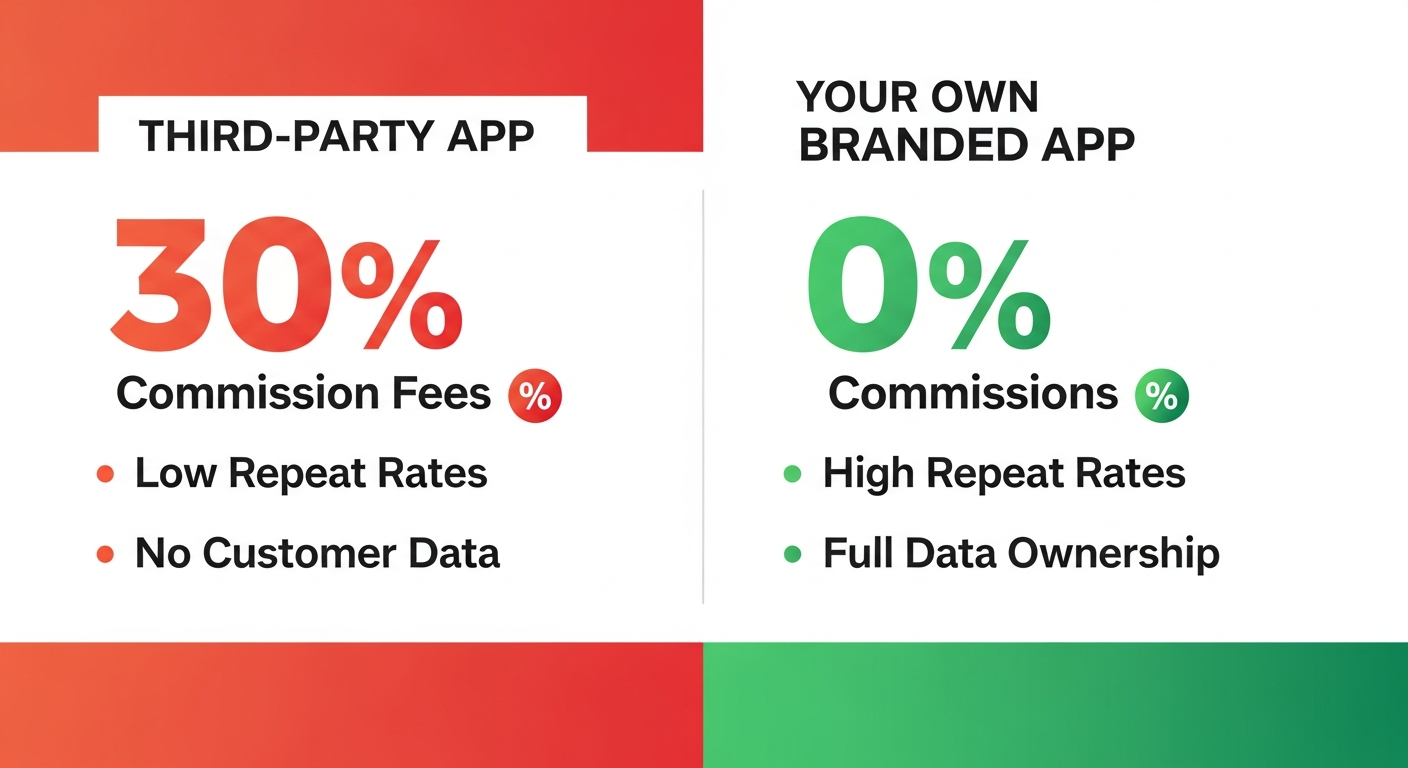
This is the whole point. Your app needs to process orders without taking a cut of every transaction. You're replacing the middleman, not swapping one for another.
The numbers back this up decisively. Square's 2025 Future of Commerce Report found that restaurants with branded digital ordering see average ticket sizes 23–28% higher than third-party marketplace orders. Olo's data shows that restaurants using white-label ordering processed over $26 billion in gross merchandise volume in 2024 alone.
Why are tickets higher on your own app? No comparison shopping. Integrated upsell prompts. Saved favorites that encourage add-ons. Your app isn't competing for attention with 40 other restaurants on the same screen.
2. Built-In Loyalty Program
This is where the compounding magic happens. Paytronix's 2024 Annual Loyalty Report found that loyalty members visit 2.5–3x more frequently and spend 18–27% more per visit than non-members. Branded app users with active loyalty programs average 4.4–5.1 visits per quarter, compared to just 1.9 visits for non-loyalty, non-app customers.
But here's the critical detail: the loyalty program must be inside the app, not bolted on as a separate experience. Thanx's 2024 State of Owned Digital Channels report found that restaurants with integrated in-app loyalty see 40–50% of total digital revenue come from loyalty members, compared to just 15–20% for web-only loyalty sign-ups.
Look for: points-based rewards, visit-based rewards, tiered programs, and automatic enrollment at first order.
3. Push Notifications and Marketing Automation
A white label app without push notifications is a menu with a download button. Push is how you drive repeat visits without spending on ads.
OneSignal's 2025 benchmarks show restaurant app push notifications deliver 4.6x higher click-through rates than email per impression. Paytronix data shows 17–22% redemption rates on targeted push offers, compared to just 3–5% for generic email blasts.
But the real win is automation — birthday campaigns, win-back messages for lapsed customers, post-visit thank-yous — all running without you touching anything. Braze's 2025 Global Customer Engagement Review found that food and beverage brands using multi-channel messaging (push + in-app + email) see 131% higher 90-day retention than single-channel approaches.
4. Customer Data Ownership
When someone orders through DoorDash, DoorDash owns that customer. You get an order. They get a relationship.
As SevenRooms CEO Joel Montaniel put it: "The most valuable asset a restaurant has isn't its real estate or its recipes — it's its guest data. When you rely entirely on third-party platforms, you're giving away that data for free."
Your white label app should give you names, emails, phone numbers, order history, visit frequency, and spending patterns. This data powers everything else — personalized offers, win-back campaigns, menu optimization. Without it, you're flying blind.
5. A Real Done-For-You Setup
This is where most restaurant owners get burned. They sign up for a platform, get handed a login, and are expected to build the app themselves — configure the menu, set up automations, design the loyalty tiers, write the push notification copy.
You run a restaurant. You don't have 40 hours to become an app developer.
The best white label platforms in 2026 handle everything: app design, menu setup, App Store submission, loyalty configuration, and ongoing marketing automation. As Popmenu CEO Brendan Sweeney noted: "Independent restaurants often think a branded app is only for big chains. That's a 2019 mindset. In 2025, a single-unit restaurant can launch a white-label app for under $300/month and see ROI within 60 days." But that ROI only materializes if you actually launch — and that means the setup can't depend on you.
6. Smart Upselling and Menu Optimization
Your app should work harder than a static PDF menu. Look for platforms that include automatic upsell suggestions, modifier prompts, and featured item placement.
This is a meaningful revenue lever. Square's data shows branded app orders run 15–20% higher than in-store orders, partly driven by these digital nudges. When a customer's thumb is already tapping "add to cart," a well-placed "Add a side for $3.99?" converts at rates your counter staff can't match consistently.
7. In-Store Promotion Tools
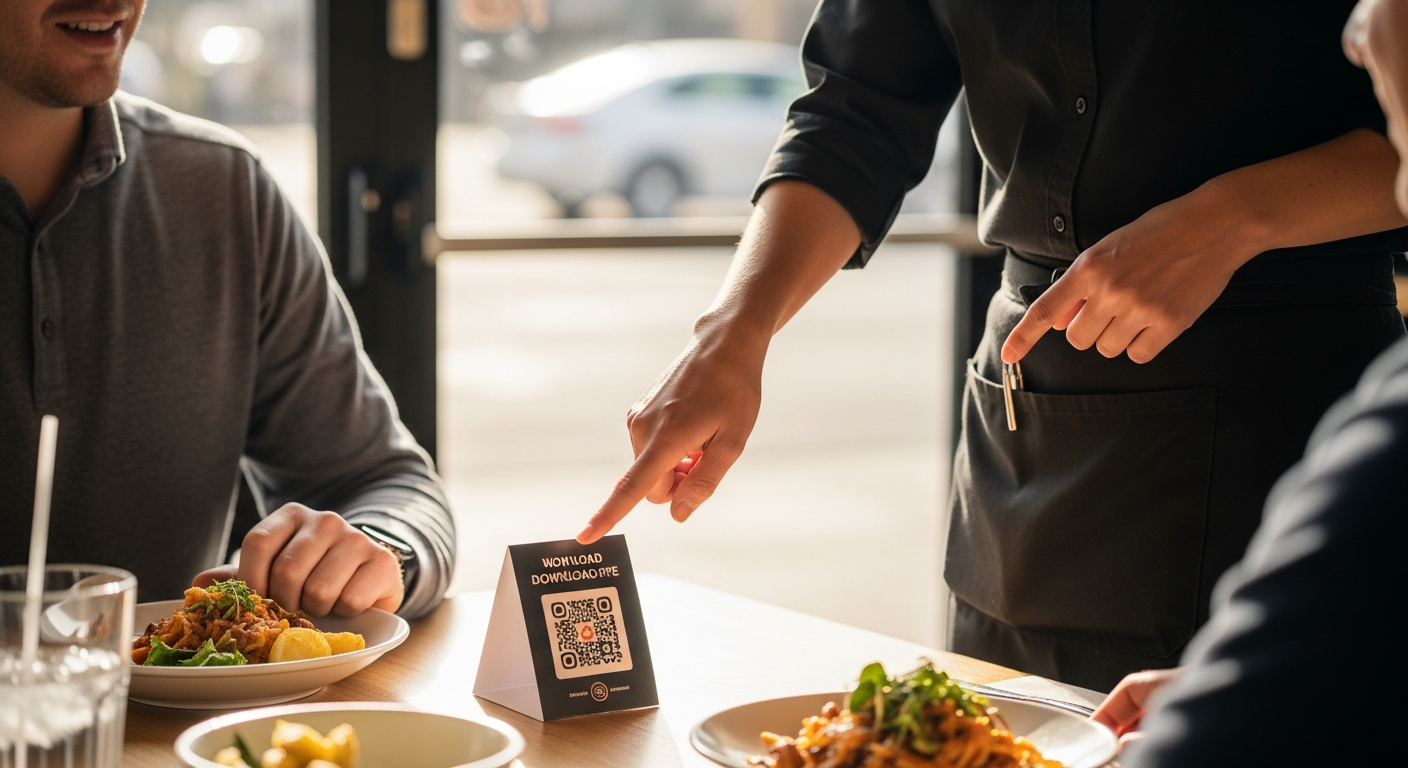
Here's a stat that should shape your entire app launch strategy: Popmenu's 2025 data shows that 55–65% of total restaurant app installs come from organic, in-store promotion — QR codes on tables, prompts on receipts, server mentions. The average cost per install via paid social (Meta/Instagram) is $2.50–$4.50 per download (Liftoff, 2025). In-store installs cost you essentially nothing.
Your white label app provider should give you QR code assets, table tents, receipt messaging, and a playbook for getting your staff to drive downloads. If they don't help you promote the app, they're selling you software, not results.
What Real Restaurants Are Getting From Their White Label Apps
Let's move from theory to receipts.
The Halal Guys (100+ locations) partnered with Lunchbox to build a white-label ordering app with integrated loyalty. Within the first year, the app drove over $10 million in direct digital sales. Their repeat order rate through the app was 54%, compared to roughly 20% on third-party platforms. They cut their annual third-party commission spend by an estimated $1.5 million (Lunchbox case study, 2024; Restaurant Business Online, 2024).
Mendocino Farms (40+ locations in LA) migrated from heavy DoorDash/Uber Eats reliance to a white-label app powered by Olo. Over 24 months, owned-channel digital orders went from 25% to 58% of their digital mix. The result: a net revenue increase of $2.8 million annually from commission savings and higher average tickets. Their app-based loyalty program hit 400,000+ members, with those members visiting 3.1x more frequently than non-members (Olo case study, 2024; Fast Casual, January 2025).
Slutty Vegan in Atlanta saw their Lunchbox-built app account for over 30% of all orders within six months. Push notification campaigns hit a 12.3% tap-through rate — roughly double the industry average. And targeted re-engagement campaigns brought back 22% of lapsed customers in a single campaign cycle (Lunchbox case study, 2024; QSR Magazine, August 2024).
These aren't tech companies. They're restaurants that made a strategic decision to own their digital channel.
How to Choose a White Label Restaurant App: The ROI Math for Your Restaurant
Let's make this concrete for a single-location independent restaurant doing $40,000/month in off-premise orders, with 60% currently going through third-party platforms.
Current state:
- Third-party orders: $24,000/month
- Average commission (25%): $6,000/month lost to platforms
- Customer data captured: zero
- Repeat rate on third-party: ~20%
After launching a white label app (conservative scenario — migrating 40% of third-party volume to direct within 6 months):
- Orders shifted to your app: $9,600/month
- Commission saved: $2,400/month
- Higher average ticket on app orders (+20%): additional $1,920/month in revenue
- Combined monthly benefit: $4,320/month
- App cost: $200–$500/month
- Net ROI: $3,820–$4,120/month
That's $45,840–$49,440 per year back in your pocket from a single location. And this doesn't account for the lifetime value increase from loyalty members who visit 2.5–3x more often, or the win-back revenue from automated campaigns reaching lapsed customers.
As restaurant marketing consultant David "Rev" Ciancio puts it: "A white-label app that costs you $200–$500/month and saves you $3,000–$10,000/month in commissions is the easiest yes in the restaurant business."
Red Flags: What to Avoid When Choosing a White Label App
Not every platform deserves your money. Watch out for:
- Per-order commissions disguised as "lower" fees. If they take 5–10% per order, they're just a cheaper middleman. You want flat monthly pricing.
- No loyalty program included. Ordering without loyalty is a one-time transaction. You need the retention engine built in.
- Self-service setup with no support. If the onboarding is a YouTube tutorial and a help desk email, you'll never launch. Demand done-for-you.
- No push notification capability. Without push, your app is passive. You need the ability to reach customers proactively.
- Long-term contracts with no performance accountability. Month-to-month or short commitments signal confidence. A 24-month lock-in signals desperation.
- They don't help you promote the app. The app only works if people download it. Your provider should give you a launch playbook, physical marketing assets, and staff training guidance.
Remember: the average restaurant app sees a 28% uninstall rate within 30 days (AppsFlyer, 2025). But apps with active loyalty programs drop that to just 8–10%. The platform you choose needs to give people a reason to keep the app on their phone.
The Bottom Line: Own the Relationship or Rent It
Meredith Sandland, CEO of Empower Delivery and co-author of Delivering the Digital Restaurant, summarized it best: "Every order that goes through a third-party app is a customer you're renting, not owning. A white-label app isn't just a technology decision — it's a strategic decision about whether you want to build a brand or be a line item in someone else's marketplace."
In 2026, the technology is affordable, the consumer preference for direct ordering is clear (67% and climbing), and the ROI math is overwhelming. The only remaining barrier, as Brendan Sweeney said, is awareness.
Now you're aware. The question is what you do next.
See What a White Label App Would Look Like for Your Restaurant
Menuro builds done-for-you branded restaurant apps with everything covered in this guide: commission-free ordering, built-in loyalty, push notifications, automated marketing campaigns, and a full launch playbook — all set up for you.
No tech skills needed. No long-term contracts. No per-order fees.
We'll show you a working demo customized to your restaurant in under 30 minutes.
Book your free demo at menuro.io/demo and see exactly how much revenue you're leaving on the table — and how to take it back.