
Picture this: it's the end of the month. You pull up your third-party delivery reports and see $50,000 in orders. Sounds great — until you realize $12,500 of that went straight to the platform. Not to your cooks, not to your rent, not to the ingredients on your shelves. To a middleman.
That's $150,000 a year. Gone.
If that number makes your stomach turn, you're not alone. According to the National Restaurant Association's 2024 report, 67% of restaurant operators say third-party delivery fees are unsustainable at current margins. And with the NRA's 2025 data showing that 45% of operators expect competition to intensify this year, the pressure on your bottom line is only growing.
So you've started asking the right question: how do I choose a restaurant app without commission in 2026? This guide will walk you through exactly what to look for, what to avoid, and how real restaurants are already saving tens of thousands of dollars a year by owning their ordering channel.
Why the Commission Model Is Bleeding You Dry
Let's start with the math, because the math is brutal.
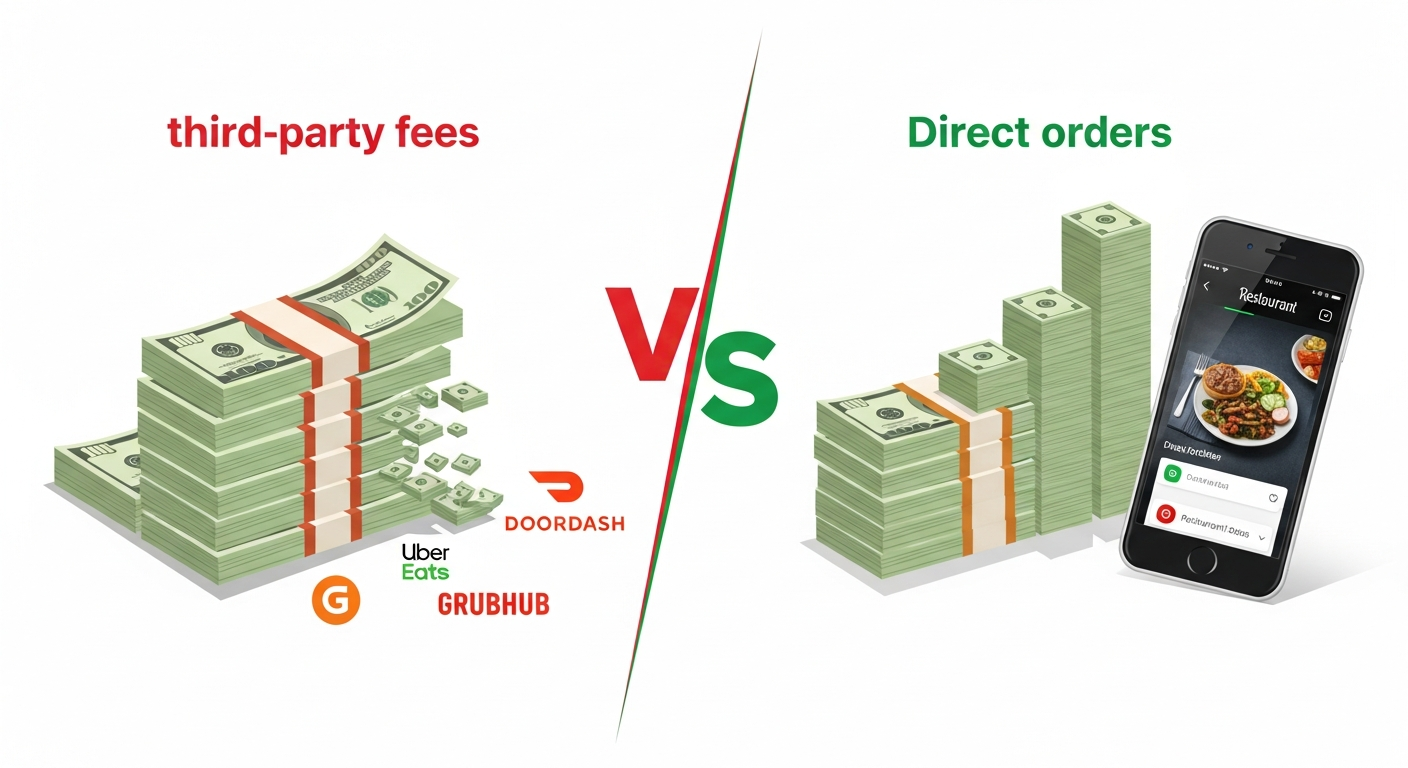
DoorDash, Uber Eats, and Grubhub charge restaurants 15% to 30% per order in commission fees, with 30% being the standard rate for non-partnered listings (Toast 2024 Restaurant Technology Report). Your average restaurant net profit margin sits between 3% and 9% according to the NRA. That means a 25–30% commission on delivery orders can literally exceed your entire annual profit.
Here's a concrete example from Toast's 2024 analysis: a restaurant doing $1 million per year in third-party delivery at a 25% average commission pays $250,000 annually to marketplaces. If your net margin is 6%, your total profit on a million in sales is $60,000. You're paying the platforms four times what you keep.
And it's not just the money. As Zach Goldstein, founder and CEO of Thanx, puts it:
"The most dangerous thing a restaurant can do is let a third party own the customer relationship. Guests acquired through your own channels have 35–40% higher lifetime value. When you lose a guest to a marketplace, you're not just losing one transaction — you're losing the entire future revenue stream from that relationship."
Restaurants relying exclusively on third-party platforms have zero access to customer email addresses, order history, or behavioral data for the majority of their digital customers (Olo 2024). You're paying a premium to rent customers you'll never truly know.
How to Choose a Restaurant App Without Commission: The 8 Features That Actually Matter
Not all zero-commission platforms are created equal. Some swap commissions for hidden fees. Others give you a bare-bones ordering page and call it an "app." Here's what to evaluate — feature by feature — so you make a choice that actually moves the needle.
1. True Zero-Commission Direct Ordering
This is the baseline. The platform should charge a flat monthly fee or a per-location fee — never a percentage of your sales. If someone is taking 5% and calling it "low commission," that's still $50,000 on a million in orders. Ask for the fee structure in writing before you sign anything.
Real-world proof this works: Pizzeria Locale in Denver switched from relying primarily on DoorDash and Uber Eats to promoting direct ordering through ChowNow (a zero-commission platform). They saved approximately $9,200 per month in commission fees across their locations. Direct orders grew from 15% to 55% of total digital orders within eight months (ChowNow 2024 customer spotlight).
2. A Real Branded Mobile App (Not Just a Web Page)
A mobile-responsive ordering page is fine as a starting point, but a native branded app is where the retention happens. According to the Apptentive/Alchemer 2024 Mobile App Engagement Benchmark Report, 30-day retention for restaurant-branded apps averages 25–30%, compared to just 12–15% for general food delivery apps where users aren't loyal to any single restaurant.
Your app should carry your brand — your logo, your colors, your menu photography. It should feel like walking into your restaurant, not browsing a marketplace.
3. Built-In Loyalty Program
This is non-negotiable. The data is overwhelming. Paytronix's 2024 Annual Loyalty Report, analyzing over 1.8 billion transactions, found that loyalty app members visit 2–3x more frequently and spend 20–40% more per visit than non-members.
Starbird Chicken in the San Francisco Bay Area has built their entire business model around this. CEO Aaron Noveshen has shared publicly that over 65% of their transactions are digital, with the owned app as the dominant channel. Loyalty members spend 67% more per year than non-loyalty guests (Fast Casual, 2024).
Look for a platform that includes loyalty as a core feature, not an expensive add-on.
4. Push Notifications
Push notifications from branded restaurant apps have an average open rate of 20–25% (OneSignal 2024 Push Notification Benchmark Report). That outperforms email's 18–20% open rate in the restaurant industry (Mailchimp 2024). More importantly, push notifications land on the lock screen — they're immediate, visible, and actionable.
Your app platform should let you send targeted pushes: lunch specials to the lunch crowd, happy hour reminders to weekday regulars, limited-time offers to lapsed customers.
5. Marketing Automation (Not Just Blasts)
Sending a generic "10% off" text to your entire list is not a strategy. You need automated flows: birthday campaigns, win-back sequences for customers who haven't ordered in 30/60/90 days, welcome offers for new app downloads.
Boqueria, a Spanish tapas group in New York, used targeted campaigns through SevenRooms to achieve a 40% open rate on email and a 12% redemption rate on personalized offers, driving an estimated $200,000+ in incremental annual revenue from repeat visits (SevenRooms 2024 case study). That's the difference between automation and noise.
6. Upsell and Order Optimization Tools
Your app should work harder than a paper menu. Smart upsell prompts — "Add guacamole?" "Make it a combo?" — built into the ordering flow make a measurable difference. Snooze, an A.M. Eatery (70+ locations) reported a 22% increase in average check for app orders versus walk-in orders, attributed directly to upsell prompts in their app's ordering flow (Olo 2024 case study).
Across the board, restaurants using their own branded ordering app see an average check size 20–30% higher than orders placed through third-party marketplaces (Olo 2024 Engagement & Ordering Report).
7. Easy Onboarding (Done-for-You Is Better)
You run a restaurant. You're not a software developer. The platform you choose should handle setup, menu upload, design, and launch. If they're handing you a login and saying "good luck," that's a red flag. The best platforms build the app for you, configure your automations, and get you live without you needing to touch a line of code.
8. Analytics and Customer Data You Actually Own
As Noah Glass, founder and CEO of Olo, said in a 2024 Nation's Restaurant News interview:
"Every order that goes through a third-party marketplace is a customer relationship you're renting, not owning. The data, the reorder behavior, the ability to personalize — it all belongs to the marketplace, not to you."
Your platform should give you a clear dashboard: who's ordering, how often, what they're spending, when they're churning. That data is the foundation of every smart marketing decision you'll make.
Choosing a Restaurant App Without Commission: What the Numbers Say About ROI
Let's make this concrete with a conservative scenario.
Say you're an independent restaurant doing $30,000/month in delivery through third-party apps at a 25% commission. That's $7,500/month — $90,000/year — in fees.
You switch to a zero-commission branded app. Even if you only migrate 50% of that volume to direct ordering in the first year (which is conservative — Pizzeria Locale hit 55% in eight months), you save $45,000 annually.
Now layer on the loyalty effect. Your app members visit 2–3x more often and spend 20–40% more (Paytronix 2024). Your average check on direct orders is 20–30% higher (Olo 2024). Thanx data shows guests on your owned channel have 35–40% higher lifetime value.
And consider churn: without a loyalty program, 60–70% of first-time customers never come back for a second visit (Thanx 2024). With a branded app and loyalty program, the second-visit rate improves to 40–55%. That's not a marginal improvement — that's a fundamentally different business.
Brendan Sweeney, CEO of Popmenu, frames it simply:
"Consumers don't have loyalty to delivery apps — they have loyalty to the restaurants they love. When you give them an easy way to order direct, they will. Our data shows 63% of consumers prefer it."
How to Get Customers Onto Your App (Without a Big Marketing Budget)
The most common objection we hear: "My customers are already on DoorDash. How do I move them?"
The data says it's easier — and cheaper — than you think.
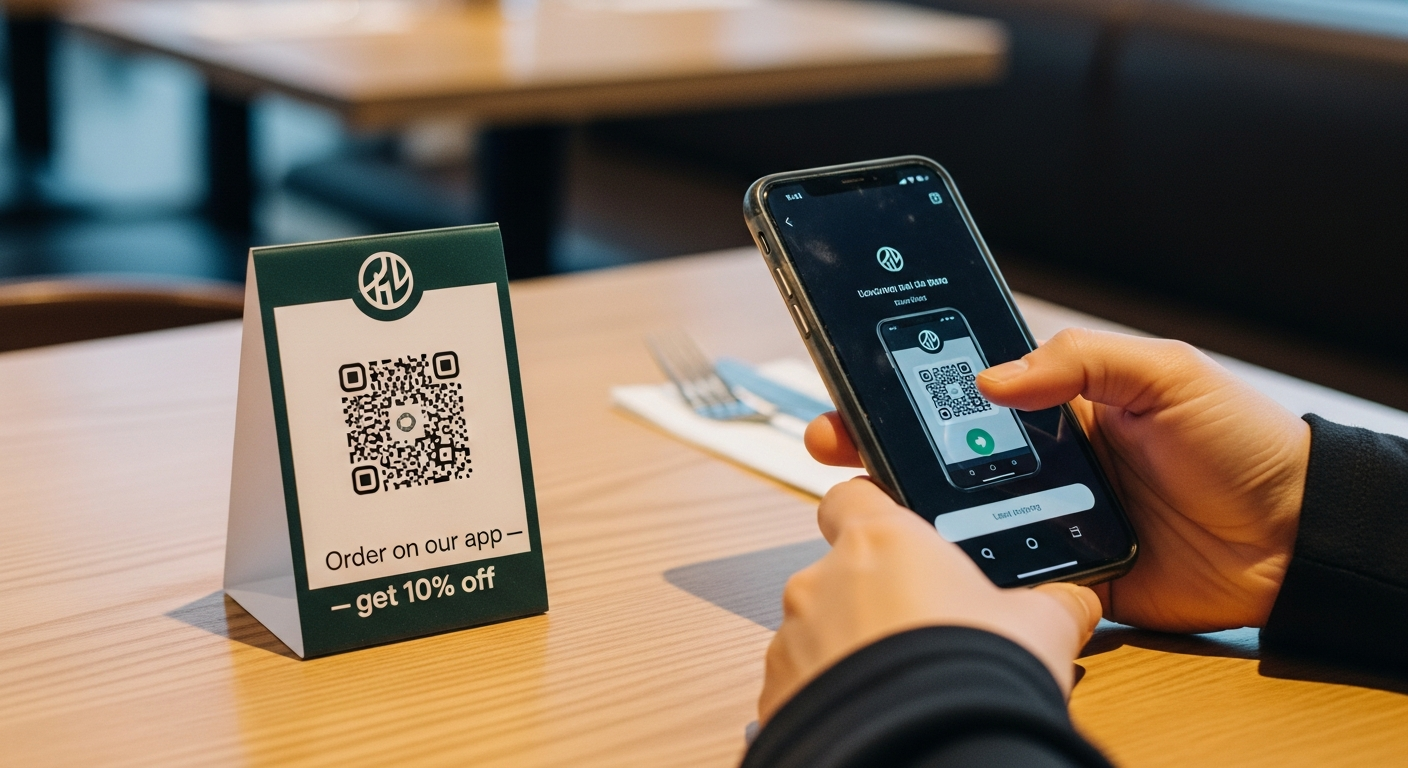
- QR codes on tables, receipts, and packaging convert at 15–25% scan-to-download (Bitly 2024 QR Code Trends Report).
- In-store verbal prompts ("Download our app for 10% off your next order") convert at 20–35% (Incentivio 2024).
- Cost to acquire a direct app user via in-store methods: $2–$5, versus $8–$15 through paid social ads (Popmenu 2024).
- Download-to-first-order conversion within 7 days: 45–55% (Incentivio 2024 Restaurant App Performance Report).
Your existing foot traffic is your best acquisition channel. Every dine-in guest, every takeout bag, every receipt is a chance to convert a one-time visitor into a repeat app user.
Slutty Vegan in Atlanta did exactly this. After launching their branded app and loyalty program, over 60% of digital orders shifted to their owned channels. Average order value on their app was $28 versus $22 on third-party platforms — a 27% increase. Loyalty members now account for over 40% of total revenue (QSR Magazine, 2024).
The Red Flags: What to Avoid When Evaluating Platforms
As you research how to choose a restaurant app without commission in 2026, watch for these warning signs:
- "Low commission" instead of zero commission. Even 5–10% adds up fast. Demand flat-fee pricing.
- No native app — just a web link. Web ordering is a start, but it doesn't give you push notifications or the retention of a home-screen icon.
- Loyalty as a paid add-on. If the platform charges extra for the feature that drives the most ROI, their incentives aren't aligned with yours.
- No automation. Manual marketing is marketing that doesn't happen. You need set-it-and-forget-it flows.
- You build it yourself. If the platform requires you to configure menus, design screens, and set up integrations, you'll burn hours you don't have. Look for done-for-you.
- They keep your data. If you can't export your customer list, you don't own it. Period.
As Meredith Sandland, former Chief Digital Officer at Yum! Brands and co-author of Delivering the Digital Restaurant, warns:
"The commission model of third-party delivery is fundamentally broken for restaurants operating on thin margins. The math doesn't work at 25–30% commission when your food cost is already 28–32%. Restaurants need to think of their own app not as a technology expense but as a margin-protection strategy."
Your Checklist: Choosing the Right Zero-Commission App in 2026
Before you sign with any platform, confirm these eight items:
- ✅ Flat monthly fee — no percentage of sales, ever
- ✅ Native branded mobile app (iOS + Android)
- ✅ Built-in loyalty program included in the base price
- ✅ Push notifications with targeting and scheduling
- ✅ Marketing automation: birthday, win-back, welcome flows
- ✅ Smart upsell prompts in the ordering flow
- ✅ Done-for-you setup — they build it, you approve it
- ✅ You own your customer data, fully exportable
If a platform checks all eight boxes, you're looking at a tool that doesn't just save you commission — it actively grows your revenue.
Black Box Intelligence Q4 2024 data backs this up: restaurants with strong digital direct-ordering programs experienced same-store sales growth 3–5 percentage points higher than those without. SevenRooms' 2024 data showed a 30% increase in guest return visits within 90 days for restaurants using their own CRM and direct channels.
This isn't about replacing delivery. It's about keeping the revenue you've already earned.
See What a Zero-Commission App Looks Like for Your Restaurant
Menuro builds done-for-you branded mobile apps for independent restaurants — with direct ordering, loyalty programs, push notifications, and marketing automation baked in. No commissions. No percentage of sales. No tech skills required.
We handle everything: app design, menu setup, loyalty configuration, automation flows, and App Store submission. You focus on the food. We build the system that brings customers back.
If you're ready to stop paying $150,000 a year to platforms that don't even share your customers' email addresses, let's talk.
👉 Book a free demo at menuro.io/demo and see exactly how it works for your restaurant.