
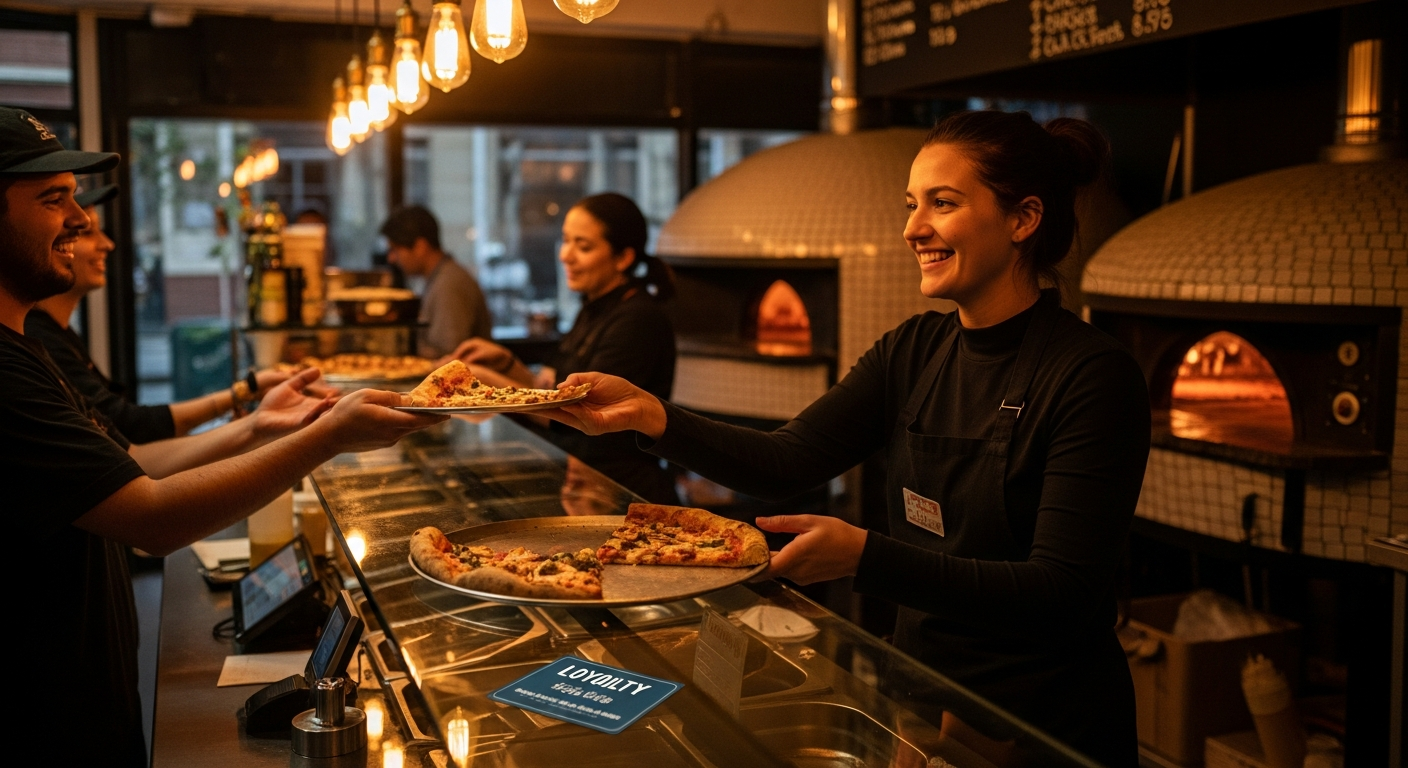
It's a Tuesday afternoon. A guy in a hard hat walks in, drops $9 on two slices and a fountain drink, and walks out. You don't know his name. You don't have his number. You'll probably never see him again.
Now multiply that by fifty. That's your Tuesday. That's most pizza shops' every day.
Here's the thing: that hard-hat guy eats pizza roughly 40 times a year, according to USDA dietary data widely cited by PMQ Pizza Magazine. He's spending that money somewhere every single week. The question is whether he's spending it with you — or the shop closer to his next job site, or worse, DoorDash pulling up Domino's.
This post is about how pizza shops can turn slice buyers into weekly regulars — not with gimmicks, but with systems. Real data, real case studies from shops that cracked this, and a clear playbook you can start running this week.
Because the math is staggering. According to PMQ Pizza Magazine's 2024 Pizza Industry Census, the average independent pizzeria customer visits about 2.5 times per month. But converting a once-a-month slice buyer into a weekly regular represents a 4× increase in annual revenue per customer — from roughly $520/year to over $2,080/year when you factor in the natural upsell from a solo slice to a weekly family order.
That's not a rounding error. That's the difference between surviving and thriving.
The $2,080 Question: Why Slice Buyers Are Your Biggest Untapped Asset
Let's start with the uncomfortable truth. According to Thanx's 2024 Restaurant Retention Benchmark Report, 60% of restaurant customers who visit once never come back. Six out of ten people who walk through your door, enjoy your pizza, and leave — gone forever.
But here's the flip side, and this is where it gets interesting: among those who do come back a second time, the probability of a third visit jumps to 70%. Andrew Robbins, CEO of Paytronix, put it bluntly in a 2024 webinar on pizza loyalty: "The key inflection point is the third visit. If you can get a customer to come back a third time within 30 days of their first visit, you have a 70% chance of turning them into a long-term regular."
So the game isn't about getting thousands of new customers. It's about engineering that second and third visit from the people already buying your slices.
And the economics back this up at every level. Acquiring a new restaurant customer costs 5–7× more than retaining an existing one, per Paytronix's 2024 Loyalty Report. Retained customers spend 67% more than new ones. And Bain & Company's foundational research — still cited in the NRA's 2025 State of the Restaurant Industry report — shows that a 5% increase in customer retention can boost profits by 25–95%.
Domino's knows this. Their 2024 annual report (SEC filing) revealed that their top 20% of loyal customers account for approximately 60% of total revenue. That Pareto distribution isn't unique to Domino's. It's the pattern across the entire pizza industry. The question is whether you're actively building that top 20%, or just hoping they show up.
Step One: Capture the Contact (Before They Walk Out the Door)
You can't turn a slice buyer into a regular if you don't know who they are. Every slice sold without collecting an email or phone number is a dead end.
Ilir Sela, founder and CEO of Slice, said it plainly in a 2024 Nation's Restaurant News interview: "Every slice sold without collecting an email or phone number is a missed opportunity to build a relationship. Our data shows that a single reorder prompt sent 5 days after a first purchase increases the likelihood of a second order by 40%."
Forty percent. From one automated text.
The capture mechanism matters. According to Square's 2024 Future of Restaurants report, actively promoting enrollment at the POS yields a 22–30% sign-up rate, compared to a pathetic 5–8% when it's passive. That means your counter staff needs a one-liner: "Want to earn a free slice? I just need your phone number."
Benny Pennello's — a late-night giant-slice chain across Ohio and North Carolina — built their "Slice Insider" email list to 11,000+ subscribers across 4 locations in just 8 months using Toast's marketing suite, capturing contacts directly from POS transactions. Email-driven revenue ended up accounting for 14% of their total monthly sales — roughly $22,000/month across locations.
That's not a side project. That's a revenue channel.
How Pizza Shops Can Turn Slice Buyers Into Weekly Regulars With Loyalty Programs
Once you have the contact, you need a reason for them to come back. And loyalty programs are the single most proven tool in the pizza segment.
The numbers from Paytronix's 2024 Annual Loyalty Report are hard to argue with: loyalty program members visit 35% more frequently and spend 15–20% more per visit than non-members. The average pizza loyalty program sees a 48–55% redemption rate — significantly higher than the QSR average of 40%, because pizza is habitual. People already want to come back. You just have to give them a nudge.
And yet, according to Toast's 2024 data, only 47% of independent restaurants have any form of loyalty program, compared to 80%+ of chains. That's a competitive gap you can close overnight.
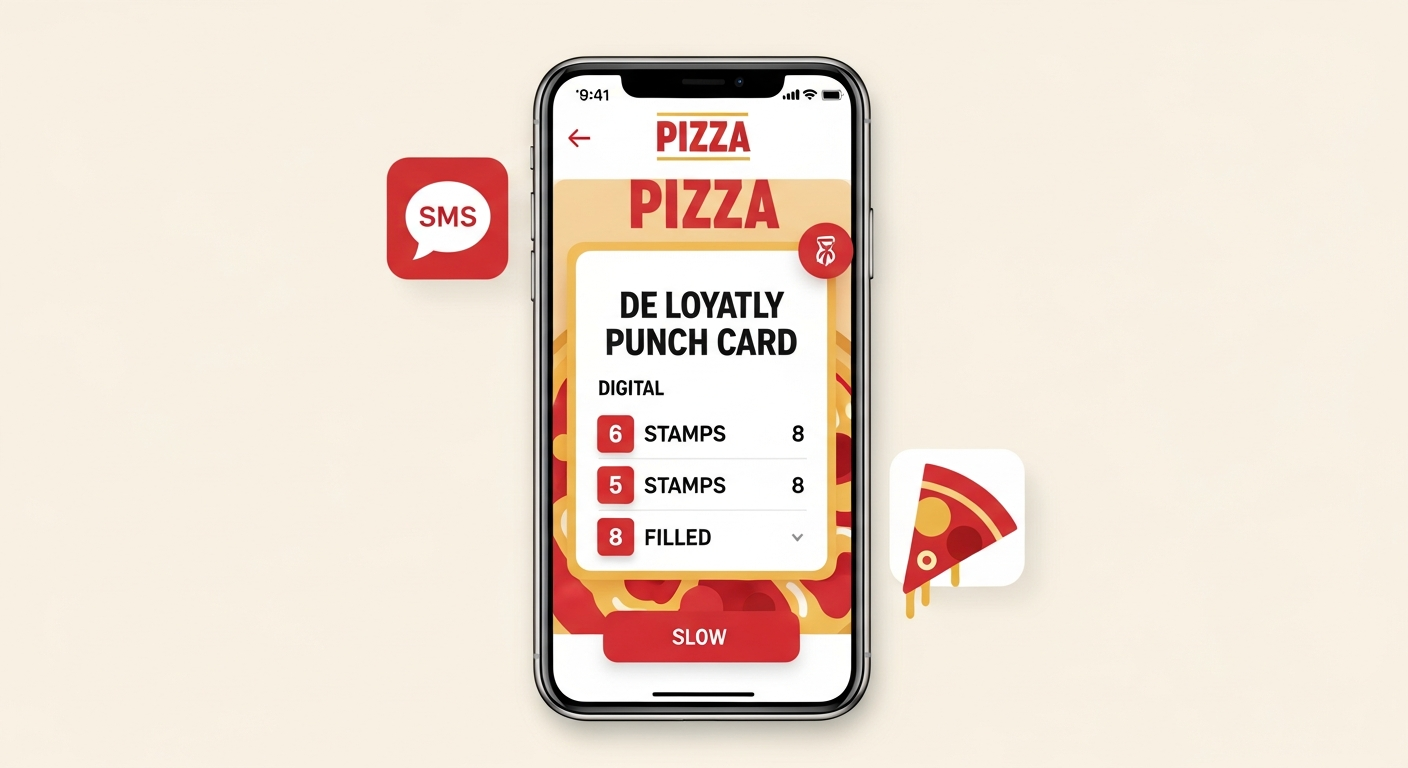
The format matters too. Toast's 2024 benchmarks show that simple punch-card-style programs see a 58–65% redemption rate — higher than points-based systems — because they're dead simple. Buy 8 slices, get one free. No math. No confusion.
Screener's Pizzeria in Brooklyn proved this out. They implemented a digital punch card through Square Loyalty in 2023 — every 8th slice free, combined with weekly SMS blasts featuring a "Slice of the Week" special. Within 6 months, repeat customer visits increased 28%, average visit frequency climbed from 1.8 to 2.6 times per month, and they enrolled 3,200 loyalty members from a single location. Their SMS open rates? 94%, with a 22% redemption rate on weekly specials.
Benny Pennello's saw similar lift: customers enrolled in their digital punch card visited 2.2× more frequently than non-enrolled customers, and their average check was $14.80 vs. $9.20 for non-members — a 61% increase.
That check size jump is critical. You're not just getting more visits — you're getting bigger visits. The slice buyer becomes the whole-pie buyer.
The Automation Layer: SMS, Push, and Win-Back Campaigns
Loyalty programs get people in the door. Automation keeps them coming back without you lifting a finger.
SMS is the nuclear option for pizza shops, and the data explains why. According to Popmenu's 2024 Restaurant Marketing Trends report and SlickText industry data, SMS open rates hit 98%, with 90% of messages read within 3 minutes. Response rates average 45%, compared to just 6% for email.
Popmenu's 2024 data also shows that restaurants using combined email and SMS automation see an average revenue increase of $8,000/month per location — with pizza concepts reporting even higher lifts due to the high-frequency, low-friction nature of pizza ordering.
But the real power is in the automated sequences, not one-off blasts. Three campaigns every pizza shop should be running:
1. The Reorder Prompt (Day 5–7 after first purchase)
Slice's platform data showed a 40% increase in second-order likelihood from a single well-timed reorder prompt. No coupon needed — just a reminder: "Hey, your favorite slice is waiting."
2. The Win-Back Campaign (30+ days since last visit)
Emmy Squared, the Nashville-based (and multi-location) pizza concept, used SevenRooms' CRM to segment lapsed customers and send targeted win-back offers. Their win-back campaigns achieved a 19% return rate — nearly 1 in 5 lapsed customers came back within 2 weeks. Across all locations, their overall repeat visit rate improved from 31% to 44% over 12 months.
3. The VIP Nurture (for your top spenders)
Emmy Squared's VIP guests who received personalized offers increased their monthly spend by 22%. These are the customers already in your top 20%. Treat them like it.
From Slice to Subscription: The Predictable Revenue Play
Here's where things get really interesting. Some pizza shops are skipping the "hope they come back" phase entirely and locking in weekly visits with subscription models.
Timber Pizza Co. in Washington, D.C. launched a "Pizza Club" — $49/month for one large pizza per week. Within 4 months, they had roughly 285 subscribers generating $14,000/month in predictable recurring revenue.
But the real story is the add-on spend. Subscribers visited 3.8 times per month and spent an average of $67/month — 37% above the subscription price — on drinks, appetizers, and desserts. As restaurant consultant Emily Plotkin told Eater in 2024: "Pizza subscriptions are the sleeper hit of 2024. The unit economics are incredible... I've seen pizza shops where subscribers spend 30–40% above their subscription price every month on extras. It's the gym membership model, except people actually use it."
And subscriber churn? Only 8% per month at Timber Pizza — well below the restaurant subscription average of 12–15%.
Go Direct or Go Home: Why Your Own App Changes Everything
All of these strategies — loyalty, SMS, subscriptions, win-back campaigns — depend on one thing: owning the customer relationship. And that means getting off third-party platforms.
The data is unambiguous. According to Olo's 2024 State of Digital Ordering report, branded/direct ordering retains 41% of customers after 90 days, compared to just 19% for third-party apps (per McKinsey's 2024 "Ordering In" report). Your own ordering channel isn't just cheaper (no 30% commissions) — it's stickier.
And digital customers are worth dramatically more. Aman Narang, President and COO of Toast, stated at their 2024 Spark Conference: "The average digital customer is worth 2.4× more annually than a walk-in-only customer."
Olo's data confirms this for pizza specifically: average online pickup orders hit $27.40, compared to $8.50–$12.00 for walk-in slice purchases. That's a 2–3× check size increase just from moving the order to a digital channel.
Paul Gee's — the beloved Brooklyn-born pizza brand — found that customers who engaged through their digital channels visited 40% more often than those who didn't. Their flagship location reported that "regulars" (2+ visits/month) accounted for 55% of total revenue.
And when you have your own branded app, push notifications become another weapon. Industry data from CleverTap shows restaurant app push notifications see 28–35% open rates — not as high as SMS, but free to send and perfect for daily specials, loyalty reminders, and limited-time offers.
The Playbook: How Pizza Shops Can Turn Slice Buyers Into Weekly Regulars This Month
Let's make this concrete. Here's the sequence:
Capture every contact at the counter. Train your staff. Offer a free slice incentive. Aim for that 22–30% enrollment rate that Square's data says is achievable with active promotion.
Launch a simple digital loyalty program. Punch-card style. Buy 8, get 1 free. Expect 58–65% redemption rates and a 35% increase in visit frequency based on Paytronix and Toast benchmarks.
Automate three SMS/push campaigns: the Day 5 reorder prompt, the 30-day win-back, and monthly VIP offers. With 98% SMS open rates and 45% response rates, this is the highest-ROI marketing channel available to you.
Move ordering to your own branded app. Cut the 30% third-party fees, retain 2× more customers after 90 days, and watch average check sizes climb from $10 to $28+.
Consider a subscription tier once you have traction. Even 100 subscribers at $49/month is nearly $5,000 in predictable monthly revenue — before add-on purchases.
The average Paytronix benchmark shows loyalty members churn at 28% annually vs. 67% for non-members. That single stat should tell you everything about where to invest your energy.
Ready to Turn Your Slice Buyers Into Weekly Regulars?
Menuro builds done-for-you branded mobile apps for independent pizza shops — with built-in loyalty programs, SMS and push notification automation, direct ordering (zero commissions), birthday campaigns, and win-back sequences. We handle everything. No tech skills needed. No monthly headaches.
You focus on making great pizza. We'll make sure the people who try it keep coming back.
Book a free demo at menuro.io/demo and see exactly how we'd set this up for your shop.