
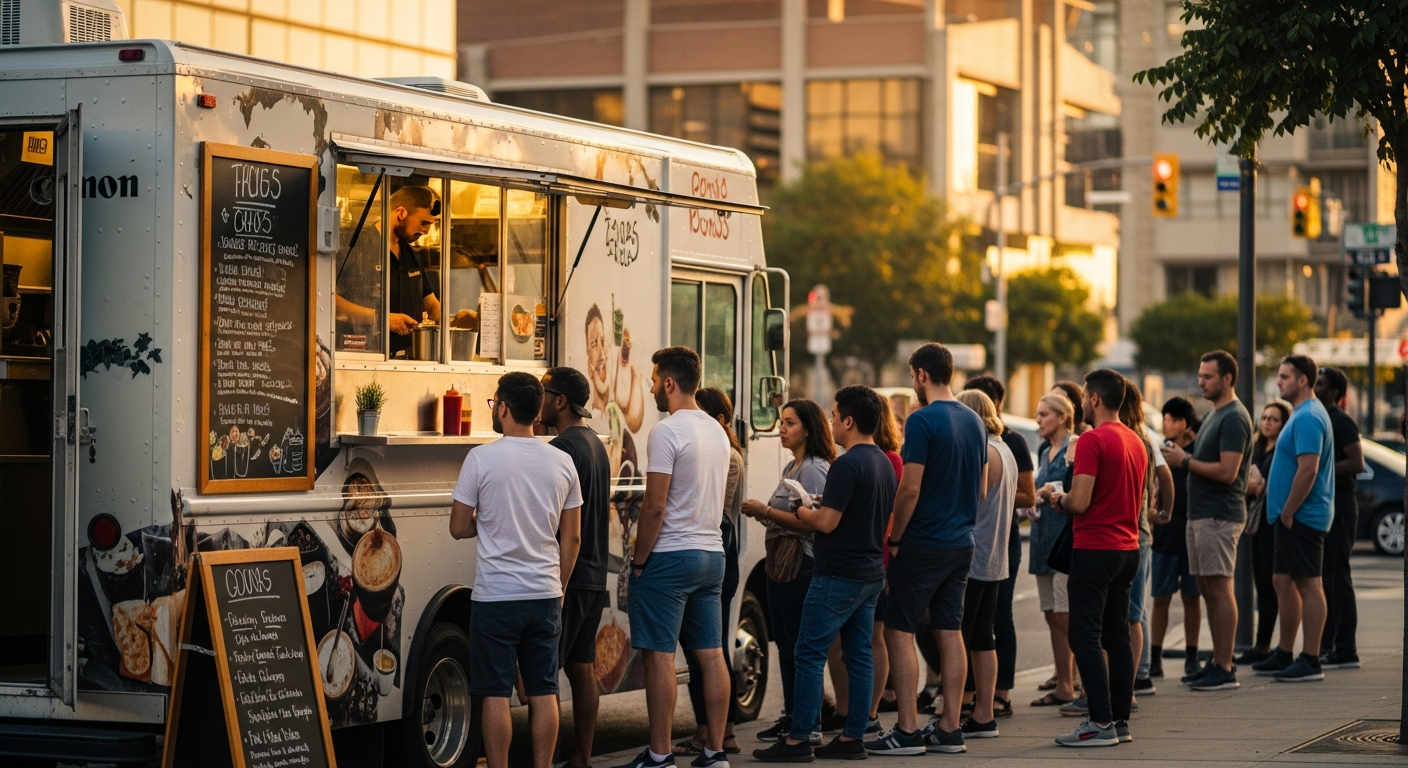
It's 11:47 a.m. on a Tuesday. You're parked at the corner of 5th and Elm, the grill is hot, and the smells are pulling people in off the sidewalk. By 1:15, you've served 87 customers and cleared $1,100. A great lunch rush.
But here's the problem: how many of those 87 people will find you again on Thursday when you're parked three miles away at the office park? How many even remember your truck's name by Friday?
If you're like most food truck operators, the answer is brutal. CHD Expert's 2024 Foodservice Trends report estimates that 60–70% of first-time food truck customers never return to the same truck — largely because they simply can't find you again. You don't have a storefront with a sign on Main Street. You don't have a fixed address in Google Maps. You're a moving target, and most of your best customers are losing you.
This is the central challenge of the food truck business model, and it's why learning how food trucks can build a repeat customer base without a storefront isn't a nice-to-have — it's the difference between surviving and shutting down. IBISWorld reports that roughly 60% of food trucks fail within the first three years. The trucks that make it are the ones that crack the retention code.
Let's break down exactly how they do it — with real numbers, real operators, and strategies you can start this week.
The Math That Changes Everything: Why Retention Beats Acquisition for Food Trucks
Before we get tactical, let's talk about why retention deserves more of your energy than chasing new customers.
A frequently cited Harvard Business Review analysis, updated in a 2024 HBR.org article on restaurant economics, puts it plainly: acquiring a new customer costs 5–7x more than retaining an existing one. Bain & Company data, cited in the National Restaurant Association's 2024 State of the Industry report, goes further — a 5% increase in customer retention produces a 25–95% increase in profits.
Now apply that to a food truck. According to Toast's 2024 data, the average food truck ticket is $12.30. The average customer without any retention strategy visits the same truck 1.3 times per month, per CHD Expert. But with a loyalty program or consistent communication strategy, that frequency jumps to 2.8–3.5 times per month, according to Square and Paytronix 2024 data.
Let's do the math on just 200 customers:
- Without retention: 200 × 1.3 visits × $12.30 = $3,198/month
- With retention: 200 × 3.2 visits × $14.50 (loyalty member average) = $9,280/month
That's nearly 3x the monthly revenue from the same customer base. You don't need more people. You need the people you already have to come back.
Build Your Digital Storefront: Because Your Instagram Feed IS Your Location
Roy Choi, the chef behind Kogi BBQ in Los Angeles — the truck widely credited with launching the modern food truck movement — put it best in a 2024 Eater LA interview: "The truck is the restaurant. Social media is the dining room. If you're not telling people where you are every single day, you don't exist."
Kogi still generates 60–70% of its daily revenue from repeat customers who track the truck via social media. On peak days, a single Kogi truck clears $8,000+ in revenue, driven almost entirely by a loyal following that plans their week around the truck's posted schedule.
The data backs this up across the industry. Popmenu's 2024 Consumer Trends Report found that 77% of diners check a food vendor's online presence before deciding to visit, and 67% have been turned off by an outdated or inactive page. For food trucks without a fixed address, this digital presence isn't supplementary — it's existential.
Sprout Social's 2024 Food & Beverage Industry Report found that food brands posting 5+ times per week on Instagram see 3.1x more engagement than those posting fewer than 3 times. And TikTok's 2024 Trend Report confirmed that food content is the #1 most-engaged category on the platform, with HubSpot's 2024 State of Marketing Report showing short-form video delivers the highest ROI of any content format.
Kevin Tan, CEO of Popmenu, summed it up: "If you're not in someone's feed, you're invisible."
What to do this week: Post your location every single day you operate. Use Instagram Stories with a location sticker. Pin your weekly schedule to the top of your profile. Post a 15-second Reel of food hitting the grill — the algorithm will reward you.
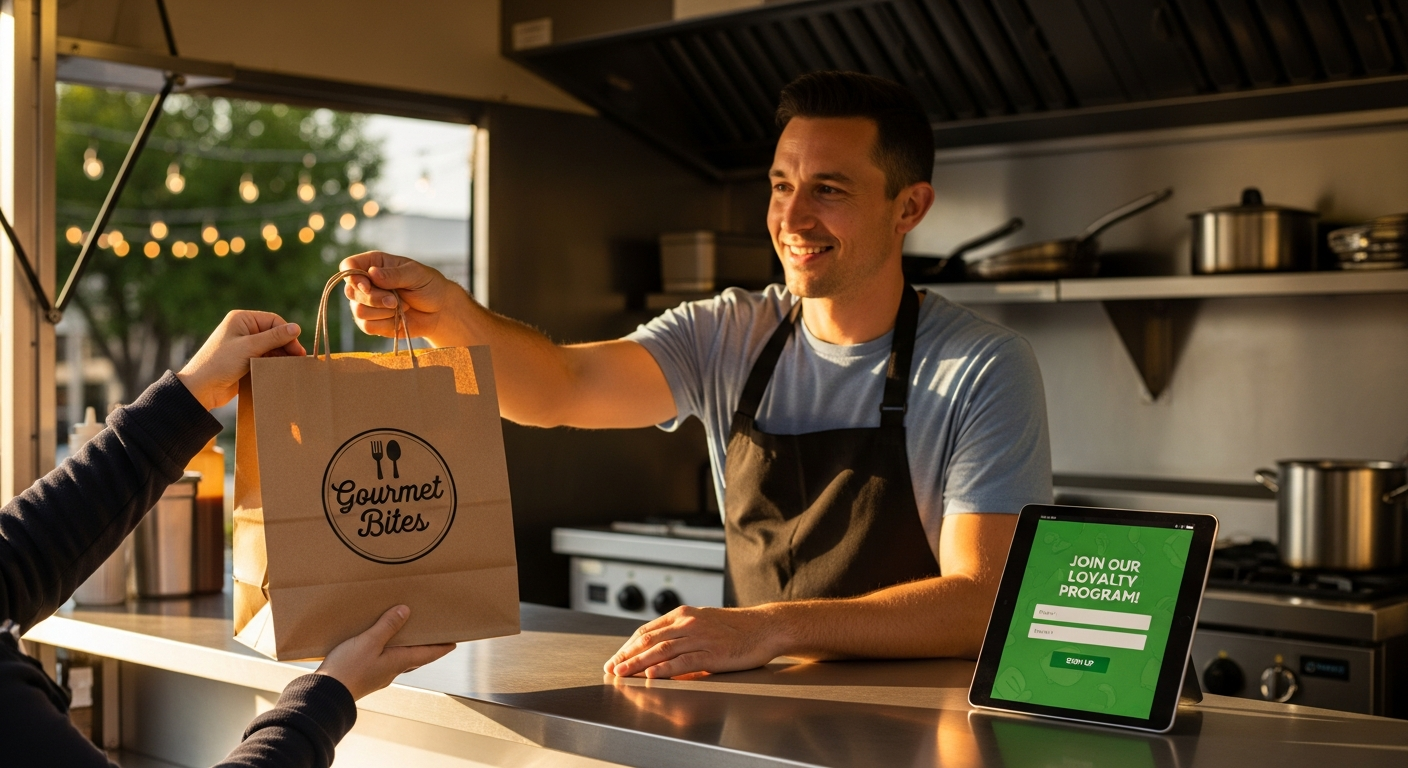
How Food Trucks Can Build a Repeat Customer Base Without a Storefront Using Loyalty Programs
If social media is how people find you, a loyalty program is how they remember you.
Square's 2024 Future of Commerce report found that food trucks using Square Loyalty saw a 35% increase in repeat customer visits within the first six months. Paytronix's 2024 Annual Loyalty Report found that loyalty program members visit 37% more frequently and spend 27% more per visit than non-members.
Marcus Johnson, owner of Wicked 'Wich, a sandwich truck in Austin, implemented Square Loyalty in early 2023. Within 12 months, he told the Austin Business Journal that loyalty members represented 48% of all transactions with an average visit frequency of 3.2 times per month versus 1.1 for non-members. Average ticket for loyalty members: $16.20 vs. $12.40 for walk-ups — a 31% lift.
Johnson credited the combination of a fixed weekly schedule at three farmers markets plus the digital loyalty program as the "one-two punch" for retention.
The Halal Guys tell an even more dramatic story. Starting as a single food cart in Manhattan, they launched a mobile app with an integrated loyalty program in 2022. By 2024, QSR Magazine reported that app users visited 2.8x more frequently than non-app customers. Their loyalty program enrolled over 500,000 members, and loyalty member average check was $14.50 vs. $10.80 — a 34% lift.
Matt Geller, CEO of the National Food Truck Association, put it directly in a 2024 Nation's Restaurant News interview: "The food trucks that survive past year two are the ones that treat every customer interaction as a chance to build a database. Get the email. Get the phone number. Get the follow. That's your storefront — it's just digital."
The Pre-Order Pipeline: Sell Out Before You Open the Window
One of the most powerful retention strategies doubles as an operational game-changer: pre-ordering.
Olo's 2024 data shows that digital ordering — including pre-ordering for pickup — increases average check size by 12–22% compared to in-person ordering. Toast reports that restaurants offering online ordering see average ticket sizes 20% higher than walk-up orders.
Paloma Lara, who runs Ms. P's Electric Cock, a single food truck in Portland, built a following of 28,000+ Instagram followers and implemented pre-ordering through a simple Google Form linked in her Instagram Stories. According to a 2024 Portland Monthly profile, 40% of her daily orders were pre-sold before the truck even opened its window.
Lara told Eater Portland: "Pre-orders changed everything. I know exactly how much to prep, I waste almost nothing, and my regulars feel like they have a VIP reservation at a truck." She reported a 30% reduction in food waste and a 25% increase in revenue after implementing the system.
Sterling Douglass, CEO of Chowly, confirmed the trend in a Q1 2024 RestaurantDive interview: "The food trucks we see thriving in 2024 are the ones that have built a pre-order pipeline. They're selling 30–50% of their daily inventory before they even fire up the grill."
Pre-ordering does three things at once: it locks in revenue, reduces waste, and — critically — turns a casual customer into someone who's actively planning their day around your truck. That's retention.
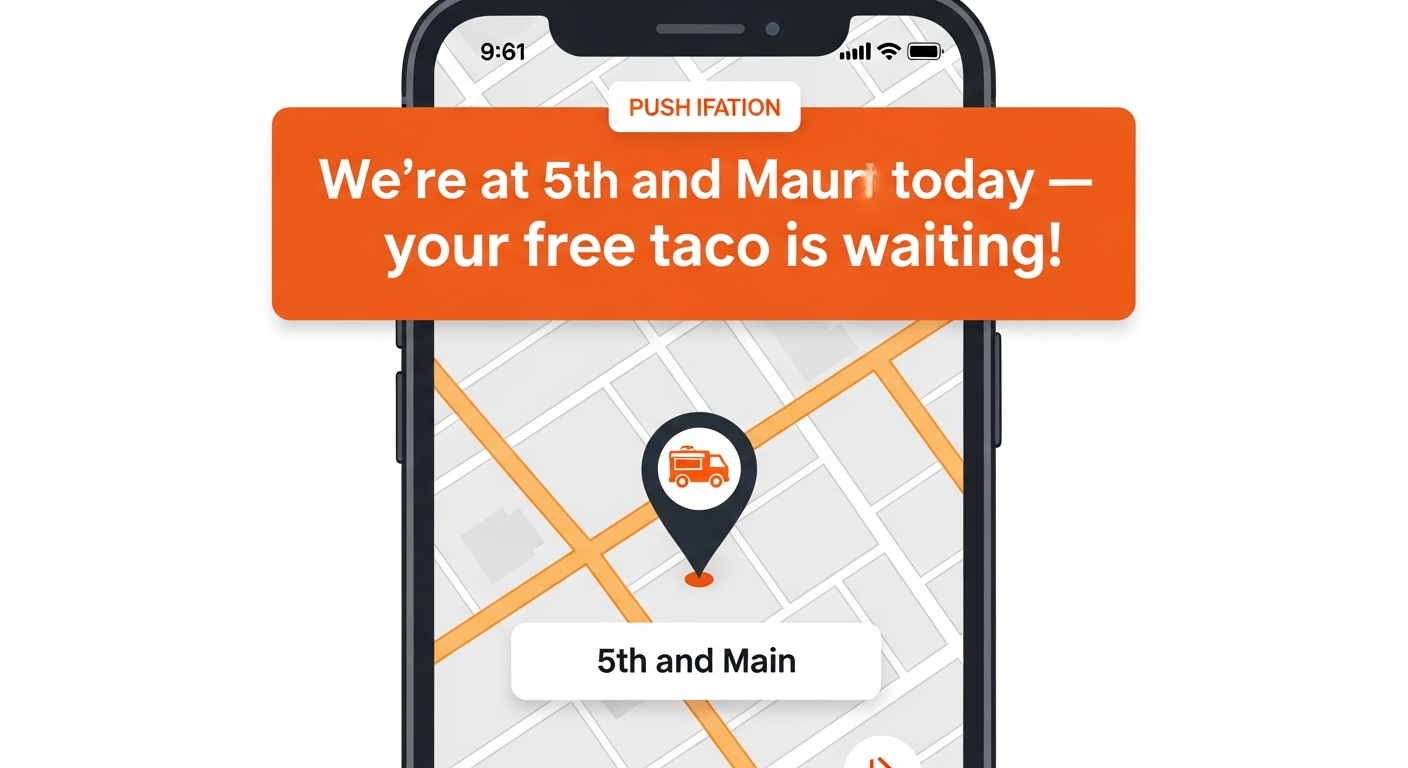
SMS and Push Notifications: The $13.40-Per-Message Channel
For food trucks, timing is everything. Your customers need to know where you are today, not next week. That's why SMS and push notifications are disproportionately powerful for mobile food businesses.
Toast's 2024 data reports that SMS marketing campaigns for restaurants achieve an average open rate of 98% and a click-through rate of 36%. Compare that to email's average open rate of 20% and CTR of 2.5%. Square's 2024 data puts the ROI even more concretely: food and beverage businesses using automated campaigns see an average return of $13.40 per text message sent.
David "Rev" Ciancio, a restaurant marketing consultant, nailed the food truck advantage on the Restaurant Unstoppable Podcast in 2024: "Food trucks have a massive advantage that most don't exploit: scarcity. You're not always available, and that creates urgency. Pair that with a text message saying 'We're at 5th and Main today only' and you've got a marketing weapon that Applebee's would kill for."
Cousins Maine Lobster, which operates 40+ franchise trucks nationwide with over $30M in annual systemwide revenue (per Franchise Times), uses a centralized app with GPS truck tracking and push notifications. CEO Sabin Lomac told Forbes in 2024 that their push notifications about truck locations have a 22% open rate — four times the industry average of 5.5% for food and drink apps, per Airship's 2024 Mobile Benchmark Report. Loyalty members account for 45% of total transactions across all trucks.
Lomac said: "We learned early that a food truck without a communication strategy is just a random encounter. Our app and push notifications turned random encounters into weekly habits. That's the difference between a $500 day and a $5,000 day."
The Predictability Play: Consistency Is a Retention Tool
Not every retention strategy requires technology. Sometimes showing up at the same place, same time, same day is enough.
Tacos El Gordo, operating in Las Vegas and San Diego, maintains a 4.5-star average across 10,000+ Yelp reviews. A 2023 UNLV Hospitality College case study found that their consistent scheduling — same locations, same days, same times — resulted in customer return rates of 72% within 30 days, far above the food truck industry average.
Yelp's 2024 Economic Impact Report confirms the broader principle: food trucks with complete Yelp profiles (photos, hours, updated location info) receive 2.5x more customer leads than those with incomplete profiles.
The lesson: predictability reduces the friction that causes food truck churn. If your customers always know where you'll be on Wednesdays, they don't need to check your Instagram. They just show up.
Don't Forget Catering: The Highest-LTV Customer You're Ignoring
Erica Cohen, owner of Baby's Badass Burgers in Los Angeles, collects email addresses at every event using a tablet-based signup offering a free side with the next purchase. Her email list grew to 12,000+ subscribers by mid-2024, and her email campaigns announcing weekly locations achieve a 32% open rate and 8% click-through rate.
But here's the kicker: Cohen told Food Truck Operator magazine that catering inquiries generated through email marketing account for 35% of her annual revenue. She called it "the most underrated food truck revenue stream."
ezCater's 2024 Catering Industry Report backs this up: catering orders average $400–$600 per order for food trucks, compared to $10–$15 for walk-up orders. Repeat catering clients book an average of 4.2 times per year. That single corporate client who books you for monthly team lunches is worth more than 150 walk-up customers.
Every email you collect, every phone number you capture — that's a potential catering lead sitting in your database.
The Full Playbook: How Food Trucks Can Build a Repeat Customer Base Without a Storefront
Let's bring it all together. Here's your retention stack, ranked by impact and ease of implementation:
- Post your location daily on Instagram and any other active social channel. Consistency of communication replaces consistency of location.
- Build a contact list from day one. Email, SMS, or both. Offer a free item for signing up. This is your digital storefront.
- Implement a simple loyalty program. Even a basic punch-card system increases visit frequency by 37% and spend by 27%, per Paytronix.
- Launch pre-ordering. Start with a Google Form if you have to. Sell 30–50% of your inventory before you open the window.
- Send SMS on operating days. At $13.40 average return per text (Square 2024), this is the highest-ROI channel available to you.
- Keep a predictable schedule. Same spots, same days. Let people build you into their routine.
- Actively market catering. One catering client equals 40+ walk-up customers in revenue.
Emily Elyse Miller, food industry analyst, summarized it at the 2024 National Restaurant Association Show: "Food trucks that invest in even basic CRM — a simple email list and a consistent posting schedule — see 2–3x the repeat visit rate of those that don't. It's not about fancy tech. It's about showing up digitally the way you show up physically."
Ready to Turn Random Encounters Into Weekly Regulars?
You don't need a storefront to build a loyal customer base. You need a system — one that captures customer data, communicates your location automatically, rewards repeat visits, and lets people order before they even see your truck.
That's exactly what Menuro builds for food vendors like you. A branded mobile app with built-in loyalty, SMS automation, push notifications with your location, and direct ordering with zero commissions. We handle all the setup. You handle the food.
Book a free demo at menuro.io/demo and see how Menuro can turn your food truck into a retention machine — no storefront required.