
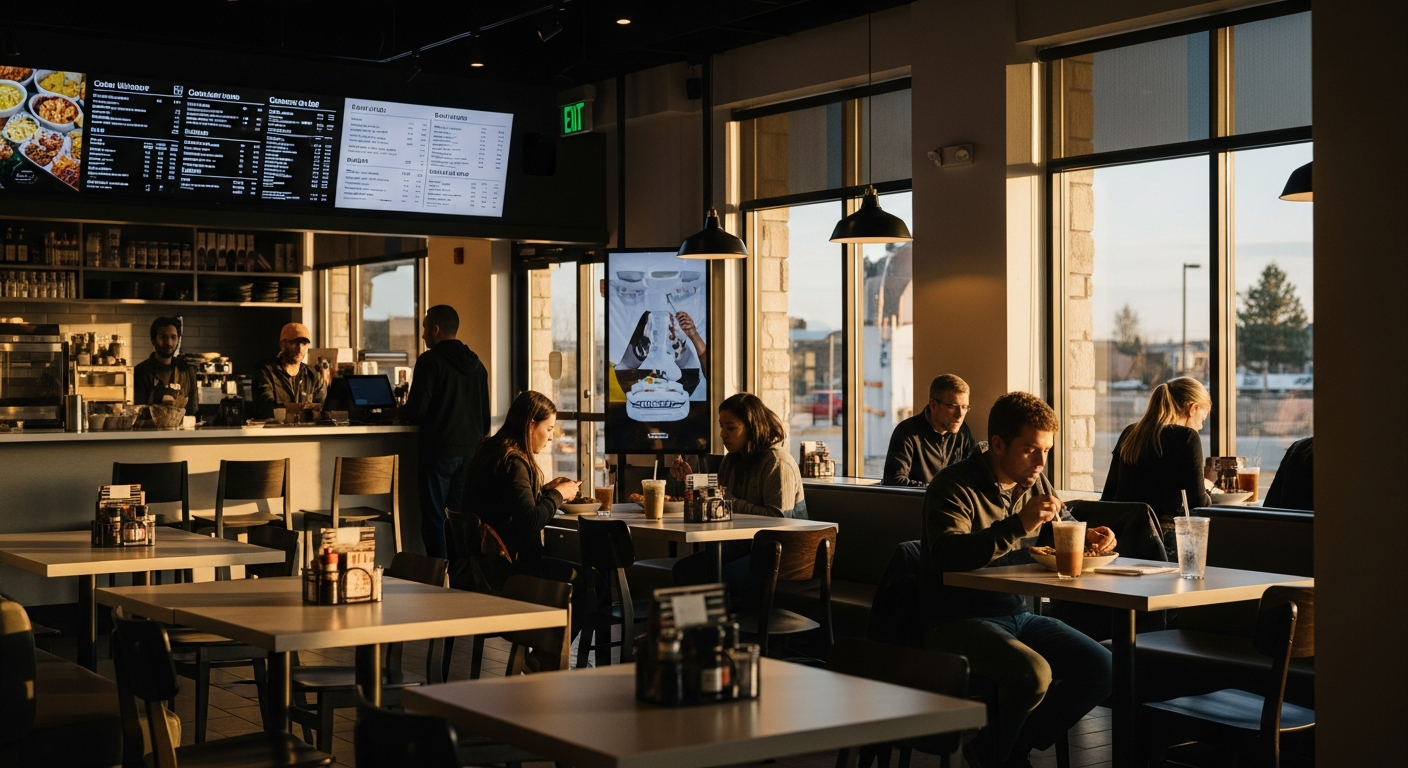
It's 2:37 PM on a Tuesday. Your lunch crew just clocked out, but your closer won't arrive for another two hours. There are three people in the dining room — one nursing a water, two staring at laptops. Your POS screen looks like a flatline. The rent doesn't pause between 2 and 5 PM. Neither does the AC. Neither does the lease on that espresso machine.
If this scene feels familiar, you're not alone. How fast-casual restaurants can fill the 2–5 PM dead zone is one of the most searched operational questions in the industry right now — and for good reason. According to Toast's 2024 Restaurant Trends Report, the average fast-casual restaurant sees a 40–60% drop in transaction volume between 2:00 PM and 5:00 PM compared to the lunch rush. For a restaurant doing $3,500 in lunch revenue, that dead zone often generates only $800–$1,200 across three full hours. That means your labor costs are frequently exceeding revenue during this window.
But here's what most operators miss: the dead zone isn't a demand problem. It's a marketing problem. And the restaurants solving it are adding tens of thousands in annual revenue without a single new hire.
The Afternoon Opportunity Is Structural, Not Seasonal
Former National Restaurant Association CEO Dawn Sweeney put it bluntly in her 2024 NRA Show keynote: "The three-meal-a-day construct is a 20th-century artifact. Today's consumer eats 4.4 times per day on average. Restaurants that cling to the lunch-and-dinner model are leaving 20–30% of potential revenue on the table."
The data backs her up. Technomic's 2024 Snacking Occasion Consumer Trend Report found that the afternoon snack is now the fastest-growing eating occasion in the U.S., with 64% of consumers snacking at least once between meals daily. Nearly half — 48% — said they'd choose a restaurant snack over a packaged one if it were convenient and affordable. And Popmenu's 2024 consumer survey found that 67% of diners would visit a restaurant during off-peak hours if offered a specific incentive.
The demand exists. It's just going to convenience stores, Starbucks drive-throughs, and vending machines because most fast-casual restaurants aren't even trying to capture it.
Aaron Allen, founder of the global restaurant consultancy Aaron Allen & Associates, quantified the upside in a 2024 analysis: "A 10% increase in afternoon transactions can translate to a 3–5% increase in total annual revenue with virtually no incremental fixed costs — it's almost pure margin."
Pure margin. Because the lights are already on. The staff is already there for shift overlap. The food is prepped. You're just not giving anyone a reason to walk through the door.
Build an Afternoon Menu That Earns Its Own Identity
The first mistake most restaurants make: they leave the full lunch menu up at 2:30 PM and wonder why nobody's ordering a $14 entrée bowl as a snack.
Square's 2024 Future of Restaurants Report found that afternoon transactions carry an average check size of $9.42 — 12% lower than the lunch average of $10.71. Technomic's data narrows it further: the average consumer spends $5.50–$8.00 on an afternoon snack occasion at a restaurant. This isn't a lunch customer. This is a different occasion entirely, and it needs a different menu.
The restaurants winning the afternoon have figured this out.
CAVA, the Mediterranean fast-casual chain, tested "Afternoon Bowls" — smaller, lower-priced bowls at $7.99 versus the standard $10.50+ — available only between 2:00 PM and 4:30 PM at select locations. CEO Brett Schulman reported in CAVA's Q3 2024 earnings call that early results showed a 17% increase in transaction counts during the test window without meaningful cannibalization of lunch sales. On an average unit volume of $2.6 million, even modest afternoon gains represent serious dollar impact.
Mendocino Farms, the premium sandwich chain in Southern California, launched an "Afternoon Reset" menu in mid-2024 — smaller portions, snack-sized salads, and specialty beverages priced between $5–$8. According to Fast Casual Magazine, test locations reported a 28% increase in afternoon transactions over 90 days.
And Olo's 2024 Digital Ordering Benchmark Report confirmed the principle at scale: restaurants offering a dedicated "snack" or "afternoon" menu on their digital ordering platforms saw 31% higher conversion rates during the 2–5 PM window compared to those displaying their full menu.
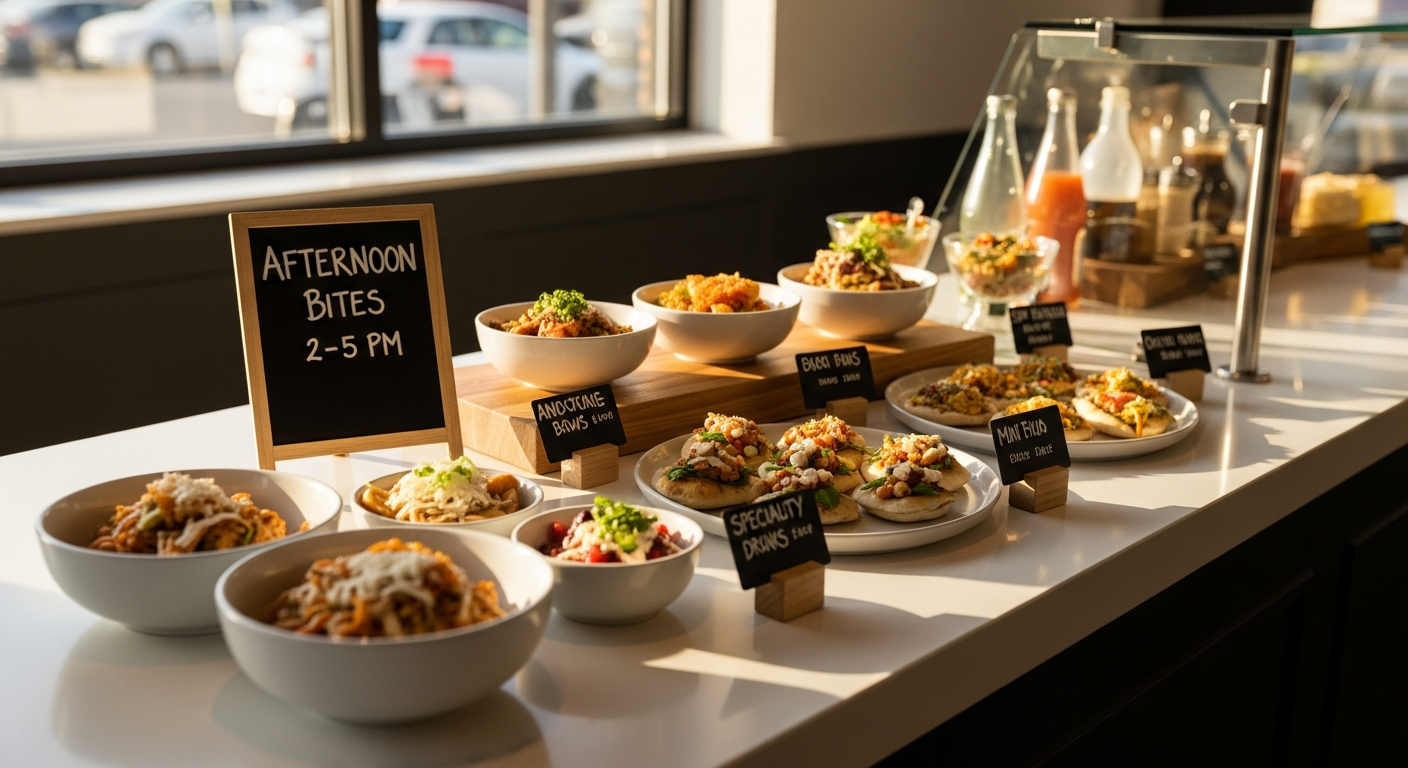
The lesson is clear: create a distinct afternoon identity. Give it a name. Give it a price point. Make it feel like a thing, not leftovers from lunch.
How Fast-Casual Restaurants Can Fill the 2–5 PM Dead Zone With Automated Marketing
A dedicated afternoon menu is necessary but not sufficient. You need a trigger — something that puts your restaurant in a customer's mind at 1:45 PM when they're starting to fade at their desk.
This is where marketing automation becomes the difference between a dead zone and a revenue zone.
Velvet Taco in Dallas uses push notifications sent through their app at 1:45 PM on weekdays to promote their Weekly Taco Feature during afternoon hours. The result: app users who receive the afternoon push notification visit 1.8x more frequently per month than those who don't engage with it. Their loyalty program, "The Velvet Room," has over 500,000 members, and afternoon-specific offers achieve a 16% redemption rate — well above industry averages.
McAlister's Deli took a similar approach with their "Tea Tuesday" promotion — free tea refills and discounted snack items between 2–5 PM, pushed through their loyalty platform. Paytronix case study data from 2024 showed the program drove a 13% increase in afternoon loyalty transactions and increased average afternoon check size by $1.40. Across 530+ locations, that modest per-transaction bump adds up to millions annually.
Emily Plotkin, VP of Marketing at Paytronix, explained the mechanics in their 2024 Annual Loyalty Report: "Time-gated offers — promotions that are only valid during a specific window — outperform open-ended offers by 3x in terms of redemption rate. For the afternoon daypart specifically, we see the highest engagement when the offer is sent 30–60 minutes before the target window and expires at the end of it. Urgency plus specificity is the formula."
The numbers confirm this across channels:
- Daypart-specific targeted offers achieve a 12–18% redemption rate, compared to just 3–5% for generic broadcast offers (Paytronix 2024)
- SMS messages with time-sensitive afternoon offers achieve an 11.2% click-through rate, versus 4.5% for non-time-sensitive messages (Klaviyo 2024)
- Emails sent between 10:00 AM and 11:30 AM promoting afternoon specials have the highest conversion rate for driving 2–5 PM visits (Klaviyo 2024)
This isn't complicated marketing. It's a push notification at the right time, to the right people, with the right offer. But it requires two things most independent fast-casual restaurants don't have: a direct communication channel to their customers (like an app), and automation that sends these messages without someone remembering to do it every day.
The Single-Unit Playbook: You Don't Need 500 Locations
The chain examples are instructive, but let's talk about what this looks like for an independent operator.
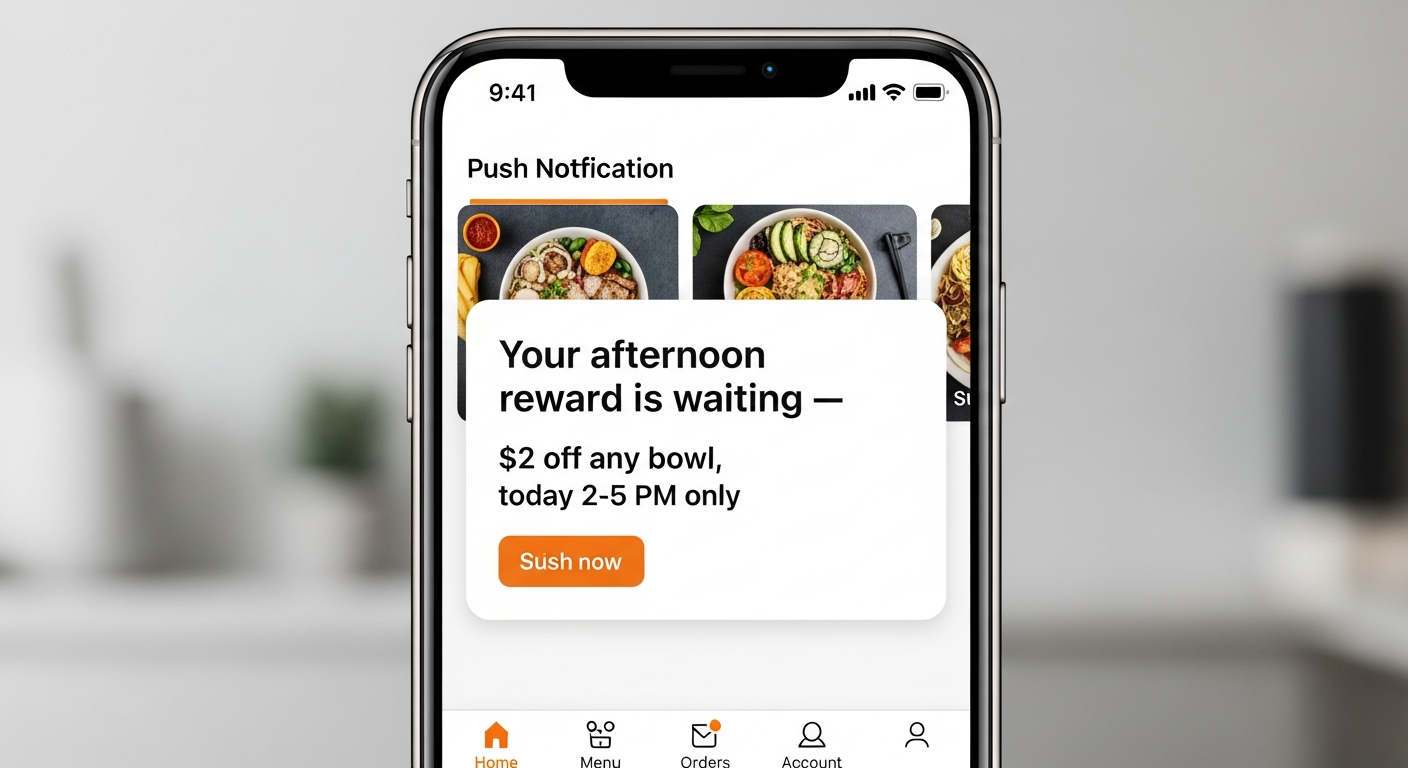
Humblefish Poke, a single-unit fast-casual restaurant in Tampa, was profiled in Popmenu's 2024 customer success stories. Owner David Chen implemented an automated "Afternoon Cravings" email campaign sent every Tuesday and Thursday at 1:00 PM to his list of roughly 4,200 subscribers. The emails featured a simple $2-off-any-bowl offer valid only between 2–5 PM.
Over six months, the campaign generated a 22% open rate and 6.8% click-through rate. Chen estimated it drove an additional $1,800 per month in afternoon revenue — meaningful for a single-unit operation doing about $65,000/month in total sales. That's $21,600 in annual revenue from one automated email, running twice a week, requiring zero daily effort after setup.
Now imagine layering push notifications on top of that. Paytronix data shows that customers who redeem an afternoon-specific offer return within 14 days 38% of the time, compared to 22% for general offer redeemers. You're not just filling the dead zone once — you're building a habit.
Why This Only Works If You Own the Customer Relationship
Here's where the math gets uncomfortable for restaurants relying on third-party platforms.
Olo's 2024 data shows that afternoon delivery orders grew 23% year-over-year — faster than any other daypart. DoorDash's 2024 Restaurant Insights report puts the average afternoon delivery order at $16.80. That sounds great until you remember that third-party commission rates run 15–30% depending on your tier.
On a $16.80 afternoon delivery order through DoorDash at a 25% commission rate, you're giving up $4.20. Your food cost on that order is probably $5.00–$5.50. You just made $7.10 in gross revenue on an order that should have netted you $11.30. Multiply that across every afternoon order, every day, and you're subsidizing someone else's growth with your dead zone recovery.
Contrast that with Tropical Smoothie Cafe, which reported that 35% of their total transactions occur between 2:00 PM and 5:00 PM — dramatically higher than the industry average. CEO Charles Watson credited their afternoon strength to positioning smoothies and flatbreads as "anytime" items. Locations running geo-targeted mobile ads during the 2–4 PM window saw a 15% lift in afternoon foot traffic. Their average unit volume hit $1.14 million in 2023, with afternoon sales contributing an estimated $399,000 per unit annually.
Tropical Smoothie owns that customer relationship. They're not paying 25% to a middleman for every afternoon smoothie. They're driving customers directly through their own channels.
As Kevin Rice, then-CMO of Wingstop, said in QSR Magazine: "The idea that there's a 'dead zone' is a failure of imagination, not a failure of demand. When we tested afternoon-specific bundles at a lower price point, we didn't just fill seats — we introduced new customers to the brand who later became dinner and late-night regulars."
And that cross-daypart behavior matters enormously for retention. SevenRooms' 2024 data found that customers who visit during two or more dayparts have a 55% lower churn rate than single-daypart visitors. Filling the afternoon doesn't just generate afternoon revenue — it builds the kind of habitual, multi-occasion customers who stick around.
The Dead Zone Recovery Checklist
Here's what the data says works, distilled into action:
Create a dedicated afternoon menu with items priced at $5.50–$8.00. Give it a name. Make it feel like its own occasion. (Olo data: 31% higher conversion with dedicated afternoon menus.)
Send a push notification or SMS between 1:00–1:45 PM with a time-gated offer that expires at 5:00 PM. (Paytronix data: 12–18% redemption for daypart-specific offers vs. 3–5% for generic ones.)
Automate it. Set it once and let it run every weekday. David Chen at Humblefish Poke added $21,600/year with a twice-weekly automated email — no daily effort required.
Drive orders through your own app, not third-party platforms. Keep 100% of revenue instead of giving up 15–30% per order. On afternoon delivery orders averaging $16.80, that's $2.50–$5.00 per order back in your pocket.
Track afternoon transactions as a separate KPI. Black Box Intelligence data shows restaurants that actively promoted afternoon dayparts saw +0.5 to +1.8% traffic growth during those hours — while the overall fast-casual segment declined 1.2%.
Use loyalty rewards to incentivize the second afternoon visit. Customers who redeem afternoon offers return within 14 days 38% of the time. Build the habit, not just the transaction.
Fill Your Dead Zone — Starting This Week
The 2–5 PM dead zone isn't inevitable. It's a symptom of marketing the same menu, to the same people, at the same times. The restaurants filling it — from CAVA and Tropical Smoothie at the national level to Humblefish Poke at the single-unit level — share three things in common: a dedicated afternoon offer, automated marketing that triggers at the right moment, and a direct channel to their customers that doesn't cost 30% per transaction.
Menuro builds all of this for you. Your own branded mobile app with built-in loyalty, push notifications that fire automatically during your dead zone, commission-free ordering, and the SMS and email automations that turn a quiet Tuesday afternoon into a $1,800/month revenue stream.
No tech skills. No coding. No daily effort. We build it, launch it, and it runs.
Book a free demo at menuro.io/demo and we'll show you exactly how to fill your 2–5 PM dead zone — with the math specific to your restaurant.