
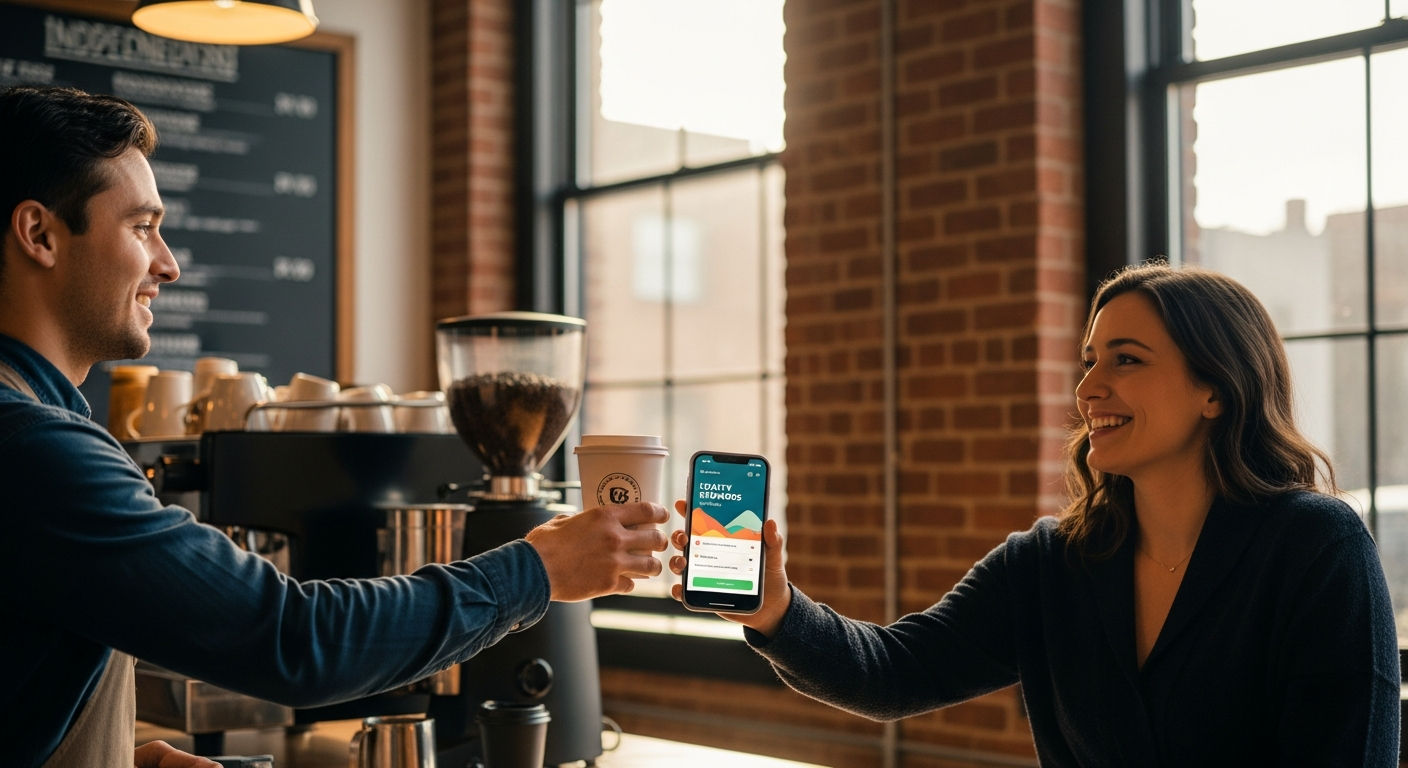
It's 6:47 a.m. and there's a Starbucks directly across the street from your shop. A regular — the one who orders an oat milk cortado every weekday — just walked in over there instead of coming to you. No reason. No drama. She just forgot you existed for a moment, and the green siren caught her eye.
That's the game. Not quality. Not price. Not even taste. It's top-of-mind awareness and the tiny, invisible switching costs that keep someone loyal to one coffee counter over another.
Here's the thing Starbucks figured out years ago and many independent coffee shops still haven't: the app is the moat. And right now, a growing number of local coffee operators are proving that how coffee shops use app-only rewards to beat Starbucks locally isn't a theory — it's a documented, numbers-backed playbook that's working in real markets across the country.
Let's break down exactly what they're doing, why it works, and what the math looks like.
Starbucks Has a Loyalty Machine — and a Crack in Its Armor
Let's give credit where it's due. Starbucks Rewards hit 34.3 million active U.S. members in Q1 FY2025, up 4% year-over-year, and those members drove 53% of all U.S. company-operated revenue (Starbucks Q1 FY2025 Earnings Release). That's a staggering number. More than half of Starbucks' revenue comes from people who have the app on their phone.
But here's where the crack appears.
In late 2023, Starbucks restructured its rewards program, making it harder to earn free drinks. The backlash was real and measurable. Biggby Coffee, a Midwest chain with over 300 locations, saw app downloads spike 30% in the two weeks after Starbucks announced the devaluation, according to co-CEO Bob Fish in a QSR Magazine interview (June 2024). Meanwhile, Starbucks posted a -4% decline in U.S. comparable store sales in Q4 2024.
David Henkes, Senior Principal at Technomic, put it plainly: "Starbucks' decision to restructure its rewards program in 2023 created a genuine window of opportunity for regional and independent coffee operators. The data shows measurable traffic shifts in markets where a credible local alternative exists with its own digital loyalty ecosystem." (Nation's Restaurant News, April 2024)
The key phrase there: "credible local alternative with its own digital loyalty ecosystem." Not a punch card. Not an Instagram page. An app.
Why App-Only Rewards Create Switching Costs That Punch Cards Never Could
Let's talk about behavioral economics for a second.
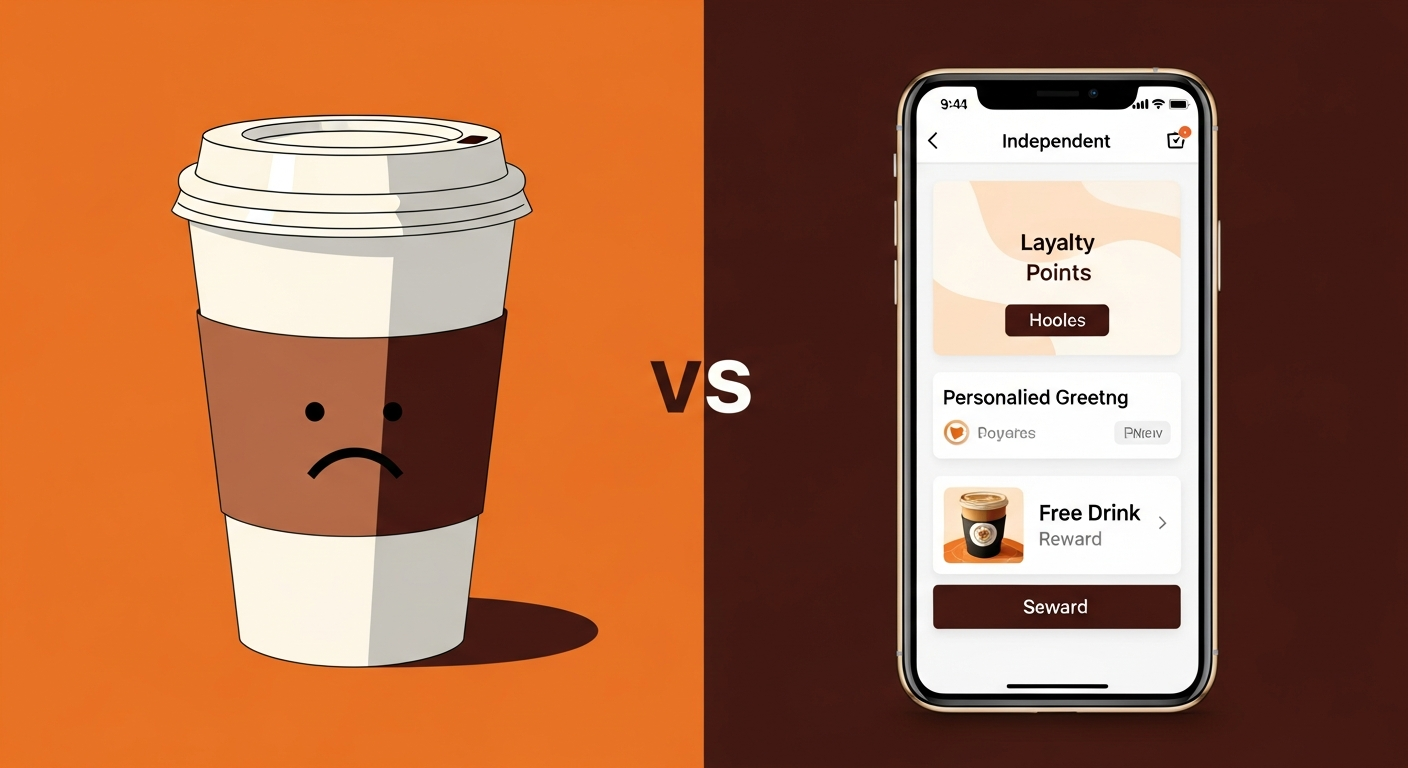
Emily Washcovick, Yelp's Small Business Expert, nailed it in a 2024 blog post: "An app-only reward creates a switching cost. Once a customer has 150 points toward a free drink at their local shop, they're not going to Starbucks on a whim. That's behavioral economics at work."
The data backs this up across every metric that matters:
Visit frequency: Coffee loyalty members average 7.2 visits per month compared to 2.8 for non-members, according to the Paytronix 2024 Annual Loyalty Report. That's not a marginal improvement — it's a 2.6× multiplier.
Ticket size: App orders carry an 18–25% premium over counter orders (Olo 2024). Independent coffee shops with app loyalty programs see average tickets of $6.80–$7.50, compared to $5.20–$5.80 without (Square 2024 Coffee Industry Report; Thanx 2024).
Retention: App-based loyalty members have a 90-day retention rate of 62–71%, while non-loyalty customers churn at 65–72% within the same window (Thanx 2024; Paytronix 2024). Read that again. Without a loyalty app, you're losing roughly two-thirds of your customers within three months.
Lifetime value: The 12-month LTV of an app loyalty member at an independent coffee shop is $280–$450, compared to $85–$140 for a non-loyalty customer (Thanx 2024; Paytronix 2024). That's a 3× difference at minimum.
A punch card sitting in someone's wallet — or more likely, lost in a junk drawer — doesn't create any of this. Punch-card programs see redemption rates of just 12–18% (Square 2024). App-based offers hit 22–35% (Paytronix 2024). The medium is the message.
How Coffee Shops Use App-Only Rewards to Beat Starbucks Locally: Real Operators, Real Numbers
This isn't theoretical. Here's what's actually happening on the ground.
Dutch Bros: 67% of Transactions Through the App
Dutch Bros launched Dutch Rewards in 2021 and by Q4 2024, 67% of all transactions flowed through the app, with over 7.5 million members enrolled. Their "Straw Points" system — exclusive to the app — drove rewards members to visit an average of 4.2 times per month versus 1.8 for non-members. App-based mobile ordering carried an average ticket of $7.80 versus $6.50 for non-app transactions — a 20% premium.
The kicker: in markets where Dutch Bros competes head-to-head with Starbucks, rewards members showed a 92% retention rate over six months. Same-store sales grew 6.9% in Q4 2024, while Starbucks' U.S. comps fell -4%. (Dutch Bros Q4 2024 Earnings Call, February 2025)
Blank Street Coffee: $340 LTV vs. $125 for Walk-Ins
Blank Street, a micro-café chain with 50+ locations in NYC and London, built its entire model around app-first ordering. Over 70% of orders come through the app (TechCrunch, September 2024). Their "Streak Rewards" — bonuses for consecutive-day visits — drove a 28% increase in weekly visit frequency.
The LTV gap is staggering: app-acquired customers had a 6-month lifetime value of $340, compared to $125 for walk-in-only customers. That's 172% more revenue per customer.
Co-founder Vinay Menda told Bloomberg (October 2024): "We don't need to outspend Starbucks on real estate or marketing. We need to out-personalize them. Our app lets a 12-person team deliver the kind of targeted experience that Starbucks needs 500 people in Seattle to coordinate."
Summer Moon Coffee: Geo-Targeted Push Notifications at 9.2% Conversion
This Austin-based chain with 50+ locations implemented a custom loyalty app through Thanx in 2023. Within 12 months, 38% of all transactions were tied to loyalty members, and app users showed a 22% higher average check ($8.15 vs. $6.68).
But the standout tactic: geo-targeted push notifications sent when customers were within 500 meters of a location, achieving a 9.2% conversion rate — notification to purchase within two hours. For context, personalized push notifications generally achieve open rates of 12–15%, roughly 3× the rate of generic broadcasts (OneSignal 2024).
Summer Moon's VP of Marketing, Sarah Mitchell, said it at Coffee Fest Austin 2024: "We went from losing customers to the Starbucks across the street to pulling their customers to us. The app lets us reward loyalty in ways that feel personal, not corporate."
Biggby Coffee: Turning Starbucks' Mistake Into 18,000 New Downloads
Biggby's loyalty app reached 1.2 million members in 2024, with app transactions representing 42% of total sales. Their "BOGO for a buddy" app-exclusive promotion — buy one, send a free drink to a friend via the app — drove 18,000 new app downloads in a single month and a 14% increase in new customer acquisition. App orders carried a $0.85 higher average ticket than non-app orders. (QSR Magazine, June 2024; Biggby Coffee 2024 Franchise Disclosure Document)
Gregorys Coffee: Exclusive Drops That Drive Downloads
Gregorys, with 40+ NYC locations, saw app-based orders grow 45% year-over-year in 2024. Loyalty members visit 3.1× more frequently than non-members. Their smartest move: app-exclusive seasonal menu drops available to loyalty members 48 hours before general release. Those early-access drops generated 22% of monthly app downloads during promotional periods. (Restaurant Dive, August 2024)
The Playbook: What These Shops Have in Common
Across every case study, the same patterns emerge:
1. The rewards are app-only. Not "also available on the app." Exclusively on the app. This creates the download incentive and the switching cost. Popmenu's 2024 Consumer Trends Report found that 41% of consumers would download a restaurant's app specifically for rewards and deals.
2. They personalize relentlessly. Even basic personalization — knowing someone's name, their usual order, their preferred location — generates a 12.4% increase in average check size and a 26% improvement in 90-day retention versus non-personalized programs (Paytronix 2024). Andrew Robbins, CEO of Paytronix, said it best: "The local advantage is authenticity. The app advantage is frequency. Combine them and you have a formula that a $100 billion company struggles to match."
3. Push notifications are the secret weapon. Push notifications have a click-through rate 7× higher than email when measuring direct conversion to purchase (Airship 2024). With opt-in rates averaging 60% on Android and 45% on iOS for food and drink apps, you're reaching the majority of your app users every time you send.
4. They make ordering frictionless. Gregorys' "Skip the Line" mobile order feature reduced wait times by 2.5 minutes and increased morning rush transactions by 15%. Digital ordering channels carry average check sizes 20–25% higher than counter orders (Olo 2024). Convenience sells.
5. They create exclusivity. PJ's Coffee of New Orleans offered "Louisiana Local" app-exclusive blends available only to rewards members, driving a 19% increase in app enrollment during the promotional quarter (Paytronix 2024 Case Study). Gregorys does early-access menu drops. Dutch Bros has Straw Points. The pattern: give app users something nobody else gets.
The Math for Your Coffee Shop
Let's run quick numbers for a single-location coffee shop doing 200 transactions per day.
If you convert 40% of customers to app loyalty members (the low end of the 40–55% enrollment-to-active benchmark from Paytronix 2024), that's 80 daily transactions through your app.
Those 80 app customers spend 20% more per visit (the consistent premium across every data point above). If your current average ticket is $5.50, app customers spend $6.60. That's an extra $1.10 × 80 = $88 per day, or roughly $2,640 per month in incremental revenue — just from the ticket lift.
Now factor in the frequency increase. App loyalty members visit 2–3× more often than non-members. Even at the conservative end, you're doubling visit frequency for a meaningful chunk of your customer base.
And the retention math is the real story. Black Box Intelligence's Q4 2024 data showed that loyalty-active coffee locations saw +2.8% same-store sales growth while non-loyalty locations saw -1.3%. That's a 4.1 percentage point swing. Over a year, on a shop doing $500K in revenue, that's the difference between growing $14,000 and shrinking $6,500 — a $20,500 gap.
The cost? A white-label branded app runs $200–$500/month (Thanx/Craver 2024 pricing). The ROI isn't close.
Your Starbucks Is Across the Street. Your App Is How You Win.
Every case study in this piece — Dutch Bros, Blank Street, Summer Moon, Biggby, Gregorys, PJ's — shares one thing: they stopped competing on coffee alone and started competing on the relationship. The app is how they own that relationship.
You don't need 34 million loyalty members. You need the 2,000–5,000 regulars in your neighborhood to have your shop on their home screen instead of — or right next to — the Starbucks app. That's the entire game.
Starbucks handed you an opening when they devalued their rewards. Your customers are already looking for a reason to support local. Give them the tool that makes it easy, rewarding, and personal.
Get Your Own Branded Coffee Shop App — Done for You
Menuro builds white-label mobile apps for independent coffee shops and restaurants. Your brand, your loyalty program, your push notifications, your direct ordering — no commissions, no middlemen, no tech skills required.
We handle the entire setup. You get an app that turns first-time visitors into daily regulars and keeps them coming back instead of drifting across the street.
Book a free demo at menuro.io/demo and see exactly how your shop can build the kind of app-only rewards program that's already beating Starbucks in markets across the country.