
Saturday night. A couple celebrates their anniversary at your restaurant. They order the tasting menu, a bottle of Barolo, and a cheese course. The check comes to $437 for two. They tell the server it was the best meal they've had all year. They leave a 25% tip. They walk out the door.
You will never see them again.
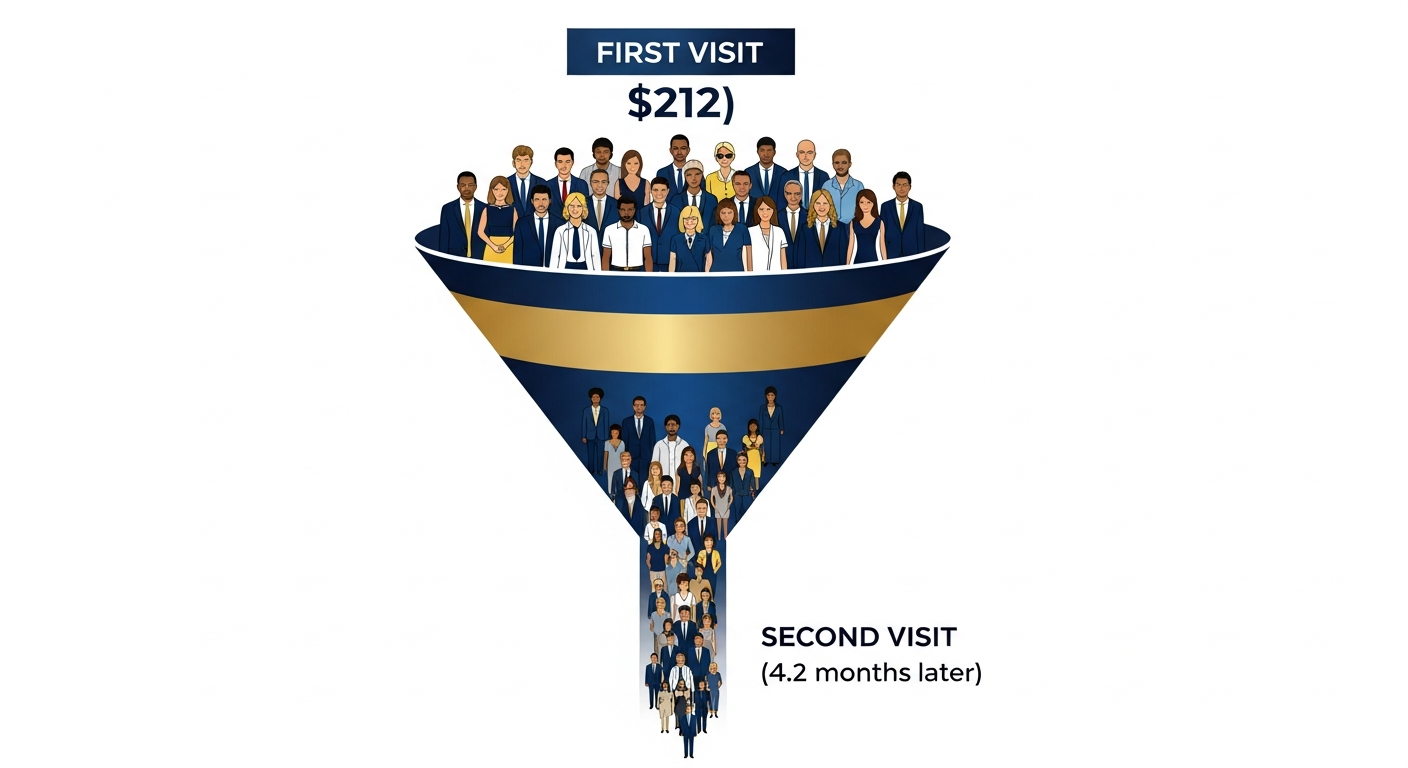
This is not a hypothetical. According to SevenRooms' 2024 Restaurant Guest Retention Study, which analyzed over 10,000 restaurant locations, 70% of first-time fine dining guests never return within 12 months. The average fine dining check in the U.S. hit $212 per person in 2024, per Black Box Intelligence's Q4 2024 Restaurant Industry Performance Pulse. That means your restaurant is routinely generating $200, $300, $400 transactions with people who vanish.
The question worth asking: why?
The Occasion Trap That Keeps Fine Dining Guests at 1.2 Visits Per Year
Fine dining has a structural retention problem that no other restaurant segment shares. OpenTable's 2024 Diner Trends Report found that 64% of diners who book a fine dining reservation describe it as a "special occasion" booking — a birthday, an anniversary, a promotion, a client dinner. Only 18% of fine dining reservations on OpenTable were made by repeat guests at the same restaurant within a 12-month window.
Compare that to fast-casual, where Paytronix's 2024 Annual Loyalty Report pegs the average guest at 8–12 visits per year. Fine dining guests average 1.2 to 1.8 visits per year to a specific restaurant, according to SevenRooms 2024 data cross-referenced with Black Box Intelligence. The average fine dining guest visits barely more than once.
This creates a paradox. Fine dining restaurants spend enormous energy (and money) on acquisition — PR firms, social media content, influencer partnerships, review management. Joel LaBava, a restaurant consultant at LaBava Hospitality Group, put it bluntly in a 2024 column for Restaurant Business Online: "Fine dining operators are spending $50 to acquire that guest through PR, social media, and reputation — and then spending $0 to retain them."
The guest had a transformative meal. They told three friends about it. And the restaurant has no email address, no visit history, no follow-up plan, and no mechanism to turn that $212 check into a second $212 check.
The Revenue You're Losing Is Bigger Than You Think
Hudson Riehle, Senior Vice President of Research at the National Restaurant Association, addressed this gap directly at the NRA's 2025 State of the Restaurant Industry press briefing. His estimate: a fine dining restaurant doing $3 million in annual revenue could add $400,000 to $600,000 by converting 10–15% of one-time guests into twice-a-year visitors.
That math holds up. If your restaurant serves 14,000 covers a year at $212 per person and 70% of first-timers never come back, you're looking at roughly 5,000–6,000 unique guests who visit once and disappear. Convert 15% of them into a second visit and you've added 750–900 covers at $212 each — $159,000 to $190,800 in incremental revenue. Factor in that returning guests tend to spend more (Paytronix 2024 data shows loyalty-engaged guests spend 22% more per visit), and the number climbs past $200,000.
Meanwhile, Black Box Intelligence's Guest Sentiment Tracker showed that fine dining experienced a net guest count decline of -3.7% year-over-year in 2024, even as average check sizes rose. Restaurants are squeezing more dollars from fewer people. That's a strategy with a ceiling.
What Alinea, Canlis, and EMP Do That Most Fine Dining Restaurants Don't
The operators who have cracked this problem share a common approach: they treat guest data like a financial asset, not an afterthought.
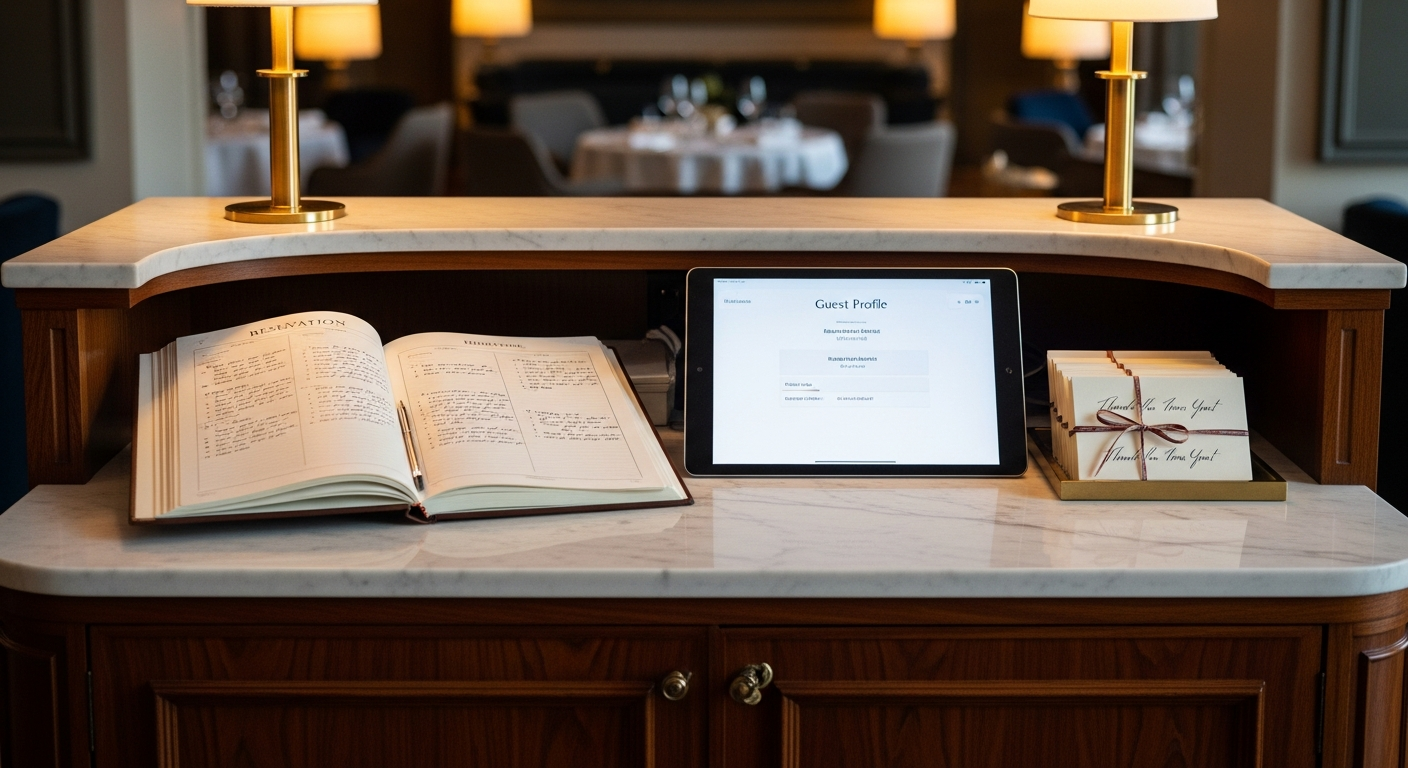
Alinea Group (Chicago) — Nick Kokonas, co-owner of Alinea, Next, The Aviary, and Roister, built the reservation platform Tock (acquired by American Express in 2023) in part because he was frustrated by how little data traditional reservation systems captured. Alinea Group tracks every diner's visit history, spending patterns, dietary preferences, and special occasions. Post-visit, guests receive personalized emails referencing their experience and previewing upcoming seasonal menus.
The result: Alinea Group achieved a repeat visit rate of approximately 40–45% within 12 months — roughly double the fine dining industry average. Kokonas has been vocal about this in interviews with Inc. Magazine (2023) and Eater (2024). As he put it: "You have someone who just spent $400 at your restaurant, and you let them walk out the door with zero mechanism to bring them back. That's insane. In any other industry, a $400 customer would get a follow-up call, a thank-you note, and a reason to come back within a week."
Canlis (Seattle) — Mark and Brian Canlis, who run the multi-generational fine dining institution, invested in guest data capture and a CRM integration through SevenRooms during and after the pandemic. Their email list grew to over 30,000 subscribers by 2024, with open rates consistently above 55%. A "community dinner" series marketed exclusively through email to past guests sold out within hours, generating an estimated $50,000+ per event with zero advertising spend. Their repeat guest rate improved from roughly 25% to 38% over two years (2022–2024), according to SevenRooms case studies and reporting from Seattle Met.
Eleven Madison Park (New York) — Despite the polarizing shift to a fully plant-based menu in 2021, EMP maintained occupancy rates above 90% through 2023–2024. Daniel Humm attributed this in part to a meticulous guest notes system and post-visit follow-up program. Every guest's preferences, allergies, conversation topics, and seating preferences were logged. In a 2024 New York Times interview, Humm noted that approximately 35% of covers in any given month are repeat guests, which he credited to "making every guest feel like a regular."
Bobby Stuckey, Master Sommelier and co-owner of Frasca Food & Wine in Boulder, captures the philosophy well. In a 2024 Eater interview, he said: "We keep a notebook on every single guest. What they drank, what they loved, who they were with, what the occasion was. When they come back — even a year later — we reference it. That's not technology, that's hospitality. But now the technology exists to do this at scale, and most fine dining restaurants still aren't using it."
The 48-Hour Window That Determines Whether Your Guest Comes Back
The data on post-visit outreach is striking. SevenRooms' 2024 data showed that personalized post-dining emails — sent within 24 to 48 hours of a visit, referencing specific dishes ordered or the occasion — achieved open rates of 60–70% and conversion-to-return-booking rates of 12–15%. Generic promotional emails? They converted at 2–3%.
Allison Page, Co-founder and Chief Product Officer of SevenRooms, shared this in a 2024 webinar: "When restaurants use even basic personalized outreach — a thank-you email that references what the guest ordered, an invitation back for a seasonal menu change — that non-return rate drops to around 45–50%. That's a massive swing in lifetime value."
The economics per email are worth noting, too. Toast's 2025 Restaurant Technology Industry Report found that restaurants using CRM-integrated email marketing generated an average of $2.60 per email sent across all segments. Fine dining operators saw approximately $4.10 per email because of the higher check sizes involved.
Popmenu's 2024 Restaurant Marketing Benchmark Report backs this up from a different angle: restaurants using automated post-visit email sequences saw a 38% increase in repeat visits within 90 days. The Painted Burro, an upscale-casual group in the Boston metro area owned by Bob Luz (former CEO of the Massachusetts Restaurant Association), implemented Popmenu's marketing automation and saw automated post-visit emails and targeted campaigns drive a 24% increase in repeat visits within six months, generating an average of $8,200 in attributable monthly revenue.
Fine dining checks are 3–5x higher than upscale-casual. The per-email revenue opportunity scales accordingly.
Why 71% of Fine Dining Restaurants Still Have No Retention Program
The National Restaurant Association's 2025 State of the Restaurant Industry Report found that only 29% of fine dining restaurants have any formal retention or loyalty program. Compare that to 72% of QSR and fast-casual concepts.
The reason is partly cultural. Fine dining operators often resist anything that feels transactional — points programs, punch cards, discount-driven loyalty schemes. That resistance is understandable. A "buy 9 tasting menus, get the 10th free" program would be absurd.
But retention and loyalty are not the same thing as discounting. The operators succeeding at this — Alinea, Canlis, EMP, Minibar (José Andrés's D.C. tasting-menu concept) — are not offering coupons. They're offering recognition, priority access, and personalized communication.
Minibar, before it closed, used Tock to build a VIP guest database. Past guests received priority access to new reservation windows and exclusive event invitations. The priority-access email program had a reported open rate of 78% and drove immediate booking action. An estimated 30% of guests were repeat visitors, according to Washingtonian magazine and Tock platform data — a remarkable figure for a $275+ per-person tasting menu.
Kevin Hochman, CEO of Brinker International (Chili's parent company), made an adjacent point during Brinker's Q2 FY2025 earnings call in January 2025. He noted that guests who engaged with digital touchpoints visited 3x more often than those who didn't, and credited CRM-driven email and app strategy for Chili's industry-leading same-store sales growth of 14.1%. If the principle works at Chili's price point, imagine the revenue impact at $212 per cover.
A Practical Retention Playbook for Fine Dining Operators
Based on what the data and these operators demonstrate, a fine dining retention system doesn't need to be complex. It needs four components:
1. Capture guest data at every touchpoint. Email address, occasion, party size, and dietary preferences — at minimum. Reservation platforms like Tock and SevenRooms make this automatic. If you're using a system that doesn't capture and store this data in a way you own and can export, you have a vendor problem.
2. Send a personalized follow-up within 48 hours. Reference what they ate, the occasion, or the wine they ordered. SevenRooms' data shows this single action can cut your non-return rate from 70% to 45–50%. That's not a marginal improvement — it's a transformation of your guest economics.
3. Create a reason to return that isn't a discount. Seasonal menu previews, priority access to holiday reservations, wine dinner invitations, chef's counter availability. Canlis sold out $50,000 events with zero ad spend by emailing past guests. The "reason" is exclusivity, not a coupon code.
4. Track and act on visit frequency. Know which guests have visited twice and which haven't returned in six months. The difference between a 20% and a 40% return rate is the difference between hoping guests remember you and giving them a specific, timely reason to come back.
None of this requires a points system. None of it cheapens the brand. All of it is hospitality — extended beyond the four walls of the dining room.
The $212 Guest Is Worth Fighting For
Fine dining restaurants operate in a segment where a single returning guest can represent $500 to $1,000+ in annual revenue. The Bain & Company benchmark — that increasing customer retention by 5% increases profits by 25–95% — applies with particular force here because the per-transaction value is so high.
The restaurants that treat guest retention as a system, not a hope, are outperforming their peers by measurable margins. Alinea doubled the industry return rate. Canlis grew repeat visits by 13 percentage points in two years. EMP kept seats full through a menu overhaul that could have emptied the dining room.
The common thread is not a specific technology platform. It's a decision to own the guest relationship after the check is paid.
See How Menuro Helps Fine Dining Restaurants Bring Guests Back
Menuro gives you a direct channel to your guests — with built-in CRM, automated post-visit messaging, and guest preference tracking — so that $212 check becomes the start of a relationship, not the end of one. If you want to see how it works for your restaurant, book a demo at menuro.io/demo.