
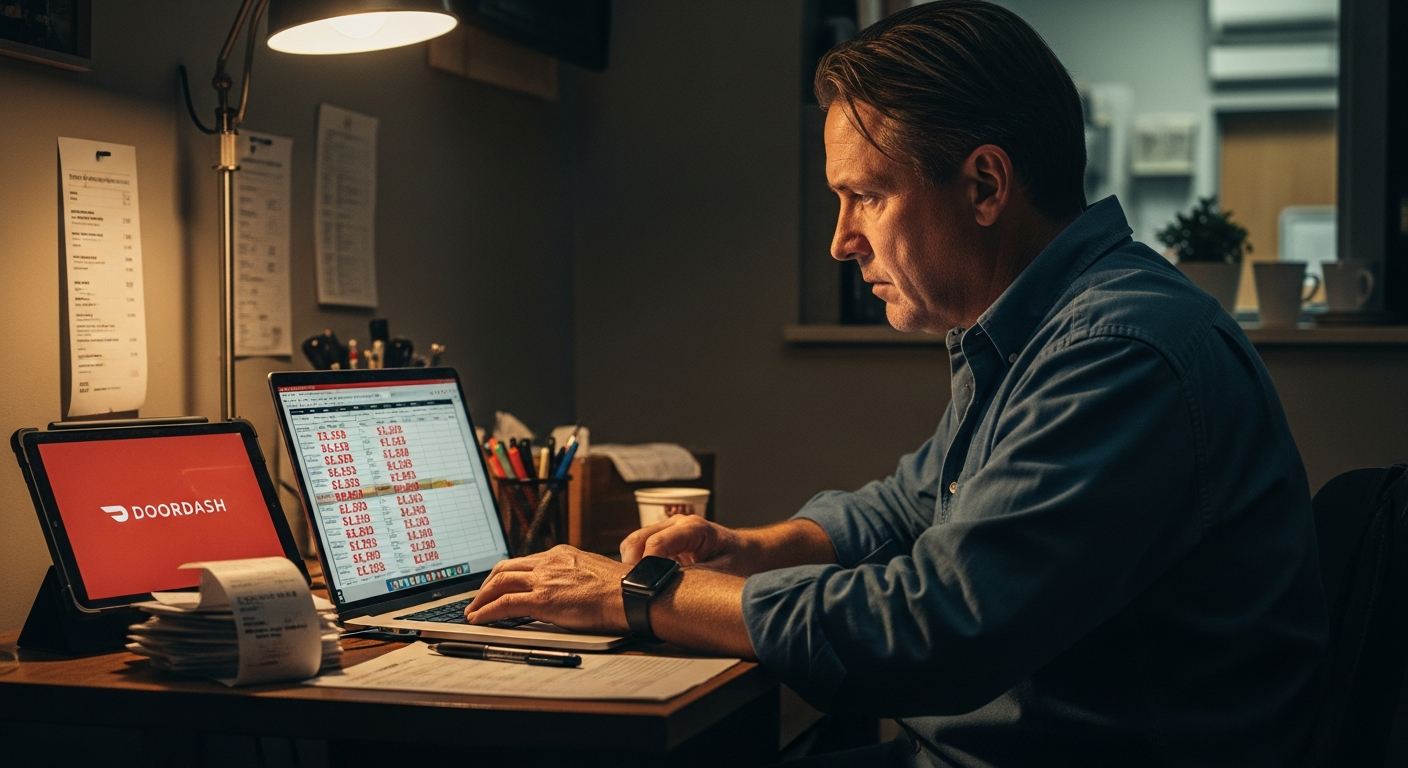
A $38 delivery order comes in on your DoorDash tablet at 7:14 p.m. on a Tuesday. Your kitchen fires it, a driver picks it up, and the customer eats your food 30 minutes later. Looks like revenue. Feels like progress.
But pull up the settlement statement at the end of the month, and a different picture forms. That $38 order left you with somewhere between $22 and $25 after DoorDash took its commission and processing fees. After food cost and the labor to prepare it, you netted close to zero. Maybe less.
Multiply that by 12 orders a day, 30 days a month, and you arrive at a number that should concern every independent restaurant owner: roughly $4,200 per month sent to a platform that keeps the customer relationship for itself.
This post walks through the per-order math, shows what those fees add up to across a year, and lays out what operators who have cut their third-party dependence did to get there.
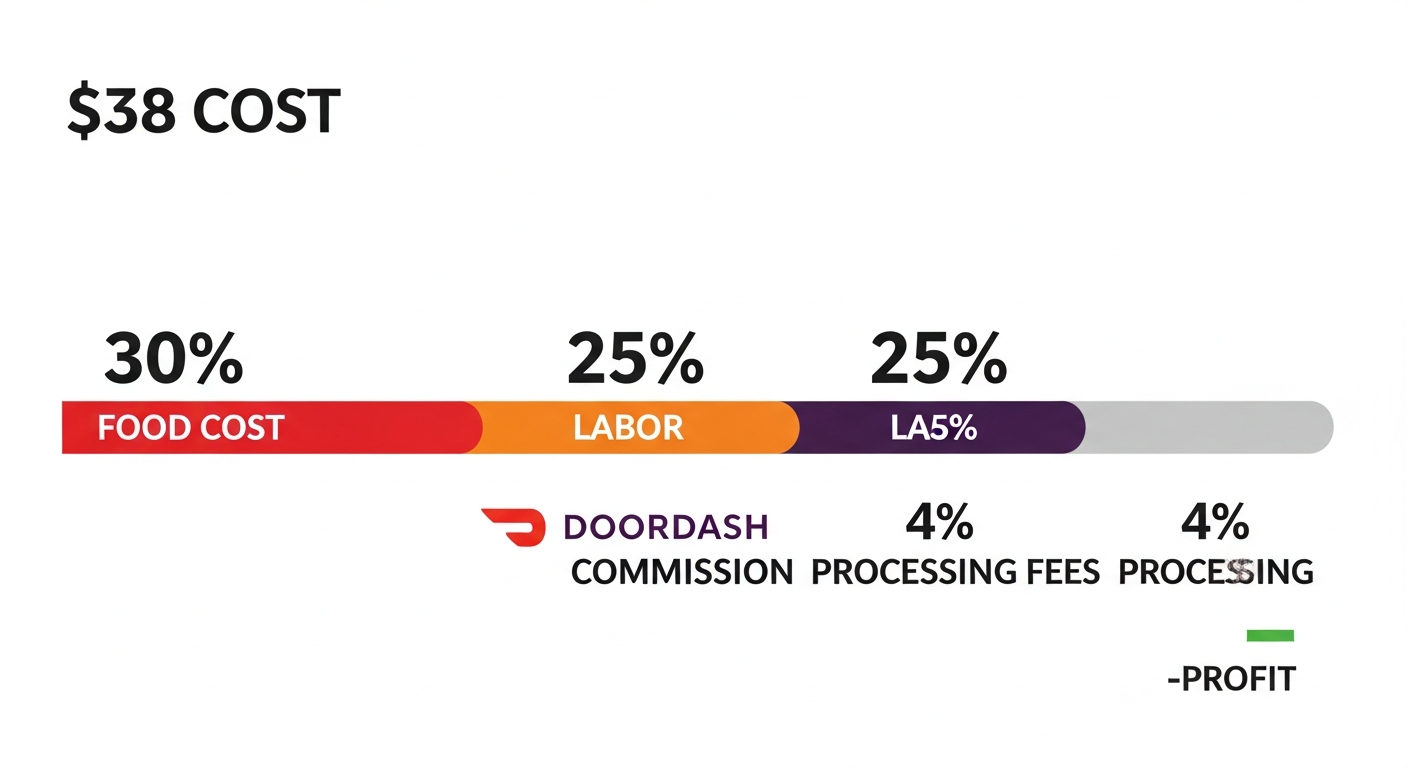
The Per-Order Breakdown: Where Your $38 Goes
DoorDash charges restaurants between 15% and 30% of each order depending on the plan tier, according to DoorDash's 2024 Merchant Terms of Service. The Basic plan at 15% sounds reasonable until you realize it restricts your delivery radius and buries you in search results. Most operators land on the mid-tier at around 25%, or the Premier plan at 30% to get full visibility.
Uber Eats runs a similar 15%–30% structure and tacks on an additional processing fee of 2.5%–3.5% per transaction (Uber Eats Merchant FAQ, 2024). Grubhub starts lower at 5%–20% base commission but layers on marketing and delivery fees that push the effective rate to 25%–35% when promotional placements are included, per a 2024 Restaurant Business Magazine analysis.
Aaron Allen & Associates, a global restaurant consultancy, published a 2024 analysis titled "The Real Cost of Third-Party Delivery" that found the effective total cost per order, when you factor in commissions, credit card processing fees passed through by the platform, tablet fees, and promotional discounts funded by the restaurant, can reach 35%–40% of the order total.
Let's use a conservative scenario. A mid-volume independent restaurant on DoorDash's mid-tier plan:
| Line Item | Amount |
|---|---|
| Average order value | $38 |
| Commission at 25% | $9.50 |
| Processing, tablet, and promo fees | $1.50–$3.00 |
| Effective platform cost per order | $11.00–$12.50 |
| Food cost at 30% | $11.40 |
| Labor allocation at 25% | $9.50 |
| What's left before rent, utilities, insurance | -$1.90 to $0.60 |
That's not a typo. On a $38 DoorDash order at a 25% commission rate, many restaurants lose money before overhead. Carl Orsbourn, co-author of Delivering the Digital Restaurant, has made this point publicly: a $40 DoorDash order nets the restaurant roughly $22–$25 after commissions and fees, and once food and labor costs are subtracted, the margin is zero or negative.
$4,200 a Month Is the Conservative Number
Toast's 2025 Restaurant Trends Report indicates that delivery represents 15%–20% of orders for full-service restaurants, and that 77% of restaurants now use at least one third-party delivery platform. For a mid-volume independent doing about 12 third-party delivery orders per day (a moderate figure backed by Toast's data), the monthly math looks like this:
- 12 orders/day × $11.50 average platform cost × 30 days = $4,140/month
Round it and you get $4,200. Over a year, that's $50,400 sent to DoorDash, Uber Eats, or Grubhub.
Toast's report found that the average restaurant pays $3,600–$5,400 per month in combined third-party delivery commissions. The $4,200 figure sits right in the middle of that range.
Aaron Allen put it bluntly in a 2024 piece quoted in Restaurant Business Magazine: "A restaurant doing $1 million in annual delivery through third parties is writing a $250,000–$300,000 check to Silicon Valley. That's often more than their annual profit."
The National Restaurant Association's 2024 State of the Restaurant Industry Report backs this up. It found that 88% of restaurant operators say third-party delivery fees significantly impact their profitability, and 45% say delivery is either break-even or a money-losing channel. Average restaurant profit margins sit between 3% and 9% for full-service and 6%–9% for limited-service concepts. A $50,000 annual line item for delivery commissions can consume most or all of that margin.
Black Box Intelligence's Q4 2024 data showed that restaurants where third-party delivery composed more than 20% of total revenue had profit margins 2.3 percentage points lower than those with delivery under 10%.
The Hidden Cost: You're Paying to Lose Your Own Customers
The commission math is painful enough. But there's a second cost that doesn't show up on any settlement statement: customer ownership.
When someone orders your food through DoorDash, DoorDash owns that customer's data, their email, their phone number, their order history, and their attention. The next time that person opens the app, DoorDash shows them your competitors. You paid 25% for a one-time transaction with no way to bring that customer back on your own terms.
Olo's 2024 analysis found that only 15%–20% of customers who order from a restaurant via DoorDash place a second order from that same restaurant within 90 days. Placer.ai behavioral data corroborated this finding. The platform retains the customer. The restaurant does not.
Contrast that with restaurants that capture first-party guest data. SevenRooms' 2024 data showed that restaurants using targeted email and SMS to reach customers they'd identified through direct channels converted 18%–22% of one-time diners into repeat customers within 90 days, compared to that sub-5% natural return rate from third-party orders.
Pinky Cole, founder of Slutty Vegan in Atlanta, described the dynamic in a 2024 Black Enterprise interview: "I realized early on that DoorDash and Uber Eats were renting my customers back to me. They'd order through the app, have a great experience with my food, and then the platform would show them five competitors the next time they opened the app. I was paying 30% for the privilege of losing my own customers."
What Operators Who Cut Their DoorDash Tab Did Differently
Several multi-unit operators have shared public data on what happened when they shifted volume from third-party platforms to direct ordering. The patterns are consistent.
Curry Up Now, the Indian fast-casual chain in the San Francisco Bay Area, offered a 10% discount for direct orders, a move that still saved them 15–20 percentage points compared to the third-party commission. They promoted direct ordering through SMS marketing via the Thanx loyalty platform. Within eight months, direct orders grew from 18% to 47% of all digital orders, according to a 2024 Thanx case study confirmed by QSR Magazine. Average check on direct orders was $6.20 higher than DoorDash orders.
Dog Haus, the Pasadena-based brand with over 50 locations, partnered with Olo for direct ordering and PAR Punchh for loyalty. They ran a "skip the app, order direct" campaign and saw first-party digital orders increase 40% year-over-year in 2024. The brand estimated annual savings of $500,000 or more across the system in reduced third-party commissions, per an Olo partner spotlight and Nation's Restaurant News coverage.
Starbird Chicken in Sunnyvale, California, founded by former McDonald's executive Aaron Noveshen, built a proprietary app and loyalty program. Over 65% of all orders now come through first-party digital channels. Noveshen stated at the 2024 CREATE Conference that first-party orders are 3x more profitable than third-party orders. His approach: treat DoorDash and Uber Eats as discovery channels, like a billboard, not as the primary sales channel. Every order that arrives through a third party becomes a conversion opportunity.
Snooze, an A.M. Eatery, the Denver-based breakfast concept with 50-plus locations, selectively partnered with DoorDash at the Basic tier (15%) while building direct catering and pickup ordering. Their direct digital orders carry a $42 average check versus $34 on DoorDash, a difference attributed to better upselling through their own user experience, per a 2024 Toast customer spotlight.
Meredith Sandland, CEO of Empower Delivery and co-author of Delivering the Digital Restaurant, summed up the strategy at FSTEC 2024: "Every order that comes through DoorDash should be viewed as a lead to convert to a direct customer. If you're not doing that conversion work, you're subsidizing DoorDash's growth with your margins."
The Direct Ordering Math: What Changes When You Own the Channel
The economics shift substantially when orders come through a restaurant's own digital channel.
Olo's 2024 data showed that restaurants using direct ordering platforms retained 85%–90% of order revenue versus 65%–75% through third-party marketplaces. That 15–25 percentage point difference on every order is the gap between losing money on delivery and making it profitable.
Average check sizes tell a similar story. According to Olo's 2024 data, direct online delivery orders average $40–$48, compared to $35–$42 on DoorDash (Bloomberg Second Measure, 2024) and $33–$40 on Uber Eats (Edison Trends, 2024). Restaurants control the menu layout, the upsell prompts, and the overall experience on their own platforms, which drives that $5–$10 check size advantage.
Noah Glass, founder and CEO of Olo, stated on the company's Q3 2024 earnings call: "When a restaurant converts a third-party customer to a direct ordering customer, the lifetime value of that customer increases by 3–5x. The order frequency goes up, the check size goes up, and the margin on every order improves dramatically."
Patronix's 2024 Annual Loyalty Report quantified the frequency difference. Average restaurant customers visit 1.5–2.0 times per month. Loyalty program members visit 2.7–3.2 times per month, a 67%–80% increase. Customer churn within 90 days drops from 68% for non-loyalty customers to 28% for loyalty members, according to Thanx's 2024 Retention Benchmarks.
Square's 2024 Future of Commerce Report found that restaurants with their own online ordering system saw 23% higher repeat order rates compared to those relying solely on third-party platforms.
Let's run the same 12-orders-per-day scenario, but with direct ordering:
| Metric | Third-Party (DoorDash) | Direct Ordering |
|---|---|---|
| Average order value | $38 | $43 |
| Platform cost per order | $11.50 | $1.50–$2.50 (payment processing only) |
| Revenue retained per order | $26.50 | $40.50–$41.50 |
| Monthly platform cost (12 orders/day) | $4,140 | $540–$900 |
| Annual platform cost | $49,680 | $6,480–$10,800 |
The annual difference: roughly $39,000–$43,000 that stays in the restaurant instead of going to a delivery platform. For a restaurant operating on a 5% profit margin, that amount can represent the difference between a profitable year and a losing one.
You Don't Have to Go Cold Turkey
None of the operators mentioned above abandoned third-party platforms entirely. Starbird Chicken still lists on DoorDash. Curry Up Now still accepts Uber Eats orders. The shift isn't about cutting off a revenue stream; it's about changing the ratio.
Brendan Sweeney, CEO of Popmenu, laid out the opportunity in a 2024 QSR Magazine interview: "The average independent restaurant is spending $3,000–$5,000 per month on third-party commissions. That's $36,000–$60,000 a year that could be reinvested in staff wages, food quality, or marketing that builds your brand."
The playbook that works, based on the operators who have shared their numbers:
Keep third-party listings active but treat them as customer acquisition, not your sales channel. Pizzeria Locale in Denver reduced third-party dependence from 30% to 12% of total orders over 18 months and saved an estimated $6,800 per month in commissions, per Restaurant Business Magazine.
Offer a meaningful incentive for direct orders. Curry Up Now's 10% direct-order discount cost them far less than the 25%–30% commission they avoided. The net savings per order were substantial.
Insert a card or sticker in every third-party delivery bag directing customers to your direct ordering channel. This is the conversion step most restaurants skip. Slutty Vegan went all-in on this approach and now drives 70% or more of digital orders through first-party channels.
Build a simple loyalty program tied to direct ordering. Paytronix's data shows loyalty members are worth 2.5–3x more annually than anonymous third-party customers. Andrew Robbins, Paytronix's CEO, stated at the 2024 NRA Show that "restaurants that aren't building direct digital relationships are running on a treadmill, constantly paying to acquire customers they'll lose immediately."
Track the shift monthly. Measure your third-party order percentage as a share of total digital orders. If it's above 50%, you have significant margin to recapture. If you can bring it under 20%, you've changed the economics of your delivery business.
The $4,200 monthly DoorDash tab isn't inevitable. It's the default outcome when a restaurant treats third-party platforms as its ordering infrastructure instead of what they are: an expensive advertising channel.
See What Direct Ordering Looks Like for Your Restaurant
Menuro helps independent restaurants launch their own branded ordering app, with direct ordering, built-in loyalty, and zero commission on orders. If you want to run the math on what shifting even 30% of your third-party volume to a direct channel would save, book a free demo at menuro.io/demo and we'll walk through the numbers with you.