
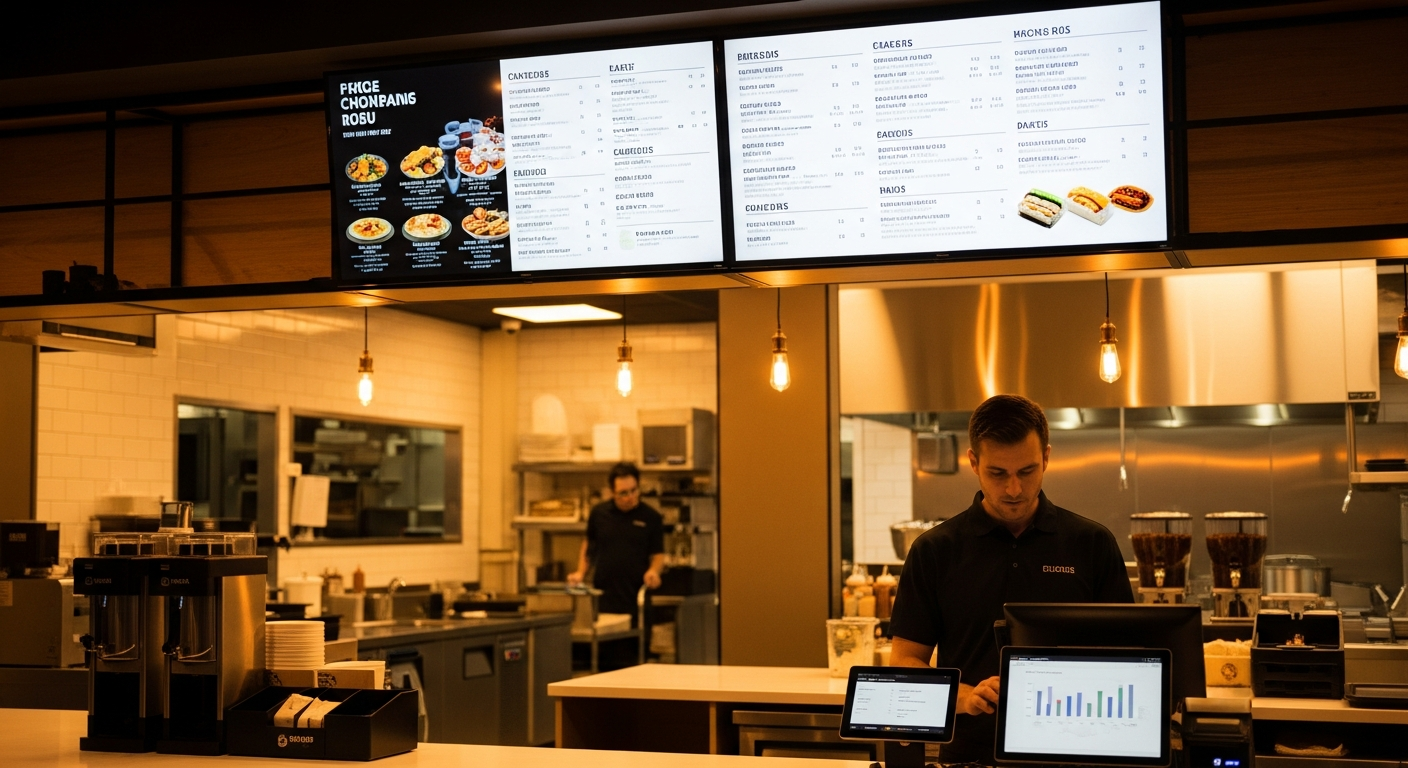
A Panera franchise operator in Ohio spent the first half of 2024 rolling out AI-powered drive-thru menu boards across 14 locations. The boards adjust what customers see based on time of day, weather, and trending orders. The tab for the technology stack, integration, and ongoing licensing: roughly $14,000 a month across those units.
Six months later, upsell acceptance at the drive-thru climbed 15%, and average check size rose 5%. Those are Panera's own reported numbers from its Google Cloud partnership, covered by Restaurant Business Online in 2024.
Fifteen percent sounds great in a press release. But strip out the cost of the technology, the integration labor, and the months of tuning, and the math gets tighter than the headline suggests. For some chains, the investment prints money. For others, it's an expensive science project.
So what separates the two? After digging through earnings calls, platform benchmark reports, and operator interviews from the past 18 months, a clear pattern emerges. Five specific AI applications produce measurable, repeatable gains. Everything else is either too early, too expensive, or too marginal to justify the spend.
The $14K/Month AI Menu Budget, Broken Down
Popmenu's 2024 Restaurant Technology Report found that multi-unit operators with 10 to 50 locations spend between $10,000 and $18,000 per month on their menu intelligence stack. That includes AI-driven menu optimization, dynamic pricing tools, and personalized digital ordering platforms. The midpoint sits right around $14,000.
Overall restaurant technology spending jumped 28% year-over-year from 2023 to 2024, according to Toast's 2025 Restaurant Technology Trends Report. The National Restaurant Association's 2025 State of the Industry Report found that 58% of operators plan to increase tech investment this year, with menu engineering and AI-powered recommendations ranking in the top five priorities.
The money is flowing. The question is where it should flow.
Move-the-Needle #1: Personalized Digital Menu Recommendations
Olo processes over 2 million orders per day across its restaurant network. Its 2024 engagement benchmarks show that restaurants using AI-driven personalized menu recommendations in digital ordering see a 12–18% increase in average check size compared to static digital menus.
That range matters because it compounds. For a fast-casual restaurant averaging a $14.50 digital check (within the $13.50–$16.00 range Toast reported for 2025), a 15% lift means $2.18 more per order. At 200 digital orders a day, that's $436 in daily incremental revenue, or about $13,000 a month from a single location.
Sweetgreen has built its business around this principle. In its Q3 2024 earnings call, the company reported that digital revenue represents 63% of total sales across roughly 230 locations. App users order 2.5 times more frequently than walk-in customers. AI-recommended "personalized bowls" carry a 22% higher attach rate for premium add-ons, and the average digital check runs $15.80 versus $13.20 in-store.
The mechanism is straightforward. When a returning customer opens the app, the menu they see reflects their order history, dietary preferences, and items with strong margin profiles. The AI doesn't show them 70 items. It shows them 8 to 12 items they're likely to buy, with profitable add-ons positioned alongside.
Wingstop runs a similar playbook. Digital sales hit 67% of total revenue in Q3 2024, and the company posted same-store sales growth of 20.9% for fiscal 2024, one of the highest figures in the industry. Digital average checks run $5 or more above in-store orders, according to Wingstop's earnings report.
Move-the-Needle #2: AI-Informed Menu Simplification
Gordon Food Service and Predictifood published data in 2024 showing that 40–70% of menu items at the average restaurant underperform on either popularity or profitability. Toast's 2025 data reinforces this: top-performing restaurants pull 70% or more of their revenue from 30% of their menu.
Chili's took this data seriously. In 2024, Brinker International used AI-informed menu engineering to cut roughly 22% of Chili's menu items, focusing the remaining lineup on high-margin, high-velocity dishes identified through data analysis.
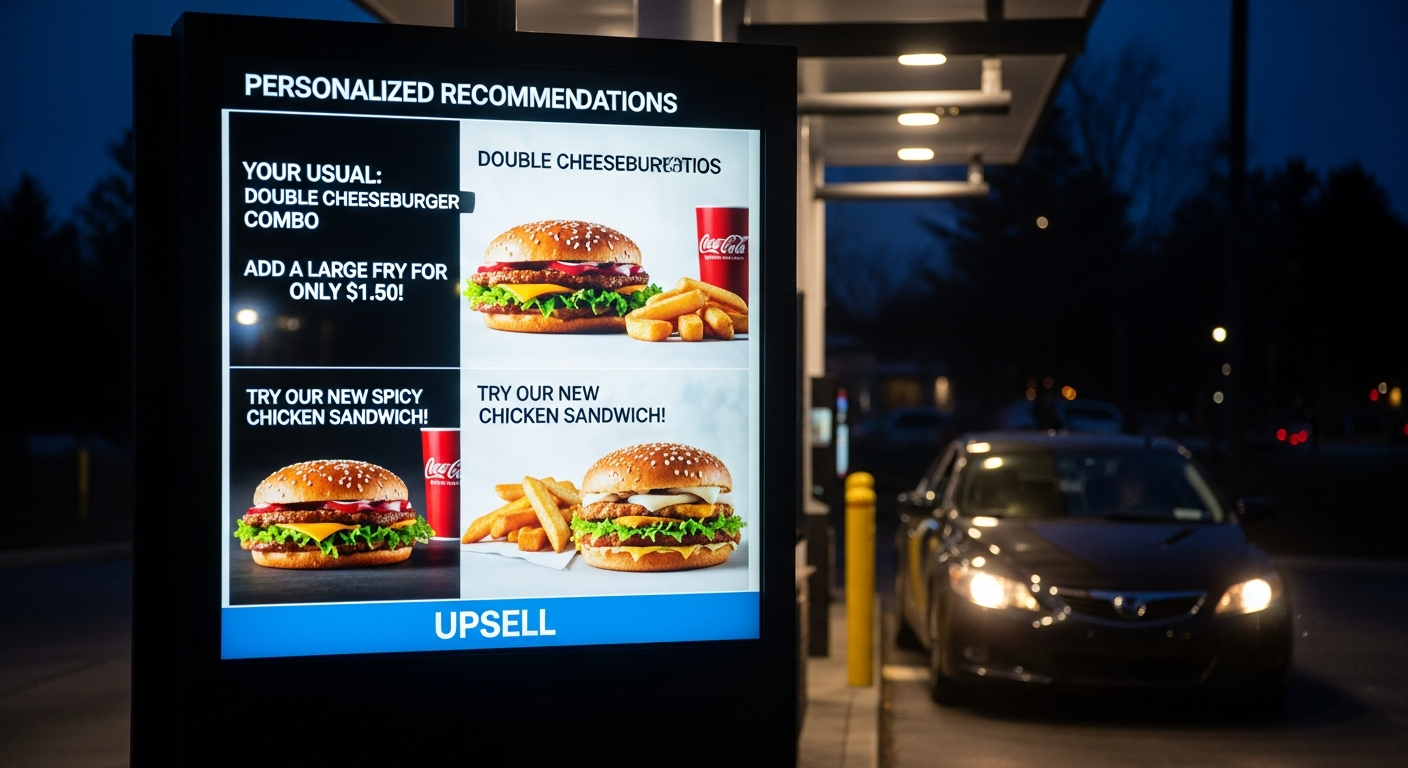
The results showed up fast. Brinker reported same-store sales growth of 14.1% in Q1 of fiscal year 2025 (October 2024 earnings call). Guest traffic increased 6.5%, making Chili's one of the only casual dining chains in the country growing traffic. Kitchen efficiency improved, with average ticket times dropping by more than 2 minutes. The "Big Smasher" burger and the reintroduced Triple Dipper, both decisions validated by AI data analysis, became viral hits.
Slutty Vegan in Atlanta ran a smaller-scale version of the same strategy. Using Toast POS data combined with third-party menu engineering tools, founder Pinky Cole's team identified that 3 menu items drove 61% of profit. After an AI-informed menu redesign that featured those items more prominently and deprioritized low-margin options, average check size rose from $16 to $19.50 (a 22% lift) and food cost percentage dropped 2.3 points. QSR Magazine profiled the results in 2024.
The lesson: AI's biggest menu contribution often isn't adding complexity. It's revealing what to remove.
Move-the-Needle #3: AI-Triggered Post-Visit Re-engagement
SevenRooms published a 2024 guest retention study with a stat that should alarm every operator: 70% of first-time restaurant customers never return for a second visit.
Automated, AI-triggered post-visit emails, personalized based on what a guest ordered and when they visited, achieve a 25% open rate and 5.8% conversion rate to rebook, according to SevenRooms' 2024 data. Generic re-engagement emails convert at 1.2%. That's a nearly 5x difference in conversion from the same channel.
SevenRooms co-founder Allison Page put it bluntly in 2024: "AI-driven guest engagement — a personalized follow-up email, a tailored offer based on what they ordered — can cut that churn by 15–20%. That's not incremental. That's transformational for unit economics."
Paytronix's 2024 Annual Loyalty Report backs this up from the loyalty side. AI-personalized offers within loyalty apps see redemption rates of 55–65%, roughly double the 35–45% industry average for generic offers. The average loyalty member already spends 35% more per visit than non-members, but AI-personalized offers push that gap to 42%.
Paytronix CEO Andrew Robbins noted in the same report: "The restaurants still sending 'Buy One Get One' to their entire database are leaving 40–50% of potential revenue on the table."
Move-the-Needle #4: Smart Cart and Abandonment Recovery
Basket abandonment in digital restaurant ordering averages 70%, according to Olo's Q4 2024 data. That number is staggering. Seven out of ten people who start building an order walk away before completing it.
When Olo's clients implemented AI-powered "smart cart" recommendations and simplified reorder flows, abandonment dropped to 52%. An 18-percentage-point improvement in completion rate, applied to hundreds of daily sessions, translates to dozens of recovered orders per location per day.
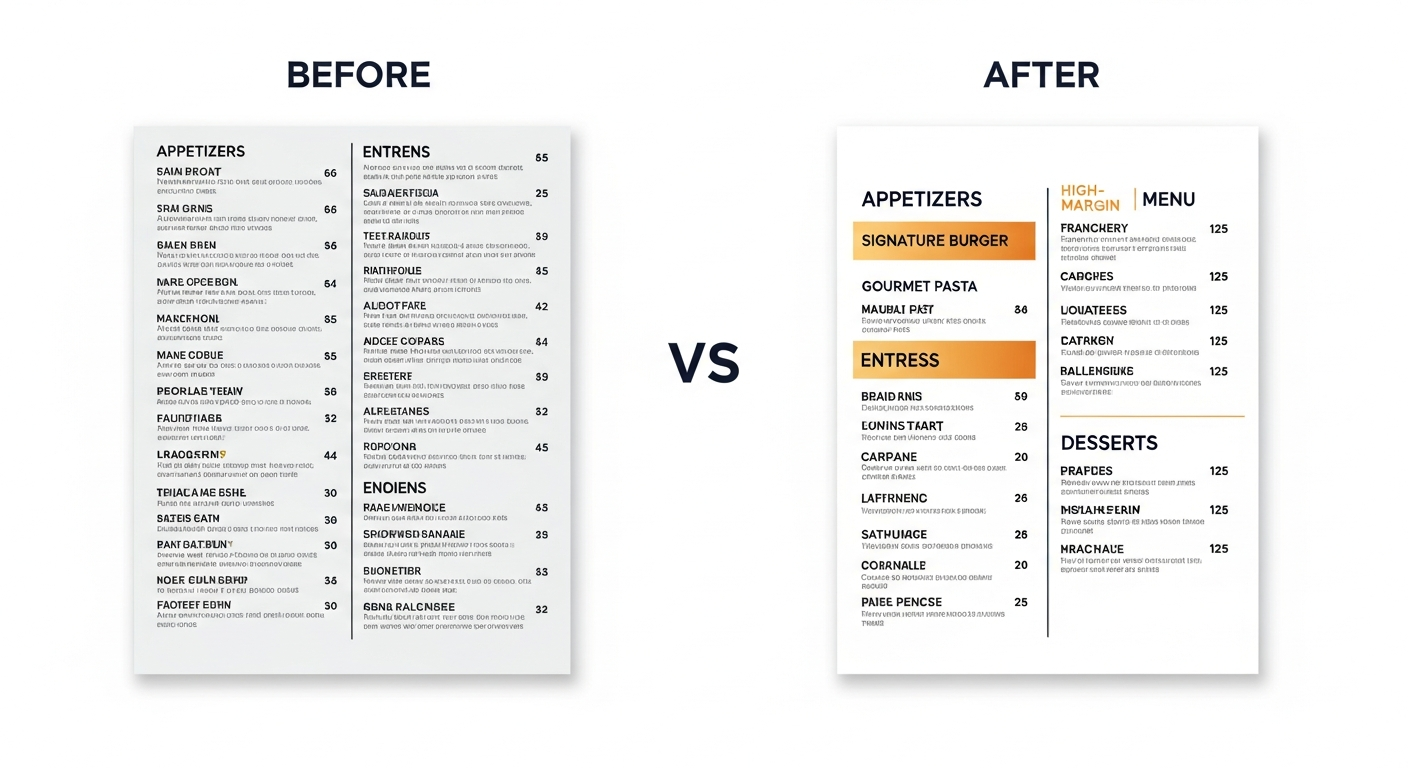
Square's 2024 Future of Commerce Report found a related signal: restaurants with AI-optimized digital menus convert browsers to buyers at 8.4%, compared to 5.1% for static menus. That's a 65% improvement in conversion rate from the same traffic.
For a restaurant spending money to drive people to its ordering page (through Google ads, social media, or even in-store QR codes), improving conversion by 65% is the equivalent of getting 65% more value from the same marketing spend.
Move-the-Needle #5: AI Phone Answering That Captures Lost Revenue
This one gets overlooked because it feels unglamorous compared to dynamic pricing algorithms. But Popmenu's 2024 data shows their AI answering bot handles an average of 187 calls per month per restaurant, preventing an estimated $4,600 per month in lost revenue from missed calls.
Shawn Walchef, owner of Cali BBQ in San Diego, has been vocal about this. At MURTEC 2024, Walchef shared that AI phone answering captures an estimated $5,000 or more per month in orders his team would have missed. Combined with AI-optimized digital menus and AI-generated social content, his online ordering revenue increased 30% within six months.
"I don't have a $14,000/month tech budget," Walchef said. "But AI tools have probably added $8,000–$10,000 a month in revenue I was leaving on the table. The ROI isn't theoretical. It shows up in my bank account."
Kevin Jaskolka, VP of Product at Popmenu, reinforced this point in 2024: "The restaurants seeing the biggest ROI from AI aren't the ones spending the most — they're the ones using AI to answer phones, personalize menus, and automate marketing. A single-unit operator spending $500/month on AI tools can see the same percentage lift as a chain spending $14,000, because the fundamentals are the same."
What Doesn't Move the Needle (Yet)
Not every AI menu investment pays off at the same rate. A few categories consistently underdeliver relative to their cost:
Dynamic pricing by the minute. Adjusting menu prices in real time based on demand sounds powerful in theory. Dynamic Yield (now owned by Mastercard) reports 3–5% increases in average order value from personalized upsell suggestions on drive-thru boards. For a chain doing $2 million per year per location, that's $60,000–$100,000 in incremental annual revenue per unit, which is meaningful. But the implementation cost and customer backlash risk (see Wendy's surge pricing PR disaster in early 2024) make this a better fit for chains with 50-plus units and dedicated pricing teams than for a 3-location fast casual.
Fully autonomous AI ordering. Wendy's FreshAI drive-thru system, built with Google Cloud, improved order accuracy to 86% (up from 78% with human-only ordering) and cut average order time by 22 seconds across 100-plus locations by mid-2024. Those are solid gains. But 86% accuracy means roughly 1 in 7 orders still has an error, and the system required months of tuning per location. The technology is promising but not yet reliable enough to run without human backup.
AI-generated menu descriptions and photography. Social engagement may increase (Cali BBQ reported 3x higher social engagement), but the direct revenue attribution remains fuzzy. Treat this as a marketing efficiency play, not a menu optimization investment.
The Math for Independent Operators
If you run 1 to 5 locations, you don't need a $14,000/month AI stack. You need to pick 2 or 3 of the five proven applications above and implement them well.
A rough budget framework based on the data:
- AI phone answering (Popmenu or similar): $200–$500/month. Expected recovery: $3,000–$5,000/month in captured orders.
- Personalized digital menu (through your ordering platform): $100–$400/month. Expected lift: 12–18% on digital check size.
- AI-triggered post-visit emails/SMS: $100–$300/month. Expected impact: 15–20% reduction in first-visit churn, with AI-personalized SMS generating $0.28 per message sent versus $0.09 for generic blasts (Paytronix 2024).
- Menu engineering analysis (quarterly, using POS data and tools like Predictifood): $200–$500 per analysis. Expected impact: 4–7 percentage points of gross margin improvement on optimized categories.
Total monthly cost: $600–$1,700. Expected monthly revenue impact: $5,000–$15,000, depending on your volume and current digital mix.
That's a 3x to 10x return, which is why Olo founder Noah Glass said at MURTEC 2024: "The era of the static digital menu is over. Every guest who opens your app or visits your site should see a menu that reflects what they love, what's most profitable for you, and what's operationally feasible right now."
You don't need Sweetgreen's engineering team to get there. You need a digital ordering platform that supports personalization, a system that captures phone orders you're missing, and the discipline to look at your menu data quarterly instead of annually.
See How Menuro Fits Into Your Stack
Menuro gives independent restaurants a branded ordering app with built-in menu personalization, automated re-engagement, and direct customer relationships — without the $14K/month price tag chains pay. If you want to see how the platform works for your specific setup, book a 15-minute demo and bring your questions.